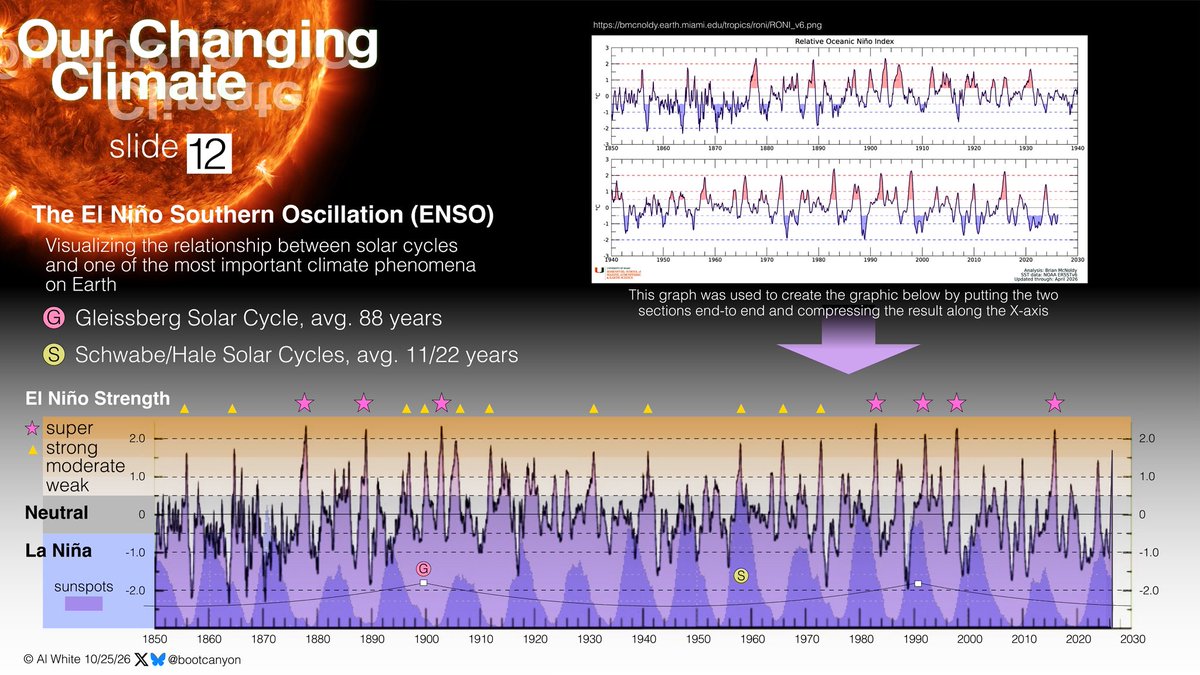
That is simply a composite of all satellite instrument data daisy-chained end to end. It’s not intended to be a reconstruction of TSI during the satellite era. The linked graph is the current NNLTSI1 model from NASA, NOAA and LASP (“NNL…”). I incorporated it into the attached graphic.
https://t.co/tzbvN3pBZ7
@HmGinYYCisBack@Random_Nobody_1 Per Stefan-Boltzmann the decrease in albedo accounts for ~2/3 of the temperature increase since 2000. Then add the reduction in aerosols and the increase in TSI and essentially all of the temperature increase is accounted for.
@Revkin Right now, our civilization can’t function without fossil fuels. To say that the world ‘loves’ fossil fuels is silly. That’s like saying animals love oxygen. So exactly what is the petroleum industry doing to hold us hostage?
I think it’s possible to conclude from this data, that CO2 does not control earth’s climate. Seeing these results and believing otherwise is like thinking that the earth is at the center of the universe. On the other hand, it is a proven fact that the earth’s temperature controls the amount of atmospheric CO2.
So what kind of tortured Bizzaro World physics did you employ to convince yourself that for 130 million years, declining CO2 made temperature increase to the highest point in the Phanerozoic?
@CaptainAdvance1@PeterDClack The fact that temperature and CO2 were anti-correlated for most of the Phanerozoic kind of blows up the CO2 Control Knob hypothesis doesn’t it?
It's worth noting that a variant of this green-indigenous divide (actually more intense) is playing out in the Amazon rain forest of Brazil, as Lula-administration forest enforcement has in some cases targeted Indigenous communities. Read this excerpt from a new @lnarloch essay (link below):
Even indigenous Brazilians, supposedly the natural allies of the environmental movement, are increasingly fed up with it. While researching a book, I stayed with my son in Ysani Kalapalo’s village, in the Xingu Indigenous Territory, and spoke with twenty or thirty indigenous leaders from across the Amazon. Most of them, to my surprise, despised environmentalists. “The NGO people don’t even come here anymore, because they know that if they do, we’ll chase them out of the village,” Ysani told me.
Her village has been asking for electricity for sixteen years. The grid runs on the other side of the Xingu River, no more than four kilometers away, but Funai, the federal indigenous affairs agency, and IBAMA refuse to grant an environmental license, arguing that the power line would cause too much deforestation. Her father has been trying to build a small lodge for sport fishermen from the city but cannot get a permit. “Just because we are indigenous doesn’t mean we have to stay frozen in time,” explained Ysani.
Since you mentioned ‘three centuries ago’…
That was the coldest point in 12,000 years (Little Ice Age) and the lowest point in solar activity for 11,000 years (Maunder Minimum). What has happened since then is the perfectly correlated rise in solar activity to a grand solar maximum, and temperature. That is not a coincidence.