This guy makes $2,700/month running an AI-girl farm with DeepSeek V4-Flash
Not because DeepSeek makes better girls.
Because the real work is the 100 boring loops around every image and video:
captions
content variations
posting schedules
DM replies
fan requests
tracking what converts
A lightweight workflow:
1. Create one character bible: voice, look, boundaries, audience
2. Use an image/video model for the actual visuals
3. Let DeepSeek Flash turn each visual into:
– 10 post angles
– captions for different platforms
– reply/DM drafts
– tomorrow’s content queue
4. Review the outputs once a day instead of writing everything from scratch
Use Claude or GPT for the few things where bad judgment is expensive:
character direction
big campaigns
weird customer requests
final decisions
Flash does the repetition.
Expensive models do the thinking.
That’s how a “content farm” becomes a one-person workflow instead of a $2k/month API bill.
An AI-girl content farm becomes 15x cheaper when you stop using expensive Claude for the boring shit
DeepSeek V4 Flash can handle the loops.
Claude should not be writing “good morning babe” 500 times a day.
The visual is only one part of the operation.
The expensive part is keeping every account alive:
captions
content variations
posting schedules
DM drafts
fan requests
testing what converts
A lightweight workflow:
1. Build one character bible once:
voice, look, boundaries, audience
2. Generate the visuals with an image or video model
3. Let Flash turn every visual into:
– 10 post angles
– captions for each platform
– reply and DM drafts
– tomorrow’s content queue
4. Review and schedule once a day
Use Claude or GPT only when bad judgment is expensive:
character direction
big campaigns
weird requests
final decisions
Cheap models do the volume.
Expensive models do the thinking.
That’s the difference between an AI-girl farm and an AI API bill with boobs.
This guy makes $2,700/month running an AI-girl farm with DeepSeek V4-Flash
Not because DeepSeek makes better girls.
Because the real work is the 100 boring loops around every image and video:
captions
content variations
posting schedules
DM replies
fan requests
tracking what converts
A lightweight workflow:
1. Create one character bible: voice, look, boundaries, audience
2. Use an image/video model for the actual visuals
3. Let DeepSeek Flash turn each visual into:
– 10 post angles
– captions for different platforms
– reply/DM drafts
– tomorrow’s content queue
4. Review the outputs once a day instead of writing everything from scratch
Use Claude or GPT for the few things where bad judgment is expensive:
character direction
big campaigns
weird customer requests
final decisions
Flash does the repetition.
Expensive models do the thinking.
That’s how a “content farm” becomes a one-person workflow instead of a $2k/month API bill.
A 31-year-old solo developer built a 3D arcade flight game with DeepSeek V4 Flash. He spent $130 on agents and
earned 3400$ from it
If he had built the same game with Claude Code, it would have cost him 15× more.
The expensive part was never writing one big block of code. It was the hundreds of stupid loops behind a playable game: broken menus, enemy pathing, save-file bugs, UI fixes, failed builds and one more test after every patch.
That is where Flash changed the economics.
You do not need a premium model for every retry. You need a model cheap enough to keep working until the game actually works.
Small creators are not getting access to “AI magic.”
They are getting access to more attempts.
A 31-year-old solo developer built a 3D arcade flight game with DeepSeek V4 Flash. He spent $130 on agents and
earned 3400$ from it
If he had built the same game with Claude Code, it would have cost him 15× more.
The expensive part was never writing one big block of code. It was the hundreds of stupid loops behind a playable game: broken menus, enemy pathing, save-file bugs, UI fixes, failed builds and one more test after every patch.
That is where Flash changed the economics.
You do not need a premium model for every retry. You need a model cheap enough to keep working until the game actually works.
Small creators are not getting access to “AI magic.”
They are getting access to more attempts.
A 26-year-old founder spent $5,200/month on Claude agents. Then he found DeepSeek V4 Flash — and his AI bill dropped 11×.
At first, he thought the problem was that he had too many workflows running.
It wasn’t.
He was using Claude for everything: reading the repo, tracing logs, running tests, rewriting the same patch after a failed tool call, checking docs, cleaning up boring edge cases.
Claude was great at the hard stuff.
But he was paying premium rates every time an agent got stuck in an ordinary loop.
DeepSeek V4 Flash changed the split.
He kept Claude for architecture, security, product decisions and anything expensive to get wrong.
He moved the volume work to Flash: repo scans, QA, bulk fixes, test runs and retries.
Same product.
Same standards.
Different economics.
The lesson is not “replace Claude.”
The lesson is: stop paying premium-model prices for work that needs persistence more than genius.
A 26-year-old founder spent $5,200/month on Claude agents. Then he found DeepSeek V4 Flash — and his AI bill dropped 11×.
At first, he thought the problem was that he had too many workflows running.
It wasn’t.
He was using Claude for everything: reading the repo, tracing logs, running tests, rewriting the same patch after a failed tool call, checking docs, cleaning up boring edge cases.
Claude was great at the hard stuff.
But he was paying premium rates every time an agent got stuck in an ordinary loop.
DeepSeek V4 Flash changed the split.
He kept Claude for architecture, security, product decisions and anything expensive to get wrong.
He moved the volume work to Flash: repo scans, QA, bulk fixes, test runs and retries.
Same product.
Same standards.
Different economics.
The lesson is not “replace Claude.”
The lesson is: stop paying premium-model prices for work that needs persistence more than genius.
@Dep2chic Exactly.
This is not about replacing the best model.
It is about refusing to pay premium-model prices for work that needs retries, volume and persistence — not premium judgment.
DeepSeek V4 Flash just beat GPT-5.6 Luna and Claude Sonnet on an agent benchmark
It also costs 14–36× less.
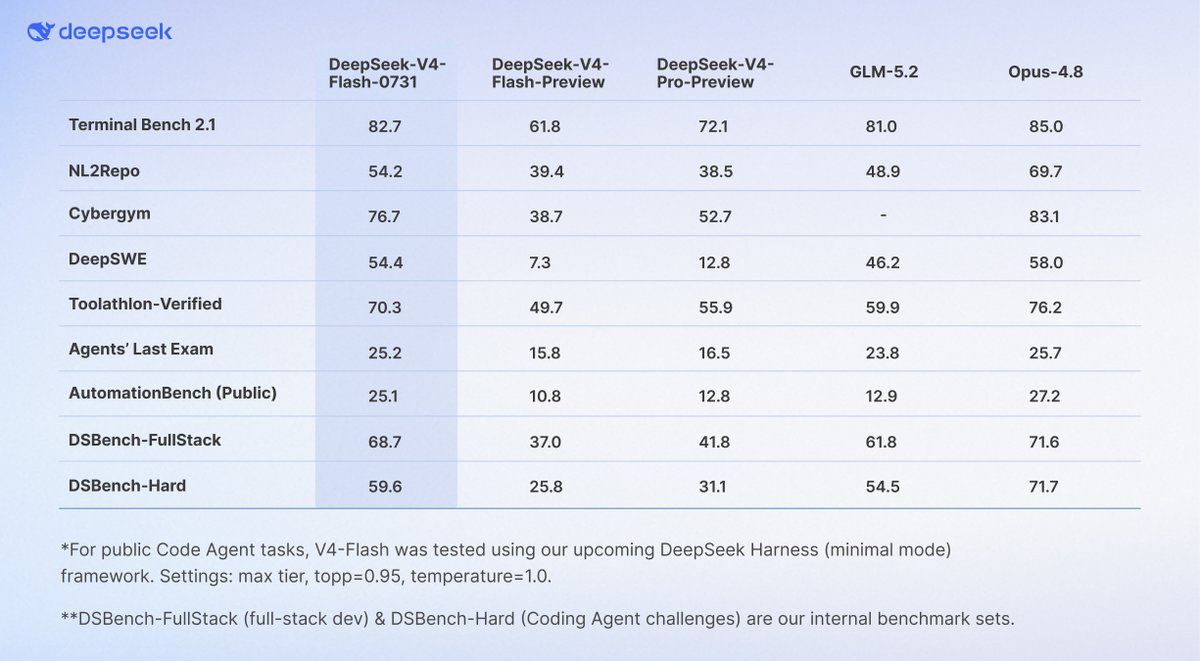
On Terminal-Bench 2.1:
DeepSeek V4 Flash: 82.7
Claude Sonnet 5: 80.4
GPT-5.6 Luna: ~80
That does not mean DeepSeek is now the best model at everything.
It isn’t.
For hard architecture, messy reasoning, high-stakes decisions and polished final work, I would still keep Claude or GPT in the stack.
But most coding-agent work is not frontier reasoning.
It is:
reading a codebase
fixing bugs
writing tests
refactoring boring files
using tools
retrying after a failed run
And that is where this update matters.
Claude Sonnet 5 costs:
$2 / 1M input tokens
$10 / 1M output tokens
DeepSeek V4 Flash costs:
$0.14 input
$0.28 output
That is 14× cheaper to read context.
And nearly 36× cheaper to generate output.
So the question is no longer:
“Which model is slightly smarter?”
It is:
“How many useful agent runs can I afford?”
With DeepSeek, you can run more agents, give them longer tasks, let them fail, retry and keep moving.
Claude is still the premium engineer.
DeepSeek is becoming the cheap engineering team you can afford to keep working all night.
DeepSeek V4 Flash just beat GPT-5.6 Luna and Claude Sonnet on an agent benchmark
It also costs 14–36× less.
On Terminal-Bench 2.1:
DeepSeek V4 Flash: 82.7
Claude Sonnet 5: 80.4
GPT-5.6 Luna: ~80
That does not mean DeepSeek is now the best model at everything.
It isn’t.
For hard architecture, messy reasoning, high-stakes decisions and polished final work, I would still keep Claude or GPT in the stack.
But most coding-agent work is not frontier reasoning.
It is:
reading a codebase
fixing bugs
writing tests
refactoring boring files
using tools
retrying after a failed run
And that is where this update matters.
Claude Sonnet 5 costs:
$2 / 1M input tokens
$10 / 1M output tokens
DeepSeek V4 Flash costs:
$0.14 input
$0.28 output
That is 14× cheaper to read context.
And nearly 36× cheaper to generate output.
So the question is no longer:
“Which model is slightly smarter?”
It is:
“How many useful agent runs can I afford?”
With DeepSeek, you can run more agents, give them longer tasks, let them fail, retry and keep moving.
Claude is still the premium engineer.
DeepSeek is becoming the cheap engineering team you can afford to keep working all night.
🚀 DeepSeek-V4-Flash Official API is now LIVE in public beta!
🔷 We’ve massively upgraded its Agent capabilities—benchmark scores are now far surpassing the V4-Pro-Preview. Check out the massive performance leap below! 👇
🔷 The official V4-Flash now natively supports the Responses API format and is fully adapted for Codex!
Check out the configuration details in our official API docs: https://t.co/smCwQZMeiq
Soon, the people who can build and command AI agents will be worth their weight in gold
Not because AI will magically replace entire companies overnight. That’s the bullshit version of the story.
They’ll be valuable because they can turn one idea into a system that researches, plans, builds, reviews, and tests at the same time.
That is a completely different kind of leverage.
A small product team normally loses days to handoffs. Someone gathers feedback. Someone turns it into a spec. Someone builds. Someone reviews. Someone finds the bugs. Then the loop starts again.
Agent workflows compress that loop.
One agent can map the problem. Another can research what users actually complain about. Another can build the first version. Another can review the code or try to break it before users do.
The work doesn’t become effortless.
But the human is no longer forced to manually push every task through the pipeline.
The real skill becomes designing the system.
Knowing what to delegate.
Choosing which agent gets which role.
Giving them the right context and constraints.
Reviewing the output.
Killing bad runs before they ship garbage.
The scarce skill won’t be knowing the name of the latest model.
It will be knowing how to turn AI agents into a team that produces useful work.
The software factory is becoming something you can run from a laptop.
And the people who know how to run it will have leverage that used to require an entire team.
Imagine sleeping while an AI agent does your work
Sounds like bullshit.
And honestly, it is — if your “agent” is just a chatbot with a long prompt and access to your files.
That setup doesn’t work while you sleep.
It just makes more mistakes without you watching.
The useful version is less sexy:
Give the agent one narrow recurring task.
Save what happened, so it can pick up where it left off.
Set a hard gate: a test, a metric, or another agent that can reject bad work.
Let it retry only when the output fails that gate.
Now it is not just answering prompts.
It is running a controlled loop.
That’s how an agent can work while you sleep without creating a disaster by morning.