@TokolosiSteyn I would watch three areas particularly closely:
Scrum penalties and consistency between the two front rows.
Breakdown decisions, especially sealing off and entry angles.
Consistency in applying yellow-card thresholds.
@HermanMashaba When the talent runs out, out comes the race card. If this is how Mashaba responds when he can't defend his position, it doesn't bode well for his leadership — particularly if he wants another shot at being Mayor of Jozi. The city needs substance, not excuses.
It’s fascinating to see @HermanMashaba respond to all the criticism. He knows he cannot play the ball. So he resorts to the only defence he can muster and that is to play the racism card even when responding to people like @AdHabb . Shameful. A big step backwards in SA politics.
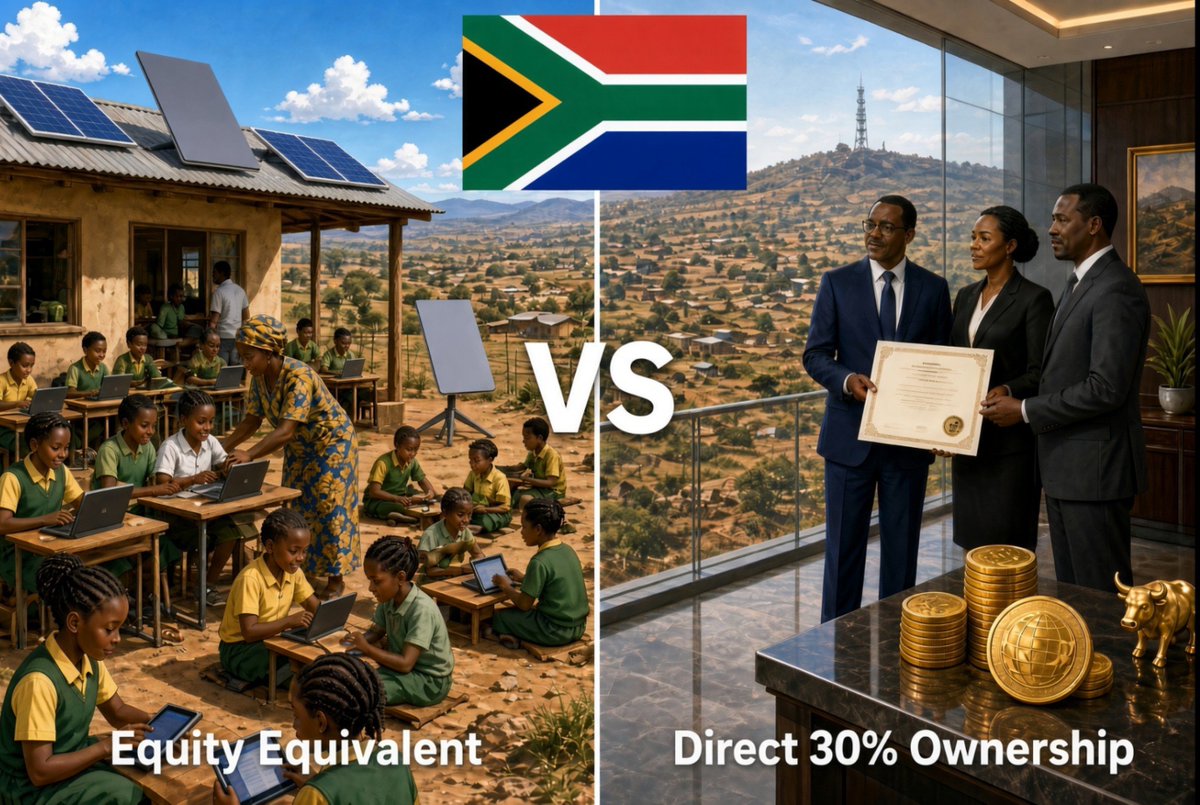
STARLINK 🇿🇦 SOUTH AFRICA ENTRY
So, Gregory Mofokeng, the Black Business Council's deputy president, argues that there is little evidence that equity-equivalent programs deliver results comparable to direct ownership, and accused SpaceX of trying to keep black South Africans from meaningful participation in the industry.
Let's debunk his statement:
— A 30% ownership transfer typically concentrates the financial upside in a small number of individuals or a consortium (often a handful of principals, sometimes with political connections). Dividends and capital gains flow to those shareholders. The rest of the population sees little or no direct benefit.
— Starlink's proposed equity equivalent investment of roughly R500 million (~$28–30 million) to equip and connect about 5,000 mainly rural schools, will potentially reach and benefit ~2.4 million learners a year.
In addition, SpaceX will also invest in related local installation/maintenance work and provide a broader connectivity investment — creating much needed employment in the process.
—> This is a concrete example of scale that a pure equity hand-over does not match.
CONNECTIVITY ITSELF IS THE BIGGER PRIZE
— Satellite broadband is especially valuable in rural and underserved areas where terrestrial networks are thin or uneconomical.
— Entry would expand coverage, introduce competition (pressure on prices and quality), and enable education, health, remote work, and small-business activity that ownership stakes do not directly create.
— Blocking or delaying entry to protect a narrow ownership transfer imposes a large opportunity cost on millions of users and potential users.
TRACK RECORD OF THE TWO APPROACHES
— Narrow ownership deals under BEE have a documented pattern of elite concentration. In mining, analyses of earlier deals showed the bulk of value (around 60% in one widely cited Chamber of Mines-related assessment) flowing to a few dozen participants, with far smaller shares reaching community structures or employees.
Broader critiques note persistent low black ownership of listed equity, high unemployment, and limited broad-based wealth effects despite large deal volumes. While some employee share schemes and community trusts exist, and a black middle class has grown, the pure ownership pillar has under-delivered relative to the “broad-based” rhetoric.
— EEIPs (Equity Equivalent Equivalent Investment Programs) are already used by multinationals (Microsoft, IBM, and others) in other sectors precisely because global ownership policies often make equity dilution impractical.
They earn empowerment points through verified spend on skills, local enterprise, and related initiatives.
EEIP ALTERNATIVES CURRENTLY EXCLUDED IN TELECOM SECTOR
In telecoms the current ICASA rules have not fully recognised EEIPs as a substitute for the Electronic Communications Act’s 30% historically disadvantaged ownership requirement for individual licences — that is the core regulatory friction — but the minister has directed alignment with the ICT Sector Code, and court challenges are testing the legal scope...
WATCH | Chaos erupted at an Emfuleni council meeting on Monday as councillors clashed over a proposed adjournment during the election of the mayor, speaker and chief whip. Water was thrown, tables were overturned, and several parties walked out. More on @IOL
📹: @Our_DA
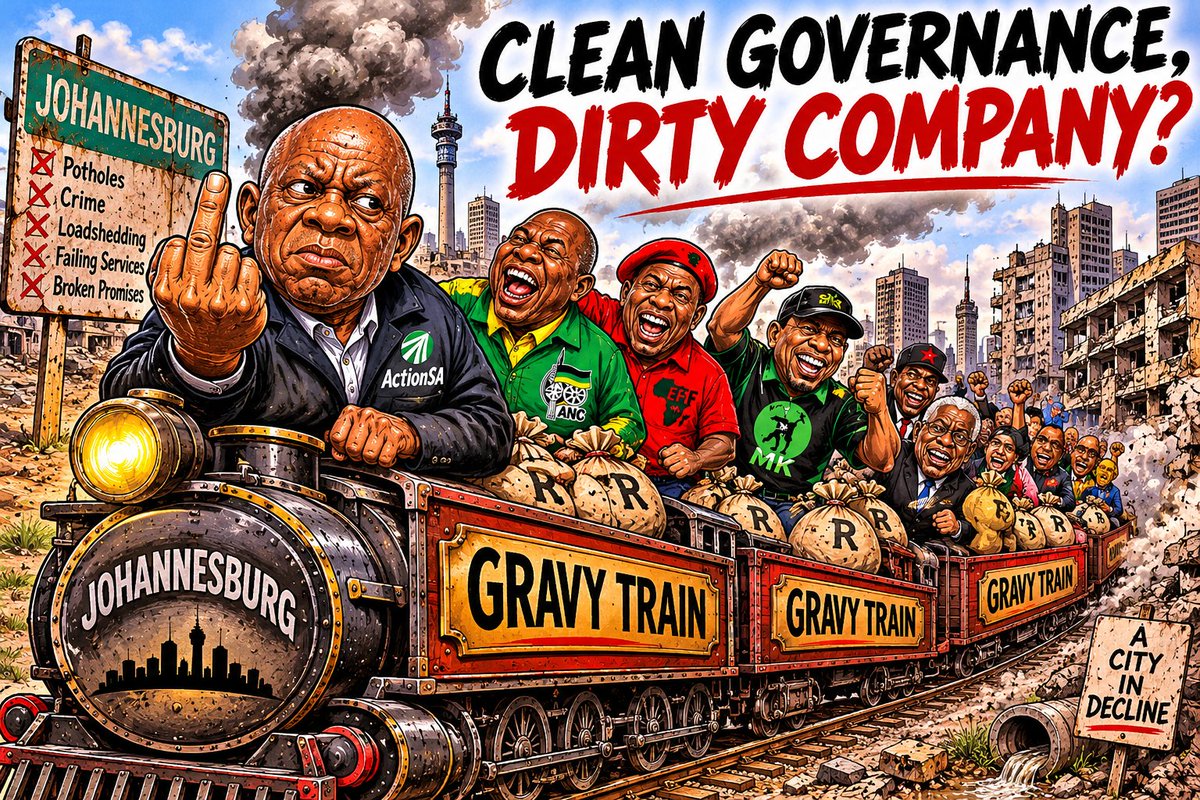
These initiatives too often become another vehicle for political patronage dressed up as transformation. We need to fund innovation and talent — not create another gravy train for politically connected cadres.
Cyril Ramaphosa's newly announced R100 million venture capital fund for AI startups in South Africa would only cover 77 minutes of Anthropic's compute costs, or be enough to purchase two server racks filled with Nvidia's Blackwell AI GPUs.
https://t.co/nc9KjwiJSA
World Rugby's silence is telling.
Pieter-Stepth du Toit was kneed in the head by Stuart McCloskey.
That's a red card offence missed.
World Rugby therefore supports violent conduct against the Springboks.
@Markosonke1 It was a deliberate ploy trying to avoid the Madlanga commission. He will rather spend time in jail now than a very long stint after the commision.