@antoniosarosi@Montyclt basically:
1. agent comes up with a task
2. another agent tries to do it e2e w/ BAML (ralph loop)
3. another agent looks at that agent's transcript to identify issues + dedupes against existing issues
4. humans triage
5. another agent tries to fix them
@Jonathan_Blow 5/x: and then use @boundaryML 's BAML for chunking things out and testing / iterating quickly. fuck llms and prompts etc but if you have to work with them BAML is like the only thing that makes it feel marginally manageable.
We are launching a programming language built for agents soon called BAML that has been in the making for 1+ years. You can follow @boundaryML
We are a small team of 6 developing it with care, gathering feedback from humans and agents.
Fully Open Source.
If you are interested DM me for early alpha access.
I benchmarked a new extraction harness on a private eval dataset for lerim-cli (new version is out now - v0.1.83) and the main lesson was very clear: if you want smaller models to work well, you should stop asking the model to do everything and start doing more engineering work.
Before, the agent was closer to a single-pass PydanticAI setup: read a large trace, understand what matters, decide what is durable memory, call tools correctly, stay inside the context window, and output clean structured records.
That puts too much burden on the model, especially when you want to use smaller or cheaper models.
The new harness is BAML (@boundaryML) + LangGraph (@LangChain).
The graph now does more of the deterministic work:
- read the trace in windows
- ask the model to scan one window at a time
- keep compact findings instead of the whole trace
- synthesize memory records only at the end
- validate/retry typed BAML outputs
- persist with normal code, not model improvisation
So the model is not the whole agent anymore -> It is one reasoning component inside a more engineered system.
On the private benchmark, using the same MiniMax M2.7 model, the new harness completed all cases while the old harness had multiple failures from tool retries and context window issues.
- Task completion: BAML+LangGraph completed 100.0% vs PydanticAI at 72.73%, a +27.27 point lead.
- Case failures: BAML+LangGraph had 0 failures vs PydanticAI with 6, meaning 6 fewer failures.
- Episode count rate: BAML+LangGraph reached 100.0% vs PydanticAI at 81.25%, a +18.75 point lead.
- Record budget rate: BAML+LangGraph reached 46.88% vs PydanticAI at 28.12%, a +18.76 point lead.
- Concept recall average: BAML+LangGraph scored 0.428 vs PydanticAI at 0.2598, a +0.1682 improvement.
- Quality average: BAML+LangGraph scored 0.3352 vs PydanticAI at 0.318, a +0.0172 improvement.
- Tool call errors average: BAML+LangGraph had 0.0625 vs PydanticAI at 1.9688, much better.
Quality is not solved yet. It is only slightly better overall and still needs better pruning before persistence. But robustness improved a lot.
This is the direction I think specialized agents should go: smaller models, more deterministic scaffolding, less magical thinking about one giant prompt doing the whole job.
Next step is to make this work well with models people can run locally.
A new version of Lerim-cli is now released with the extract agent refactored to use Langgraph+BAML. Next agents will be refactored as well soon in the next releases.
https://t.co/dbuv9CeZcP
Refactoring is definitely much easier now. Here's how i used agents to refactor our entire compiler (+65k, -117k, 74 commits).
1. Forked parallel crates (foo --> foo2) 2. Strict dependency firewall (enforced via precommit)
3. Audited core data structures first <-- took time
My dear front-end developers (and anyone who’s interested in the future of interfaces):
I have crawled through depths of hell to bring you, for the foreseeable years, one of the more important foundational pieces of UI engineering (if not in implementation then certainly at least in concept):
Fast, accurate and comprehensive userland text measurement algorithm in pure TypeScript, usable for laying out entire web pages without CSS, bypassing DOM measurements and reflow
Announcing the BAML Bounty...
For all power-users of BAML, we're giving away free BAML merch! (t-shirts, stickers, hoodies 🔥🧯).
Share what you built with BAML with #baml → Fill out https://t.co/oglxEbz5eG → Free merch!
Hurry! Supplies are limited to the first 50 posts.
syntax makes a huge difference to how good coding agents are, and languages should be rethought. some great learnings from rust and go!
great post by @aaronvi
@cursor_ai 30% agent-written PRs is crazy. We're betting on the same future of self-driving codebases. Gardens you tend > repos you commit to. As agents write more, we think they need a more cooperative language. That's why we're making one 🔥 https://t.co/86OxprVH1y
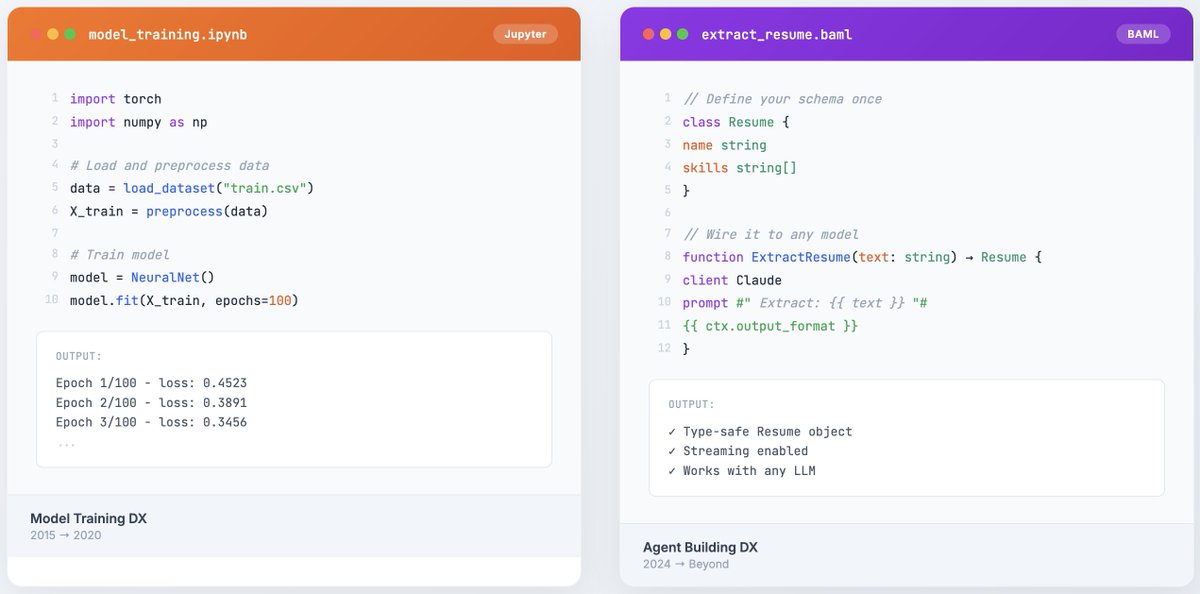
Hot take: building agents without BAML in 2026 is like training models without Jupyter notebooks in 2020.
Technically possible? Sure.
But why would you torture yourself?
Type-safe prompts. Instant playground testing. Multi-language support.
https://t.co/tty1NnmGTA
I think it must be a very interesting time to be in programming languages and formal methods because LLMs change the whole constraints landscape of software completely. Hints of this can already be seen, e.g. in the rising momentum behind porting C to Rust or the growing interest in upgrading legacy code bases in COBOL or etc. In particular, LLMs are *especially* good at translation compared to de-novo generation because 1) the original code base acts as a kind of highly detailed prompt, and 2) as a reference to write concrete tests with respect to. That said, even Rust is nowhere near optimal for LLMs as a target language. What kind of language is optimal? What concessions (if any) are still carved out for humans? Incredibly interesting new questions and opportunities. It feels likely that we'll end up re-writing large fractions of all software ever written many times over.
Seattle, this one's for you. 🫶 We've added @lenadroid to our already awesome speaker lineup.
Come spend an evening with us, hear from Lena and @radgendervibes from Zed, @vaibcode from @boundaryML, and @matsonj from @motherduck go on a much needed rant on what AI gets wrong (and sometimes gets right).
Link to rsvp in the thread. 🧵