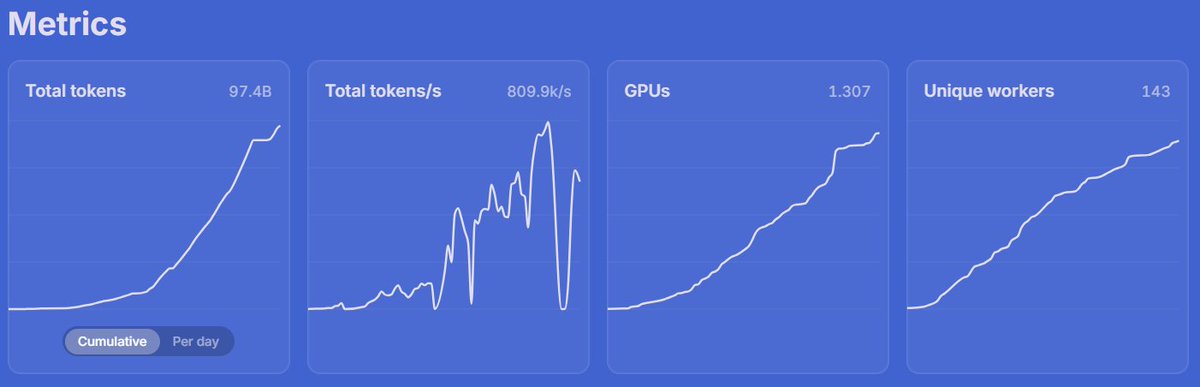
64.4B tokens yesterday (https://t.co/q4de8E2fG9). Priced at OpenRouter floor rates for Qwen 3.6 35B, that is ~$15,400/day. ~$5.6M/year. 100% routed to POD buybacks.
Against a $15M cap, that is ~37% of the entire cap bought back annually, at the floor.
And it is single-model math. The network runs a basket (Gemma 31B, 26B, cheaper and faster), so the real demand pool is wider. Buyback-to-emissions: 7.6x. Net supply shrinks as it scales.
For scale: Venice runs ~100B tokens/day at a $616M cap. Dolphin is already at 64% of that throughput for under 3% of the valuation, and it builds the uncensored models that power the Venice ecosystem. Same category, real partnership.
$156M FDV is not an overhang when the protocol buys back faster than it emits.
And the API is not even live yet. The buybacks have not started. This is the floor. Pre revenue, pre OpenRouter listing, pre agent demand.
base:0xed664536023d8e4b1640c394777d34abaff1df8f
The AI Scientist: Towards Fully Automated AI Research, Now Published in Nature
Nature: https://t.co/nNfpSV5e5I
Blog: https://t.co/i6h8LVQOdl
When we first introduced The AI Scientist, we shared an ambitious vision of an agent powered by foundation models capable of executing the entire machine learning research lifecycle.
From inventing ideas and writing code to executing experiments and drafting the manuscript, the system demonstrated that end-to-end automation of the scientific process is possible.
Soon after, we shared a historic update: the improved AI Scientist-v2 produced the first fully AI-generated paper to pass a rigorous human peer-review process.
Today, we are happy to announce that “The AI Scientist: Towards Fully Automated AI Research,” our paper describing all of this work, along with fresh new insights, has been published in @Nature!
This Nature publication consolidates these milestones and details the underlying foundation model orchestration. It also introduces our Automated Reviewer, which matches human review judgments and actually exceeds standard inter-human agreement.
Crucially, by using this reviewer to grade papers generated by different foundation models, we discovered a clear scaling law of science. As the underlying foundation models improve, the quality of the generated scientific papers increases correspondingly. This implies that as compute costs decrease and model capabilities continue to exponentially increase, future versions of The AI Scientist will be substantially more capable.
Building upon our previous open-source releases (https://t.co/H1tBT14Yx8), this open-access Nature publication comprehensively details our system's architecture, outlines several new scaling results, and discusses the promise and challenges of AI-generated science.
This substantial milestone is the result of a close and fruitful collaboration between researchers at Sakana AI, the University of British Columbia (UBC) and the Vector Institute, and the University of Oxford. Congrats to the team!
@_chris_lu_@cong_ml@RobertTLange@_yutaroyamada@shengranhu@j_foerst@hardmaru@jeffclune
Robotics narrative is finally heating up
$peaq partnered with USDT to create the rails for robotic payments
$roba is launching their no-code robotics builder and GPU compute services both in June
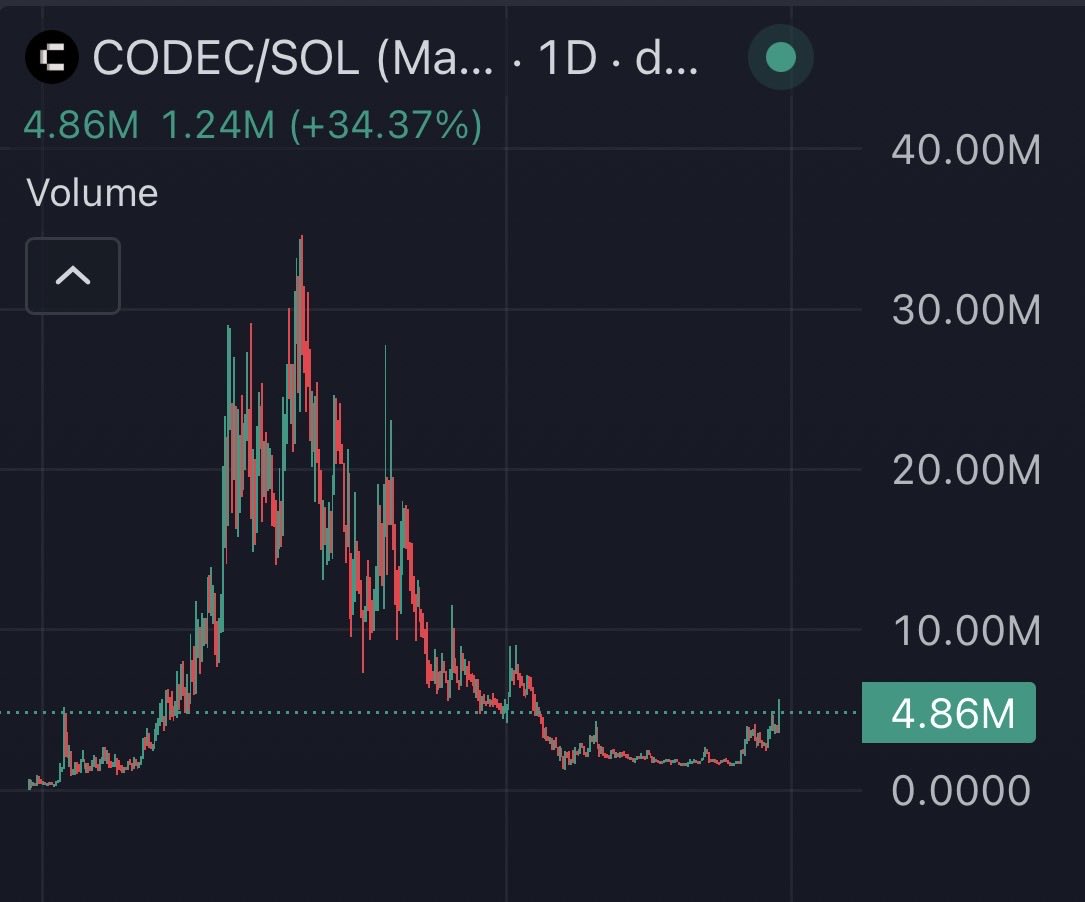
$codec launched their robotics simulator
Both of these charts look the same, the uptick in interest is noticeable
Currently holding both of these in anticipation we see new ATH’s on both soon
I let a loop of AI agents build GTA 6 while I slept. Woke up to a dead Mac and a half walking NPC.
Day 8. We're moving the whole game from Godot to Unreal, and the agents kept shipping right through it:
- the first NPC walks but no animations
- in-game phone now has maps, contacts, and a wallet.
Bad news: the Mac died overnight because every agent opened the game at once to screenshot it.
Fix was one line in claude.md, only one game or editor open at a time. Agents are back to looping, one at a time.
Tomorrow: finish converting the entire repo to Unreal, and work the walk animation so the NPC actually looks real.
The loop keeps building the phone apps, and I might pull the map onto the phone so the whole thing feels seamless.
One catch: the licensed Unreal assets can't be shared publicly, so that part stays in a private build.
Happy to see solana gaming getting the attention it deserves.
I wanted to bring my game back into the spotlight as I made this a month ago.
https://t.co/2ku3zrG6Zm is a game where you pay to spawn and earn other people's spawn fee.
you can wager sol rn, and soon you will be able to also wager the $FRAG token.
working on adding a marketplace. so you can buy/sell cosmetics with $FRAG!
I'll be working on it live on pump
CA: J4Y92jy5Lr9ho1aV41bhguytnzBbsPhZJahmaVszpump
THREAD 🧵
https://t.co/lz71H1QPPT
Sekedar Tips buat yang suka trade cepet (fast trade)
mungkin bisa coba GMGN di bagian trending dan pake yang 1 Menit
disitu muncul token-token yang volnya kenceng di menit menit awal, jadi enak buat nyari earlyan apalagi yang new pair, tinggal sesuaiin aja kalian maennya kaya gimana, kalo main tech tinggal cari token-token tech disitu, begitu juga buat meme
dan biasanya meme meme old yang tiba-tiba ada vol juga muncul disini
Aku pribadi sering banget pake metode screening yang ini, tinggal dipaduin sama style trade masing-masing
dan untuk Filternya ada di bawah postingan ini:
Stumbled upon World of Claudecraft, an open source MMO created with Fable 5 (RIP).
It's shockingly full featured - you can accept quests, trade items, duel, earn rewards, and more. And you can interact with other live players!
Fun look at the future of vibecoding real games 👀