The reduced royalty rates do encourage additional production, which DOGMA accounts for, but not nearly enough to overcome the substantial reduction in federal revenue.
I’ll be posting additional details of this analysis on RFF’s web site later this week--stay tuned!
These values represent only the approximately 50% share of royalties retained by the federal government, so the cuts would lead to similarly large revenue losses to the states where the oil and gas is being produced.
My analysis on potential impacts of expanded US LNG exports is available here https://t.co/sehfWBpFad
@RFF's analysis of oil & gas leasing led by @bprest can be found here https://t.co/JnLqSOXIoi
One can read these and verify the letter's statement is incorrect.
We have a paper out in @ScienceMagazine today showing how new guidelines allowing for income weighting in federal cost-benefit analysis would affect the social cost of carbon. Main takeaway, the SC-CO2 increases nearly 8x to ~$1300/ton. @rff@ERGBerkeley
https://t.co/iL15hhmW8x
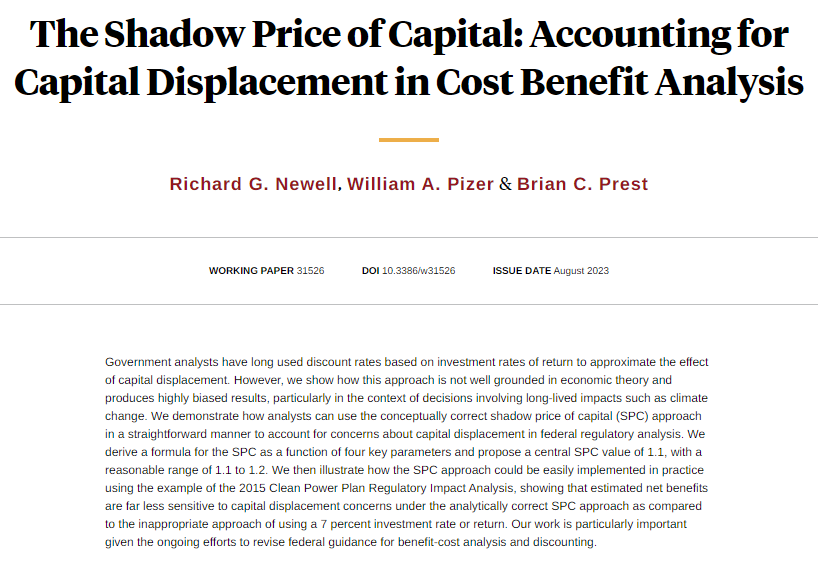
Discounting in benefit-cost analysis using investment rates of return can yield very misleading estimates of the costs and benefits of policies with long-lived impacts, from @richardgnewell, @billypizer, and @bprest https://t.co/sqnlZjmjnF
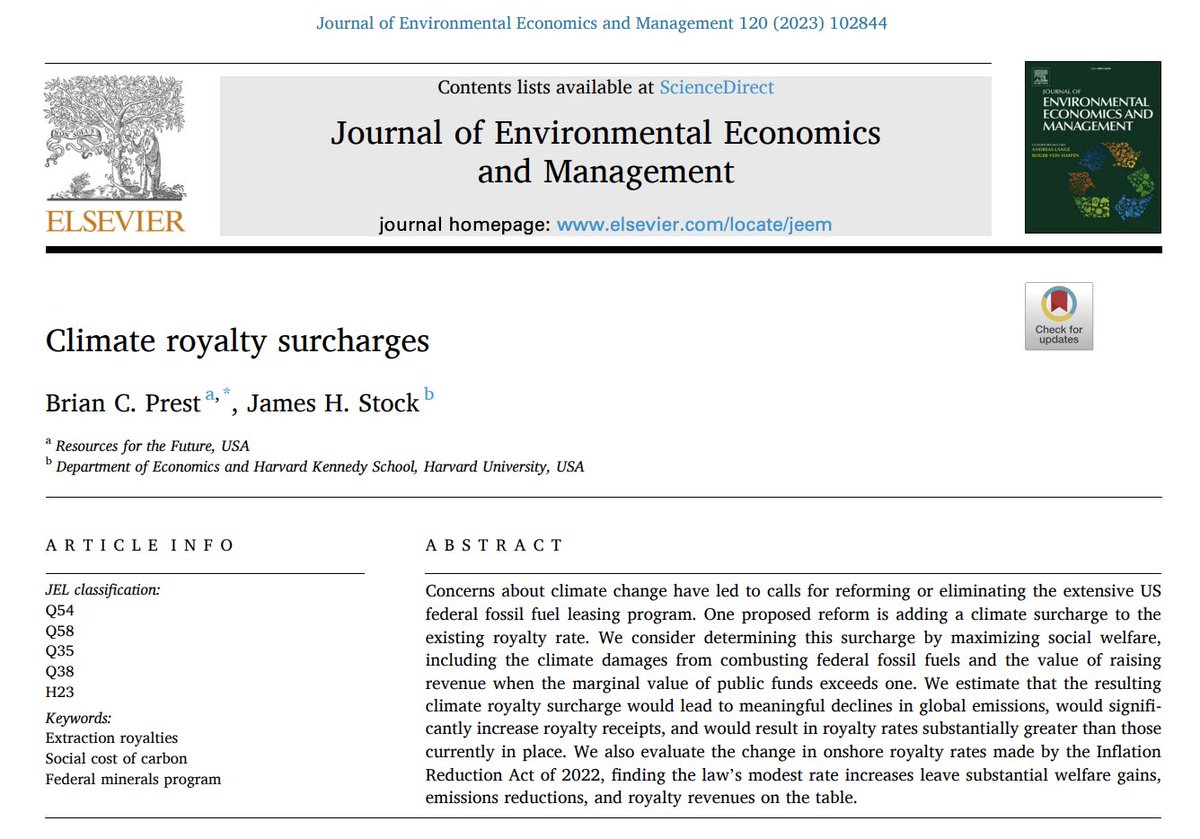
Check out this new research in #JEEM on climate royalty surcharges on fossil fuels by Brian C. Prest (@bprest) and James H. Stock (@jimstockmetrics).
Increasing royalty rates on federal fossil fuel reduces global emissions.
Link to paper: https://t.co/3X0GBpguNw
@stroebel_econ @ProfJAParker@JohnHCochrane Also the time profiles of costs and benefits need to align for an investment rate to make sense.
But there's a better way: the shadow price of capital, which was implicitly endorsed in the old A-4, but given much more prominence in the revision.
https://t.co/UVDFYO5lFo
Psyched about this new @rff working paper from @bprest, Zach Whitlock, & me. It asks: in a future with more ambitious climate policies, what happens to oil and gas production in different US regions, and how does that affect local gov't revenue? 1/8
https://t.co/3rY02uWnu1
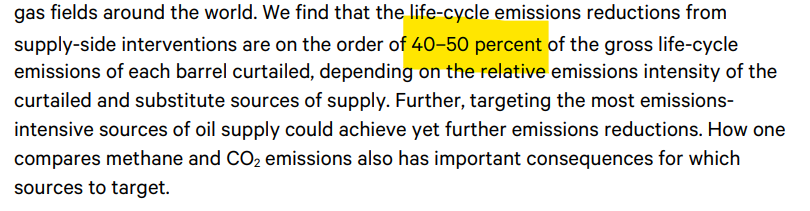
@DByers21@DanielRaimi@DxGordon But--and this is key--it is incredibly unlikely that reducing oil supply results in more emissions. That would require (1) oil demand to be ~perfectly inelastic and (2) implausible substitution patterns (e.g., Gulf of Mexico oil being partially replaced by oil sands)
@DByers21@DanielRaimi@DxGordon In my recent paper, I do the emissions impact calculation both at the play level (e.g. Permian basin) and aggregated by region (e.g., N. America) using the OCI+ data. Roughly speaking, the emissions effects vary by field, but less than you might expect. https://t.co/u1gEYeKEj5
This is super important for properly measuring the benefits of climate policy and regulations. like the @EPA's soon-to-be announced successor to the Clean Power Plan.
In the near term, the difference is small. We show this by redoing the cost-benefit analysis of the 2015 Clean Power Plan, showing that the SPC approach is similar to using 7% for near-term benefits (here, health cobenefits), but massively different for long-term climate benefits