How many can say this:
New Yorker, February 2026:
$4.05 billion in family take from ventures that exist because he’s president.
Forbes:
his net worth went from $3.9 billion to $7.3 billion by September 2025. Nearly doubled in eight months.
Wall Street Journal:
$4 billion in proceeds and paper wealth from ventures launched since his re-election.
House Oversight Democrats’ wealth tracker:
$5.1 billion in new family money.
Bloomberg:
crypto alone added $1.4 billion in a single year. One-fifth of the family fortune now sits in digital assets that didn’t exist the first time he ran.
All that work is really paying off.
📸 “Where’s Joe?” Republicans and Jake Tapper always ask.
Well, today, @JoeBiden was at Grotto Pizza in Wilmington supporting a small business.
That comes after South Dakota Friday night supporting Democrats and Philadelphia supporting Pride.
The man is battling stage 4 cancer and still keeps showing up.
That’s Joe Biden’s life story:
Knocked down. Never staying down.
GET UP.
In 1879, JP Morgan paid a man to invent the lie that is the foundation of modern economics.
A billionaire who helped start Amazon just exposed the whole thing on Diary of a CEO, and once you hear it you will never look at paychecks the same way again:
146 years ago, a guy named Henry George wrote a book called Progress and Poverty.
It was the first mainstream book about the rich systematically stealing from the poor, and It literally became the bestselling book in the history of the United States at the time.
The working class was reading it everywhere, and the people at the top of the economy completely lost their minds.
So JP Morgan personally brought a man named John Bates Clark to Columbia University, which was essentially the intellectual headquarters of Wall Street, and told him to fix the problem.
Clark wrote a book called The Distribution of Wealth. In it, he invented something called the "theory of marginal productivity," which claims that because markets are perfectly efficient, the amount of money you earn reflects EXACTLY the value you contribute to the economy.
If you make $15,000 a year, that's because you're providing $15,000 of value. If a hedge fund manager makes $500 million a year moving money around, that's an accurate reflection of the value he creates in the world.
And Clark literally said the quiet part out loud IN HIS OWN BOOK.
He wrote that they had to prove to working people that no matter how much they make, whether it's a little or a lot, it accurately reflects their value, because if workers ever concluded that their labor was worth more than they were being paid, they would revolt and destroy the entire system.
That was the whole point. The theory was built to prevent a revolution.
And it worked so well that it got absorbed into mainstream economics and is STILL taught as a foundational principle to this day.
Every time a CEO tells you "the market decides your salary," they're repeating a framework that was literally commissioned by JP Morgan in the 1800s to convince you not to ask for more.
Nick Hanauer, the billionaire who told this story, also shared the numbers that prove why it matters right now:
The median full-time worker in America earns about $60,000 a year. If that same worker had maintained the same share of GDP they held in 1975, they wouldn't be making $60,000. They'd be making $120,000. That gap goes all the way up to the 90th percentile. If you earn $180,000 today, you'd be earning $250,000 under the old distribution.
The ONLY people who benefited from 50 years of economic growth were the top 10%, and the vast majority of that went to the top 1%. That is trillions of dollars every single year that used to be wages for ordinary working people and now sits in the accounts of the wealthiest people on the planet.
This happened because of policy. Tax cuts for the rich, deregulation for the powerful, and wage suppression for everyone else, all justified by an economic theory that was invented specifically to make you believe you deserve exactly what you're getting.
And the craziest part is that GDP growth rates in America were 4 to 4.5% for decades when workers were included in prosperity. As soon as the neoliberals took over in the mid-1970s and implemented these policies, GDP growth fell to 3% and eventually to 2%.
Including people in the economy doesn't slow growth down. It's literally the thing that CREATES growth. And the theory that convinced the world otherwise was a hit job paid for by one of the richest men in history to keep workers quiet.
What do you think?
Seems like if we're really concerned that capital will displace labor, we should start by closing the 16 percentage point tax advantage capital enjoys over labor.
I don't think I've pissed any crows off, but it's approaching the time of year where I'll undoubtedly be dive-bombed by red-wing blackbirds if I venture 100yds of their nesting sites!
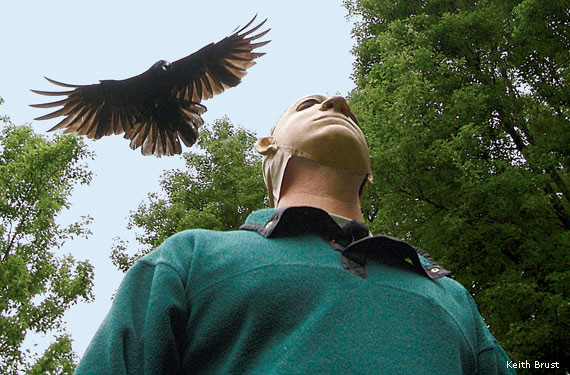
The crow watching you from the tree branch knows your face. Not just as a human, but you. And they will remember the things you did.
Researchers at the University of Washington spent nearly two decades studying this. They trapped a few crows once, harmlessly, while wearing a particular mask, banded them, and let them go. Then they walked around campus in that same mask for years afterward. The crows scolded and dive-bombed it every time.
Here's the part that should give you some pause if you're considering being mean to crows. Crows that were never trapped did it too.
Birds that had only watched the others react learned to treat the mask as dangerous. And crows born years later, who had never seen the original event at all, inherited the grudge from their parents and scolded a face they had never met.
A control mask, worn the same way, was ignored completely. It was never about masks or people in general. It was about one specific face, flagged as a threat and passed down through a population like a piece of news.
So the crow on the wire isn't just watching. It's profiling you, and it will tell its kids about you.
In the US, spending on data center construction now exceeds spending on public transportation infrastructure — including airports, marine terminals, and all mass transit.
@Axaxia88 So, the original owners kept her for 19 yrs. If this was a milk cow, didn't she have calves in order to keep lactating? (If so, she wasn't always alone.) If not a milk cow, why were they willing to keep feeding her? Just wondering...
Ronny Chieng had one message for Harvard grads during his commencement speech: destroy AI.
"Look, a lot of other respected graduation speakers in colleges around America are talking about you guys needing to master AI for the future. I'm here to tell you the mission of your generation is to destroy AI...
"And I know, I know there's someone sitting out here right now who’s just like, 'Well, you know, what about the use of AI to pioneer breakthroughs in medicine and physics?' Well, first of all, shut up, nerd. I'm not talking about that. Obviously, if you're using it for that purpose, you're not the problem.
"I'm talking about the accumulation of cognitive debt due to excessive use of large language models according to a study by MIT published in 2025. That's right, MIT. MIT did that study. I guess you guys were too busy giving each other A's. Feel free to boo MIT, by the way, and AI, and yourselves, I guess.
"Look, this is actually good news, okay? This is why you guys shouldn't be scared of AI, because I think AI is just going to end up making mediocre people dumber. Have you heard how dumb people brag about how they use AI? They're always like, 'Hey, did you know that AI can now read my email, summarize it, and drop a response?' Yeah, you know who else can do that? Me. I can do that. You can't do that? How useless are you? You need artificial intelligence just to match me? I'm a dumb*ss who couldn't get into Harvard.
"From what I can see, getting an actual advantage from AI in the future will require a minimum escape velocity of intelligence that I'm assuming you guys from Harvard have. Everyone else who can't match that is just going to get dumber, and that's when you run up the score on them, assuming we still have a functioning society, of course.
"But to run up the score, you’re going to have to master your craft. And AI can be the fuel, but fuel is useless if you can't kindle the fire. For example, I recently used AI to use regression analysis to prove that a certain race of people are mathematically terrible at sports. I won't say which race, but thank you for not inviting Hasan Minhaj to Harvard. My point is, learning the fundamentals still matter. If I didn't know what a regression analysis was, and if I wasn't fundamentally racist, would I have been able to do any of that? No.
"Untalented people love bragging about using AI to help them draft their speeches and their scripts and their podcasts and their promo videos for UFC fights at the White House, which to be fair, even if they had filmed that for real, it would still have looked like AI. But what they're missing is this: the creating is the fun part. The best part of comedy writing is figuring out the puzzle pieces of a joke and getting the self-regard from having accomplished a difficult thing. Why would I want AI to take that away from me?
"You know what problem I want AI to solve? I want the problem of AI making everything look like sh*t. I want AI to solve that problem. How about that?
"Or how about, can AI take away the part of comedy writing where my TV pilot gets passed on and when I ask if I can pitch it to someone else, the network says, 'We don't want it, but we also don't want anyone else to have it. We just want you to be sad.' Can AI solve that?
"I recently tried to introduce my friend to Buddhism through a book called Buddhism Made Simple. It was literally a book about Buddhism made simple. And instead of reading it, he used AI to summarize it in 10 seconds. Believe it or not, he didn't reach enlightenment. It turns out speed running Buddhism is completely missing the point.
"And I know this platitude is almost worthy of AI, but the reason shortcuts to skip to the end aren't always good is because the journey isn't just how we acquire skills. The journey is the point of all this. It is! It turns out maybe the real Harvard was the friends we made along the way.
"Look, I know this won't apply to everyone's industry, but I'm just saying whatever your chosen profession is, please don't let AI rob you of the fun part of it.
"I think your generation's upcoming battle won't be humans against AI. That's at least two months away. It's going to be people with substance versus people with shallow knowledge. It’s going to be mastery versus faking it. It's going to be people with good taste versus tacky. I trust you will put in the work necessary to be on the right side of those battles."
Ossoff: This is what small men like Donald Trump and JD Vance and Stephen Miller will never understand—that our national greatness flows not through our blood or our genes, but through our ideas.
Americans are not a race, we're a people united not by ethnicity, but by our shared convictions, and that is what makes us exceptional
@StatisticUrban I believe there once was a political reason, something to do with the balance-of-power in the Senate between slave and free states.
However, like so many other historical anomalies, it's probably time to turn the page.
@MattBruenig So, approximately 10% of the population spends 10% of its income or less on housing, while 70% spends at least 30%, and so on. Am I reading this right?
The research behind this is wild. A cat has about 470 taste buds. You have 9,000. A dog has 1,700. So the cat in this video can barely taste that pancake, and that is the whole reason it sniffs the thing like it might be poison while the dog just bites straight in.
Taste barely works for a cat, so it leads with its nose. To a cat, smell is how you tell food from not-food, and safe from dangerous. The sniff you are watching is a safety check. Most of the time, the answer comes back no.
The reason runs back thousands of years, to the kind of animal a cat used to be. House cats come from small wild hunters that caught fresh prey, mice, birds, the odd lizard, and ate it on the spot. They did not scavenge or pick through rotting leftovers the way some animals do. So a strange smell has always meant one thing to a cat: possible poison. A cat that has never seen a pancake does not look at it and think food. It might as well be a wad of paper.
There is a second catch. Cats cannot taste sweet at all. Scientists found the gene for it is broken in every cat, from your couch cat to lions and tigers. So a sweet, syrupy pancake gives a cat nothing back. The smell is wrong, there is no sweetness to enjoy, and the texture feels off. It checks the thing and walks away.
The dog is running the opposite script. Dogs come from animals that lived off scraps near early human camps, and their bodies changed to match. A 2013 study in the journal Nature found that as wolves became dogs, they picked up ten genes for digesting starch, the soft, carb-heavy stuff in bread, rice, and yes, pancakes. Wolves are bad at digesting starch, but dogs got good at it. A dog was practically built to eat our leftovers, and that pancake is close to the exact food that turned a wolf into a dog.
Dogs also bolt their food because their ancestors had to. In a pack, anything you left sitting got stolen, so the fast eaters won and passed it down. A dog's 42 teeth are made for grabbing and tearing, not slow tasting. So the dog does not test the pancake. It just bites in.
One animal treats every meal like it could be a trap. The other treats every meal like it could get stolen. Both are still running survival rules that were written long before anyone held out a pancake.