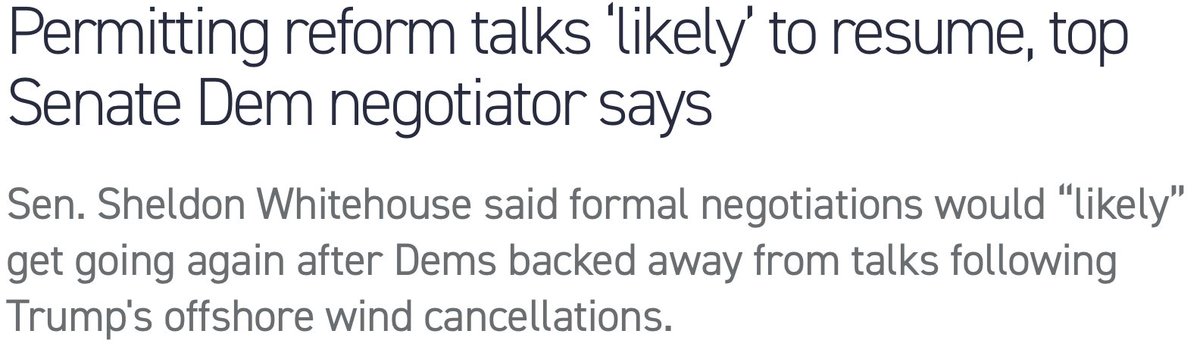
CEBA is delighted @SenWhitehouse and @SenCapito are signaling a return to permitting reform talks. Bipartisan permitting reform legislation is critical to move all essential energy infrastructure forward. This is a historic opportunity to unleash abundant American clean energy through permits, not politics, and build a reliable, affordable energy future for families and businesses. We’re excited about this step in the right direction and continuing work to get permitting reform done. @POLITICOPro
Last night's State of the Union touched on energy costs, oil and gas production, and what it means for America's economic future. What often gets lost in the debate: Clean energy & climate aren't at odds with economic growth, they ARE the economic imperative. Watch our response.
The intersection between the geography of demand and investment decisions about where to build manufacturing facilities and source components is not nearly as well understood as it should be.
It's almost like our economic future depends on our ability to get ahead of where the economy's heading, rather than trying to slam on the brakes.
Too bad no one saw this coming :/
NEW, from @heatmap_news:
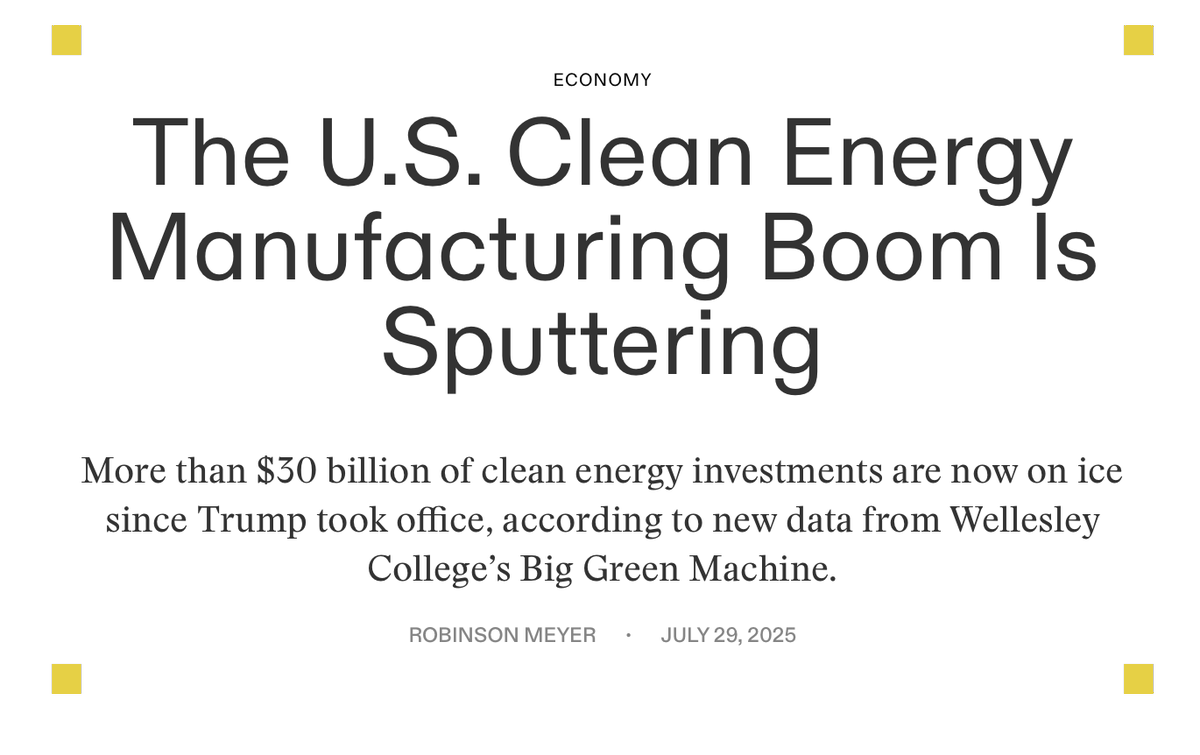
America’s clean energy and EV manufacturing boom is sputtering, according to a new report.
Since President Trump took office, more than $30B in manufacturing investment has been paused, canceled, or delayed.
Only $3B in new investment has been announced.
We’ve seen the headlines following passage of the budget reconciliation bill, but what’s next for clean energy and climate advocates? Read @natkeohane’s thoughts in this new op-ed from @washpost on lessons learned and the political path forward.
https://t.co/7igfkixmKt
@gabriel_weil@noahqk@mattyglesias Based on LOTS of conversations we had over the last several months with hill offices, the answer is most of it.
Don’t forget what the House passed.
Was the final product better? A low bar to be sure, but undoubtedly yes.
And why? Jobs, jobs, jobs.
@gabriel_weil@noahqk@mattyglesias And…even more difficult to parse out is Noah’s underlying question about how effectively economic opportunities in the transition could be in attracting political support.
Would we have loved to have more support? Yep.
But out of what there was, how much was tied 2 jobs?
@gabriel_weil@noahqk@mattyglesias Was anyone saying it was a silver bullet though? No one working in politics should have ever believed it was.
Post-election, what does “resisting immediate repeal when R’s take power” mean?
Presuming no one really believed we’d keep the entire thing intact, where’s the line?
@noahqk@gabriel_weil@mattyglesias Respectfully - what wld success have looked like to u?
The economic case was the only thing dozens of offices wanted to discuss and I think it’s a mistake treat success as binary.
Magical thinking by many put the goal posts where they never should have been to begin with.
@RobAtkinsonITIF Again, disappointing that the President of one of the orgs I most deeply respect on innovation and technology policy is trolling people on twitter instead of trying to improve the largest piece of economic policy in decades...which is what I'm going to get back to doing.
Groups representing a broad swathes of the energy industry issued a warning that the Republican reconciliation bill "would 'freeze investment in hundreds of gigawatts' of energy projects."
Note the highlighted warning from the energy industry:
https://t.co/msG8N2WtSE
@RobAtkinsonITIF I'd expect the President of ITIF to understand. It's inane that we're reliving the innovation/deployment debate in 2025, and that you're pretending to not be familiar with the contours of this debate. We need both and fast...
There will be significant economic and energy security consequences of this decision.
The only question is how significant the political consequences will be.
Those underestimating either will regret moving this forward.
The US will need ~450 GW of new electricity generation capacity by 2030 to meet rising demand from data centers, reshoring, etc.
And the Senate is about to vote on a bill that could wipe out ~500 GW of potential energy generation capacity.
Companies who've ALREADY MADE INVESTMENTS, now have to make the decision whether to try and cover these broken promises themselves, or...shut the projects down entirely and eat those investments.
And...next time they'll build overseas, where policy is supportive and stable.
“This is a really, really significant setback for clean heat in the U.S.,” C2ES VP @bradjtownsend told @CanaryMediaInc on the loss of $3.7 billion in funding for industrial decarbonization. https://t.co/LGVXrFERLb
🚨 BREAKING: The federal funding freeze has now cost the economy more than $ 1 billion. That's money that should be creating jobs and advancing American manufacturing. Track the real-time impact: https://t.co/qDjbFri7Im
One thing I wish Americans understood about “clean tech”:
It’s not just about climate. It’s about tech that feeds into future industries.
EVs -> autonomous vehicles
Solar, wind, geothermal -> data centers
Batteries -> drones, robotics, defense
IDP can be a boon to domestic manufacturing in high-growth sectors. We should be supporting these innovators, not pulling the rug out from underneath them.
Proposed cuts to DOE's Industrial Demonstrations Program threaten nearly 300K American manufacturing jobs and billions in economic activity. "These are the very manufacturing jobs that the administration is rightfully prioritizing," says @bradjtownsend. https://t.co/R6VpApySGX