Ten years ago today I co-founded Simple Modern
Since then the company has exceeeded a billion dollars in sales and 60 million orders.
It has been more than I could have ever dreamed.
Here's me sharing in 165 seconds what I've learned over the past ten years.
This has been a huge unlock for us @simplemodernco. We used to attribute all performance marketing to DTC, which crushed its P&L and — as @TaylorHoliday says — suffocated growth.
Holdout experiments showed us that Amazon and wholesale saw MORE lift than .com from our marketing.
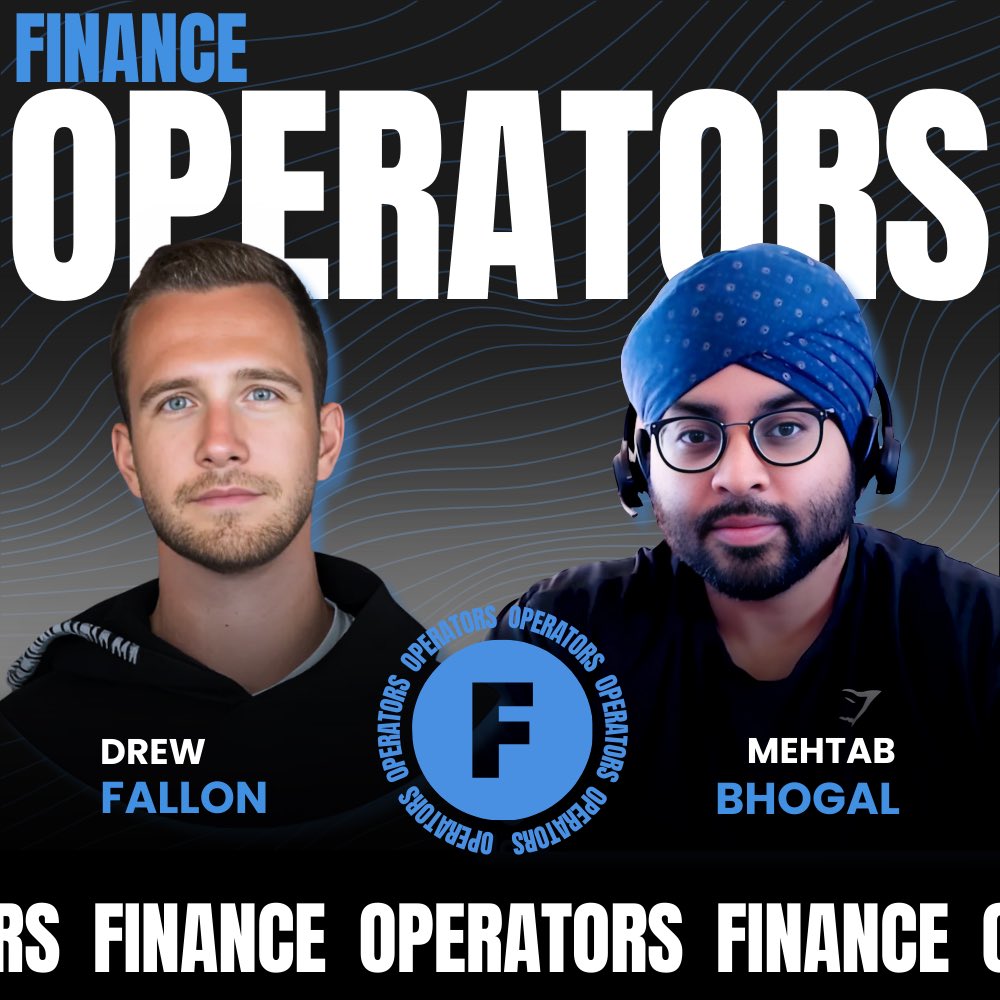
Excited to announce I’ll be hosting the new @9operators Finance pod alongside @drewfallon12!!!
I already love writing long form content, so this will be an amazing way to scratch the itch in a more meaningful way!
Thanks to the Operators team for the opportunity, especially to @finn_radford for all of his work!!!
Great stuff from @MehtabKarta !
At @simplemodernco we’re focusing on 5-6 initiatives in 2025 that all fall in the high impact quadrants. Constraints lead to clarity and focus, which leads to high performing teams.
What's the most common way we see brands butcher their performance? DUMB PLANNING.
Let's walk through how to avoid butchering 2025 for your DTC brand with under $50m in rev...
Look at the picture in this post. The bottom left quadrant is a massive death trap that will annihilate growth.
Most founders know to avoid the Money Pit quadrant - it’s not rocket science…
Literature on impact VS effort will say that tasks falling into the Incremental quadrant should be done when there is “extra time available”.
That is a bad way to look at it because literature that says that is offering advice to managers at companies with $500m+ in revenue where a small initiative can easily pay for someone's salary many times over.
As a fast-growing brand with under $50m in revenue, that doesn't apply.
Spending time on incremental initiatives lowers growth rate substantially. It’s simple math. What would happen if you invested all of your money in a company that returned 10% a year instead of 200% a year? Returns would be horrific.
It’s easy to fall into the trap of working on incremental tasks because they do move the business forward, and can be satisfying to complete.
Twitter demon @DaveRekuc summarized it nicely…
“The bottom left quadrant is so pernicious because the true impact is always less than estimated and the true cost greater.”
Examples of common initiatives you see in DTC that can be classified as Incremental…
CRO. People love this. Running elaborate A/B tests - which have some bug that tanks data - that will not produce much lift even if things go well. Why are you testing button colors when you have not tested pricing, free shipping tiers, or offers? TEST MORE OFFERS (@zachmstuck is probably one of the best examples of crazy offer testing velocity).
Dashboards. All departments are guilty of wasting a ton of time building out some crazy dashboard with extensive automations. CFO-types love it and it’s a huge waste of time. When I was visiting @seanfrank at Ridge, his dashboard was easy to read and relatively straightforward - and he runs a 9 figure business. You do not need some custom built beautiful Tableau dashboard for your dog blessing company with $14m in revenue.
What is the antidote?
It’s very simple. Make sure your team understands how to prioritize initiatives and allocate resources; set high return targets, expressed in a quantitative way.
What is Meaningful Impact?
What is a quantitative definition that you can use to assess how how impact a given initiative has?
The two most common financial metrics for this are MOIC & IRR.
MOIC = multiple on invested capital. If you invest $1 and receive $4, then MOIC is 4x.
IRR = internal rate of return. Discount rate that makes the net present value of an investment equal to zero. I like IRR because it accounts for time.
You can not consistently calculate MOIC or IRR for any initiative in a startup environment.
What you can do, is run quick analysis to ensure you aren’t focusing on something that would fall into the Incremental quadrant.
I suggest setting a “high” target. Something like 4x - 5x MOIC within 12 months.
That number seems high, but there’s a lot of nuance to this…
High targets give you a nice buffer for failure or underperformance. It also encourages you to take substantial swings which prevents you from underdeploying capital. Sitting on excess cash in a business is a sign of bad management.
Few initiatives deploy 100% of the required resource up front. Factor this in when calculating target returns and the target is far less daunting. For example, if you have net 30 terms from receipt of goods on a new supplier with better pricing, you do not actually incur the cost for 30 days AFTER receiving the product. This means you had an additional 30 days of sales before spending a dollar - with the exception of the time spent sourcing.
Factor in raw dollar costs and the team’s time required.
The grayer and less quantitative the impact, the bigger the expected return on investment needs to be.
How Do I Implement This?
1. Send your team this post :)
2. What is your target growth rate? What about EBITDA & revenue? Once those are set, work backwards to determine the IRR you need on initiatives in the pipeline.
3.Make a big list of initiatives and map out what expected IRR is per initiative. Be sure to break out when the associated financial or human costs will be incurred - and when returns will be realized. This changed the internal rate of return substantially!
4. Review each initiative to make sure everything is on track.
5. When a team member has an idea…ask them if it meets the targets you outlined in step 2. Never do the math for them. Always ask them to do it and show you their thinking.
Simple Modern unveiled Trevi, a new hydration brand for people who want better-tasting electrolyte powders but aren't hardcore athletes. The company spoke with Modern Retail about this latest foray. https://t.co/34csl8dAeX
@PrestonRuther10 This is on point! We’re stepping into brand marketing at @simplemodernco feeling uncomfortable with measuring the impact.
Have you done any work to apply this thought process beyond DTC, to Amazon, wholesale, etc?
@MattiSchroder Love this. At @simplemodernco we coined a metric called aMPER—acquisition marketing profit efficiency ratio. Really, it’s just another way of looking at the same thing: profit per new customer.
Great thoughts @drewfallon12!
We’ve found water bottles at @simplemodernco to be kind of like apparel in that consumers carry them like an accessory. Accordingly, we’ve seen a ton of impact from leaning into drops.
The most important things to get right as a DTC brand, by category, in 1 word:
- Food/Beverage: Taste
- Supplements: Subscription
- Apparel: Drops
- Personal Care: Margin
- Home Goods: AOV
- Toys/Games: Virality
- Luxury: Brand
- Electronics: N/A
What did I miss?
Proud to work for a company that stands for values like Generosity and Togetherness.
Today we announced the next chapter of @simplemodernco through a refresh of our brand identity! Check out this letter from our CEO highlighting our story and how we arrived at our new look.
To Simple Modern's Customers and Supporters:
We’ve taken a fresh look
Simple Modern has been around for over nine years, and in that time, we’ve experienced tremendous growth and success – thanks to our customers who believe in our mission to give generously and by creating high-quality products that serve a need in their lives.
This year, we’ve taken time to slow down – not with new products or with our giving – but in our review of who we are, what we want to represent and what story we want to tell.
And we’re so pleased to announce our new, refreshed brand identity complete with an updated logo and new tagline that we believe more accurately aligns with our company’s ideals, our story and our future.
Before we started on refreshing our brand identity, we wanted to hear from you. Through significant time with focus groups and surveys, we heard directly about what you loved about Simple Modern and where we could improve our storytelling and focus. You helped us crystalize our thoughts about our values. You helped us see if our ideas were cohesive or confusing. You helped us know exactly why you’ve grown to trust us and where you’d like to see us grow in the future.
Two ideas kept rising to the surface of what’s important to convey in our brand messaging: mobility and generosity. We believe our updated brand and new tagline, “Good Everywhere,” convey those two guiding principles for Simple Modern.
For one, we are dedicated to creating products that allow you to have mobility to ease your busy life. We believe every Simple Modern product is a perfect companion for any activity. Where you go, we are good to go there too.
And, we’re working to help bring good to everywhere in the world: By the start of 2025, we will have given more than $10 million to more than 1,000 nonprofits in less than 10 years. Very simply, we exist to give generously, and we’re so proud to be able to come alongside our nonprofit partners and help them achieve their varied and important missions. It is humbling to see tangible change happening in this world because of their work.
With this refresh, we wanted a logo that could still be clearly identified as us when written as SM, as it has become shorthand for both us and our customers. And you’ll notice we’ve added a water drop to every iteration of the logo. This obviously ties into our background with hydration products, but it also serves as a visual reference to our values: We truly believe that one drop can create a ripple effect of change throughout the world. We believe this modified brand brings clarity to our products and to our story of generosity, tying our products and our mission to give generously more closely together. The drop will be an icon you’ll start to see in our communications, whether it be on product, in packaging, or talking about our brand values.
When will you see the new brand on the products you love? As of August 28, the new brand and tagline will be on all digital assets like the website and digital ads. You’ll start seeing products with the new logo about the end of September. And all products should have the new look by the beginning of 2025.
We are so thankful for all that have joined us on our journey during the last nine years. Because of you, we can be generous with others. Thank you for helping us live out our mission. With you, we can bring good everywhere.
Simple Modern is one my favorite success stories in eCom, look at this traction:
2017 ~$10m
2018 ~$20m
2019 ~$40m
2020 ~$60m
2021 ~$80m
2022 ~$95m
2023 ~$180m
2024 ~$225m
What's amazing is it's bootstrapped!
What's more amazing is est. earnings this year $40-50m!
🐐🚀🙌
@iamkawawong@lifeofbi I’m on the Finance team @simplemodernco - in the early days: solid unit economics and a basically negative cash conversion cycle on Amazon. We would also factor our receivables with Target, etc, getting $0.80 on the dollar.
Pumped to have @drewmarc live tomorrow along with @brettbone from @simplemodernco and @andrewbcase from @noonbrew to talk pricing.
Such a cool topic that overlaps with finance, marketing, math, psychology and culture.
Everyone has to make calls on pricing, and yet so often it's ignored as a strategic lever...let's fix that.
@mikebeckhamsm This was my fourth week at @simplemodernco , and I remember thinking, having just left a safe, comfortable job: “what have I done?!” But it was really special watching the team rally and come together to get through it.
Say 👋hello👋 to the newest product in our lineup, the Voyager360.
The Voyager360 is your new go-to ceramic tumbler. The real taste ceramic-lined interior preserves the integrity of your coffee's flavor, redefining how you enjoy it on the go.
https://t.co/7K9LE0zAYv