Rackspace ($RXT) is shutting down its Spot cloud platform for good after a November 17 breach. Intruders with stolen credentials read customers' Kubernetes secrets, and Spot went dark until November 21. Remaining workloads get deleted December 8.
https://t.co/JTn4YnpUCE
Radio New Zealand staff lost Wi-Fi, editorial systems and VPN on November 25 while the public broadcaster contained what it calls an attempted cyber breach. It came one day after the attack that knocked out Allied Media's newspaper servers. No link between the two has been confirmed.
https://t.co/Fv2isYIzhz
Hackers broke into Vinton Steel, the El Paso, Texas mill owned by Japan's Kyoei Steel (TSE: 5440). The attack, confirmed November 19, cut staff off from the internal network and shared files. Kyoei says shipments and plant operations kept running while it restores from backups.
https://t.co/j5dbTBN6iN
Iran's foreign minister, Abbas Araghchi, says Israel is trying "to deceive the US into fighting yet another war on its behalf."
He was answering Israel Katz (Likud), Israel's defense minister, who said Tuesday that Iranian cells inside the United States are working to kill President Donald Trump (R) and his family, that Iran is building chemical weapons, and that Israeli and U.S. Central Command strike plans are ready for Trump's call.
Tehran calling Israel a liar proves nothing. The sharper pushback came from inside Israel.
Avigdor Liberman (Yisrael Beiteinu), a former Israeli defense minister, wrote that "from an intelligence and operational standpoint, there is no justification for an independent Israeli attack in the immediate term."
He also said caretaker Prime Minister Benjamin Netanyahu (Likud) and Katz have a "lust for power" that drove them "out of their minds."
When an Israeli who once ran the same ministry says the war pitch doesn't add up, Americans should hear it before Trump makes the call.
In 1973 an Israeli hit team in Norway shot a Moroccan waiter with no militant ties, and Norwegian judges convicted five of them. How the wrong man died, and how police caught the team on the same plates:
https://t.co/WAn4Z1JaHJ
Israel Katz (Likud), Israel's defense minister, told reporters Tuesday that Iranian cells inside the United States are working to kill President Donald Trump (R), his family and senior American officials.
In the same briefing he said Israel's military and U.S. Central Command have strike plans ready for Iran, with the final call on an American strike sitting with Trump. The warning and the pitch for a joint war came from the same podium.
Tehran's threat has a paper trail. In November 2024 the Justice Department charged Farhad Shakeri, an Iranian Revolutionary Guard asset living in Tehran, after he told the FBI he'd been ordered to draw up a plan to kill Trump.
Israel's own tips have a weaker one. In August, a current and two former U.S. officials said Israel had passed Washington several warnings of Iranian plots against Trump over the previous year, and American intelligence could not verify them. The CIA rated some of that intelligence low confidence.
Then look at who is warning Americans about foreign hit teams.
Israeli journalist Ronen Bergman counts at least 2,700 targeted-killing operations by Israeli agencies in about 70 years in his book "Rise and Kill First." He says no Western country has run more since World War II.
A lot of them ran on the soil of friends.
Rome, October 16, 1972. Wael Zwaiter, the PLO's representative in Rome and a translator, was shot 12 times in the doorway of his apartment building. His killers were never caught.
Paris, December 8, 1972. Mahmoud Hamshari, the PLO's representative in France, answered his home phone. Mossad agents had hidden a bomb under the telephone table and set it off by remote signal. He died a month later.
Lillehammer, Norway, July 21, 1973. A Mossad team hunting a Munich planner shot Ahmed Bouchikhi, a Moroccan waiter with no militant ties, 13 times in front of his pregnant wife. Norwegian judges convicted five of the team. In 1996 Israel paid his family about $400,000 and still admitted nothing.
Dubai, January 19, 2010. The team that killed Hamas commander Mahmoud al-Mabhouh in his hotel room traveled on 12 forged British passports.
British Foreign Secretary David Miliband (Labour) said there were "compelling reasons" to believe Israel was responsible and expelled an Israeli diplomat. A friend doing it, he said, added "insult to injury."
Italy, France, Norway and Britain were all friends of Israel. Each one learned about the operation from the crime scene.
Before America takes a hit-team warning from Israel's defense minister, it should remember which government wrote the modern manual on killing people inside a friendly country.
Part 16 of The Kill Files follows the Lillehammer team from the swimming pool where they picked the wrong man to the getaway car Norwegian police stopped on the same plates:
https://t.co/WAn4Z1JaHJ
The tool believed used in the CIA hack is ARTEX, a free AI program that finds and breaks into computer systems on its own.
Two people familiar with the case told Nextgov/FCW, the federal technology trade outlet, that ARTEX is believed to have been used against the open source intelligence network shared by the CIA and the Office of the Director of National Intelligence. That network is where U.S. analysts study news, social media and commercial data.
A Chinese engineer who goes by "Autumn-27" built ARTEX. It has become a favorite of criminal hackers.
Hackers also used it in a recent break-in at the Defense Department's Cyber Defense Command, two people told the outlet, though one called that breach low-impact.
The New York Times reports the National Geospatial-Intelligence Agency, the spy agency that reads satellite imagery, was hit at the same time as the CIA.
The CIA declined to comment. Nobody in Washington has said who ran the attack.
How ARTEX works, who built it, and how the same kit forced the European Commission to pull its own payroll system offline:
https://t.co/KNO8qrYZ97
CIA and FBI Hacked: Six Federal Breaches Since September
On Tuesday, November 24, 2026, word broke that hackers got into a CIA and Office of the Director of National Intelligence network. The ODNI is the office that oversees the whole American intelligence community.
Four days earlier, on November 20, the news came out that the FBI was investigating an intrusion at the National Crime Information Center, the database police across America check at traffic stops.
A source inside the FBI says the CIA breach happened the same day the FBI was hit.
Those are the fifth and sixth federal breaches made public since September. Two of the six were claimed by the crews that did them. For the CIA and the FBI crime database, nobody in Washington has named who got in.
WHAT THE CIA LOST
The CIA network that got hit runs open source intelligence. That is the spy trade of collecting and studying public material: the internet and the commercial databases that anyone can buy.
The ODNI says there were "no disruptions to critical capabilities or classified systems." A person familiar with the case says no classified information was involved and the problem has been fixed.
People who know the case say files from other federal agencies were exposed too.
Unclassified does not mean worthless. The public material on that network is free to anyone. What is not free is the list of what American analysts chose to pull, save and study.
On a network built to study public material, the secret is the selection. Read enough of what the analysts pulled and you know which people, companies and countries the agency is watching.
THE DATABASE BEHIND EVERY TRAFFIC STOP
The FBI built the National Crime Information Center, known as NCIC, in 1967. It started with about 350,000 records in five files: wanted persons, stolen vehicles, stolen license plates, stolen guns and stolen articles.
Today it holds more than 19 million records and handles about 10.7 million checks a day for police, sheriffs, courts and federal agents.
It now carries files on missing persons, protection orders, sex offenders, gang members, violent persons and known or suspected terrorists. Its missing-person file alone held 88,093 active cases at the end of 2025, and 21,487 of them were children.
When an officer runs a plate on a dark highway, NCIC is what tells him the driver may be armed and dangerous.
Now picture that list in the hands of a cartel. The gang file tells them who police have tagged. The terrorist file tells a foreign service who the FBI is watching.
There is a second danger. Gary Barlet, public sector chief technology officer at the cybersecurity firm Illumio, warns that investigators have to check whether anyone changed records, not just copied them. A faked warrant or a deleted one sends an officer up to a car with the wrong picture in his head.
WHO TOLD THE COPS
The FBI runs NCIC, but local police enter the records. They are its users and its source.
As of Monday, November 23, state, local, tribal and territorial police still had no formal word from the FBI about the intrusion.
On Thursday, November 19, after bureau officials learned of the breach, FBI Director Kash Patel went on Fox News to praise the bureau's cyber work. He talked about Operation Winter Shield, a push to get companies to patch their systems that wrapped up months ago, as if it were still running.
"Other administrations could have made these updates, but they didn't," Patel said.
On Tuesday, November 24, reporters asked Patel who got in and what they took. "The matter is ongoing," he said. In the same answer he claimed intrusions are "down 36% based on FBI caseload."
President Donald Trump (R) called the hack "not good" on Saturday, November 21. Then he added, "maybe we will learn things that we would've never learned otherwise."
SIX BREACHES IN THREE MONTHS
Line them up in the order the public learned about them.
In September, it came out that unauthorized users had spent from October 2025 to July 2026 inside a Defense Manpower Data Center system. They reached unencrypted files on 2.76 million living people and about 294,000 dead ones, with Social Security numbers, birth dates, race and military job codes.
Also in September, a hacking crew called ShinyHunters claimed it stole FBI employee and applicant data through the bureau's jobs website. The sample it posted named people working counterintelligence, "clandestine technical operations," and cases on Russia, China, Iran and Hezbollah.
On October 28, a hacktivist group calling itself the Department of Peace dumped the names, phone numbers and addresses of more than 40,000 Homeland Security agents and associates, including people in undercover work. The group says it got in through the department's single sign-on system, the one login that opens many systems at once.
The week of November 16, the Agriculture Department's farm programs office reset every database password in every system it runs after hackers reached the system that pays America's farmers.
Richard Fordyce, the USDA under secretary over farm programs, called it a "cyberthreat," not a software update. Farmers lost payment tools for days in the middle of grain sales and year-end loan payments.
Then came NCIC. Then the CIA.
THE PATTERN IS OLDER THAN THIS YEAR
In April 2026, the FBI declared a suspected Chinese break-in of one of its surveillance systems a "major incident." Federal law saves that label for breaches that can cause demonstrable harm to national security, the economy or public health.
Investigators tied the tactics to Salt Typhoon, the Chinese hacking campaign uncovered in 2024. Salt Typhoon broke into eight American telecom and internet providers, pulled call records on millions of Americans and got into some of the systems phone companies keep for court-ordered wiretaps.
Cynthia Kaiser, a former senior official in the FBI's cyber division, put it plainly. "China is consistently targeting any information that can help them identify and track their own targets."
Go back to 2015. Hackers took background-check files on 21.5 million people from the Office of Personnel Management, the federal government's personnel office. Those files held foreign contacts, drug and alcohol use, money trouble and mental health history, plus 5.6 million sets of fingerprints.
You can change a password. You cannot change your fingerprints.
WHY THE PILE MATTERS MORE THAN ANY ONE BREACH
Each breach looks small on its own. An unclassified network. A jobs portal. A personnel file. A farm payment system.
Stacked together, they draw a map.
The Pentagon file gives names and job codes. The FBI jobs data says who works counterintelligence. The DHS dump gives phone numbers and addresses.
A crime database tells who police are hunting and who the FBI has flagged. An open source network shows what the CIA wants to know.
Justin Sherman, a senior associate at the Center for Strategic and International Studies, a Washington think tank, warned on November 13 that every stolen data set can now be combined with others and run through AI models.
He also pointed out that Iran has tried in recent years to assassinate a former senior official and the president inside the United States. Iran would want the names and addresses of agents working against it. So would the cartels.
That warning came before NCIC and before the CIA.
FEWER PEOPLE ON THE WALL
The Cybersecurity and Infrastructure Security Agency, known as CISA, is the federal office that helps agencies defend their networks. It had about 3,400 employees when this administration took office. By June 2026, Homeland Security Secretary Markwayne Mullin (R) put the number at about 2,200.
At a House hearing on November 18, Rep. Adam Walkinshaw (D-Va.) asked Mullin how many fully onboarded employees CISA has today. After hours of testimony, Mullin did not give a number.
On a ship, you don't cut the engine room crew and then act surprised when the bilge floods.
WHO ANSWERS FOR IT
Two committees in Congress oversee the spy agencies. The Senate Intelligence Committee is led by Chairman Tom Cotton (R-Ark.) and Vice Chairman Mark Warner (D-Va.). The House Intelligence Committee is led by Chairman Rick Crawford (R-Ark.) and Ranking Member Jim Himes (D-Conn.).
Patel says the FBI will share what it can through the Justice Department or "our engagements on Capitol Hill." That puts the questions on those four desks.
Who got into NCIC, and were any records changed? Which agencies' files sat on the CIA's open source network? Were the CIA and FBI breaches run by the same hands on the same day? Why had police across the country heard nothing formal from the FBI days after the break-in?
Taxpayers fund every one of these systems. They deserve the answers in public, not just in a closed briefing room.
Leaks cost more than files. In 2025 it came out that U.S. authorities were hiding trackers in AI chip shipments headed for China. Then came the Nvidia ($NVDA) spy leak. Did it burn an American operation?
The trackers, the spy budget and the CIA's history of owning a tech company are laid out here:
https://t.co/K7p6Ov9dwf
SOURCES
CIA/ODNI breach, ODNI statement, other agencies exposed (Reuters, Nov 24, 2026): https://t.co/LfAOGErsiP
CIA open source system, no classified data, resolved (AP, Nov 24, 2026): https://t.co/mFdT6cISrn
Same-day breach, FBI source (Fox News, Nov 24, 2026): https://t.co/zTRtJkx7BD
NCIC breach, Patel on Fox, Operation Winter Shield (CNN via WSVN, Nov 20, 2026): https://t.co/MxgTkiLO6D
Police not notified, Trump remarks, Barlet (Nextgov, Nov 23, 2026): https://t.co/tmWF2XbpMb
Patel "the matter is ongoing" (CyberScoop, Nov 24, 2026): https://t.co/Cqb0WLxc0r
NCIC history and files (FBI, Jan 27, 2017): https://t.co/VFuGk37b1k
NCIC FY2025 records and missing-person counts (Dallas Express, Nov 21, 2026): https://t.co/oJDGxBVcoJ
USDA password reset and outages (Nextgov, Nov 19, 2026): https://t.co/QTaacA1T4X
USDA farm payment system, Fordyce (ABC News, Nov 20, 2026): https://t.co/UzRTlO4Vkz
Pentagon DMDC breach (FEDweek): https://t.co/YfHizX1wXq
DHS 40,000 personnel leak (NPR, Oct 28, 2026): https://t.co/isGYuxVQFt
FBI surveillance system major incident, Salt Typhoon, Kaiser (NBC News, Apr 2, 2026): https://t.co/fT1J4DJnpi
OPM 2015 breach details (U.S. Navy OPM FAQ): https://t.co/min7BkDzUl
CSIS on the breach pileup (Justin Sherman, Nov 13, 2026): https://t.co/SgNS0VKR6A
CISA staffing, Mullin hearing (USA Today, Nov 18, 2026): https://t.co/Cg6d0RgrUH
Intelligence committee leaders (CDT letter, Oct 26, 2026): https://t.co/MXl78Suv4w
Photo: FBI CJIS Division building, Clarksburg, https://t.co/fnynUkQiJT., FBI photo, public domain: https://t.co/4tMsjId2jJ
The Factoring Rumor Would Break RSA, Not Bitcoin's Signatures
Computer scientist Scott Aaronson wrote on his blog Shtetl-Optimized on Tuesday night that he has heard "many, many rumors that one or both labs are sitting on Factoring in P." The labs in that sentence are OpenAI and Anthropic ($ANT). He added, "I don't know how much to credit this."
Factoring in P would mean an ordinary computer could break a large number into its prime factors efficiently. That is the math problem underneath RSA, the encryption still used in banks, government systems, software signing and much of the internet.
If that method existed and was fast enough, RSA would fall. Bitcoin does not use RSA for its signatures.
On Wednesday, Aaronson came back to the point. He said he is "virtually certain, from multiple reliable sources," that the AI labs are sitting on "one or more bombshells" in cryptography.
Until he sees details or hears directly from someone at a lab, he feels "much, much less confident about the specific nature of those bombshells." He said he does not want to spread unverified rumors, and that the exact claims may have been "mangled in a game of Telephone."
Neither OpenAI nor Anthropic has announced a factoring algorithm, or any break of a cryptosystem already in use. No such proof has been published.
Charles Guillemet, the chief technology officer at the hardware wallet company Ledger, wrote Wednesday that he is hearing several rumors that frontier labs have broken major cryptographic systems. On the factoring claim, he was direct: "Still, I don't think factoring is in P."
He also wrote, "Personally, I don't think findings like these are coming."
Guillemet also relayed a separate rumor that elliptic-curve cryptography has been broken. That would take down ECDSA, the signature method Bitcoin still uses, and ECDH with it, on ordinary computers.
That claim is unverified too. Aaronson wrote Wednesday that he does not have a verified answer on whether ECDSA is broken, and that he will not stand behind a specific claim until he sees details.
Bitcoin signs with ECDSA and Schnorr signatures, both built on an elliptic curve called secp256k1. Those signatures rest on the elliptic-curve discrete logarithm problem, a different hard-math problem from factoring.
A classical factoring breakthrough would not hand an attacker the private keys that spend bitcoin.
A large enough quantum computer would. Shor's algorithm, published by mathematician Peter Shor in 1994, solves that discrete-log problem. Once it has a public key, it can produce the private key.
That exposure can already be counted on the chain, and it does not depend on an unverified rumor from an AI lab.
Glassnode, the on-chain data firm, counted about 6 million BTC on May 20, 2026, about 30% of issued supply, sitting behind public keys anyone can already read. CoinDesk later reported Glassnode's October count a little higher, at 31% of circulating supply.
The oldest coins are the worst off. Most of Bitcoin's mining rewards from 2009 to 2011 were paid to an old script type called pay-to-public-key, which writes the full public key on the chain with no hash at all. Google's quantum lab puts more than 1.7 million BTC in those scripts.
Reused addresses are the biggest pile. Once you spend from a hashed address, the spend reveals the public key, and any coins left there, or sent later, sit behind a known key.
Taproot addresses, the ones that start with bc1p, carry a public key in the address itself.
Glassnode tied more than a quarter of the exposed coins to exchanges. Coinbase ($COIN) showed about 5% of its labeled balance exposed. Binance showed 85%. Robinhood ($HOOD) showed 100%.
Glassnode warned those figures are a map of where keys are already visible, not a risk ranking of any exchange.
In March 2026, Craig Gidney, Ryan Babbush and other researchers at Google Quantum AI, the quantum lab of Alphabet ($GOOGL), joined by Stanford computer scientist Dan Boneh, estimated that Bitcoin's curve could be broken with about 1,200 to 1,450 logical qubits, fewer than half a million physical qubits, in minutes.
A logical qubit is a reliable qubit built from many error-prone physical ones. Google's figure is about 9 minutes per key. Bitcoin blocks average 10.
Today's machines are nowhere near that size. Google's Willow chip, unveiled in December 2024, has 105 physical qubits. IBM ($IBM) said on November 11, 2026 that its current Nighthawk chip runs on 120 physical qubits.
IBM's planned fault-tolerant machine, Starling, is aimed at 200 logical qubits in 2029. That would still be short of the 1,200 logical qubits Google's estimate needs.
The U.S. government is already moving off this kind of math. NIST, the federal agency that sets U.S. encryption standards, finalized its plan on October 27, 2026.
Quantum-vulnerable signatures, including ECDSA, the kind Bitcoin uses, are deprecated after 2030 and disallowed after 2035. President Donald Trump (R) signed Executive Order 14412 on June 22, 2026, ordering the government's most sensitive systems onto post-quantum signatures by the end of 2031.
Bitcoin has no date yet. BIP-360 and BIP-361, the two Bitcoin Improvement Proposals written to give Bitcoin a quantum-safer address type and later retire old signatures, were still drafts as of November 22, 2026. Neither has been adopted.
Which coins already show those public keys, how far today's chips of about 100 qubits still sit from Google's estimate, and what Bitcoin developers want to do with the coins nobody can move, including the genesis coins that have never been spent, is in 6 Million Bitcoin Already Show the Key a Quantum Computer Needs:
https://t.co/t20O2j2ZSX
RUMORS OF AI BREAKING MODERN CRYPTOGRAPHY INTENSIFY
Computer scientist Scott Aaronson says he has heard multiple rumors that OpenAI or Anthropic, or both, have discovered a polynomial-time algorithm for integer factorization.
Ledger’s CTO has now confirmed hearing similar rumors surrounding three major cryptographic breakthroughs at frontier AI labs:
• INTEGER FACTORIZATION IN P: A sufficiently efficient algorithm would break RSA encryption without requiring a quantum computer, threatening banking systems, government communications, digital authentication, software signing and much of the world’s digital infrastructure.
• ELLIPTIC CURVE CRYPTOGRAPHY (ECC): Bitcoin does not rely on RSA but instead relies on elliptic curve cryptography for its digital signatures. A practical breakthrough here could allow attackers to derive Bitcoin private keys from exposed public keys and steal funds using ordinary computers. Bitcoin’s SHA-256 hashing and proof-of-work mining would not necessarily be compromised.
• RING-LWE: A breakthrough undermining its quantum resistance could compromise a major mathematical foundation of post-quantum cryptography, jeopardizing parts of the world’s ongoing migration to quantum-resistant systems.
Unlike quantum computing, an efficient classical attack on RSA or ECC could potentially be distributed as software and executed on conventional computers worldwide.
Perhaps the bigger concern is what such discoveries would reveal about AI’s ability to solve foundational mathematical problems that have resisted decades of human research.
Ledger’s CTO remains skeptical that any of these cryptographic primitives have been completely broken but acknowledges that responsibly disclosing such a discovery without triggering mass exploitation would be extremely difficult.
All three rumors remain unverified.
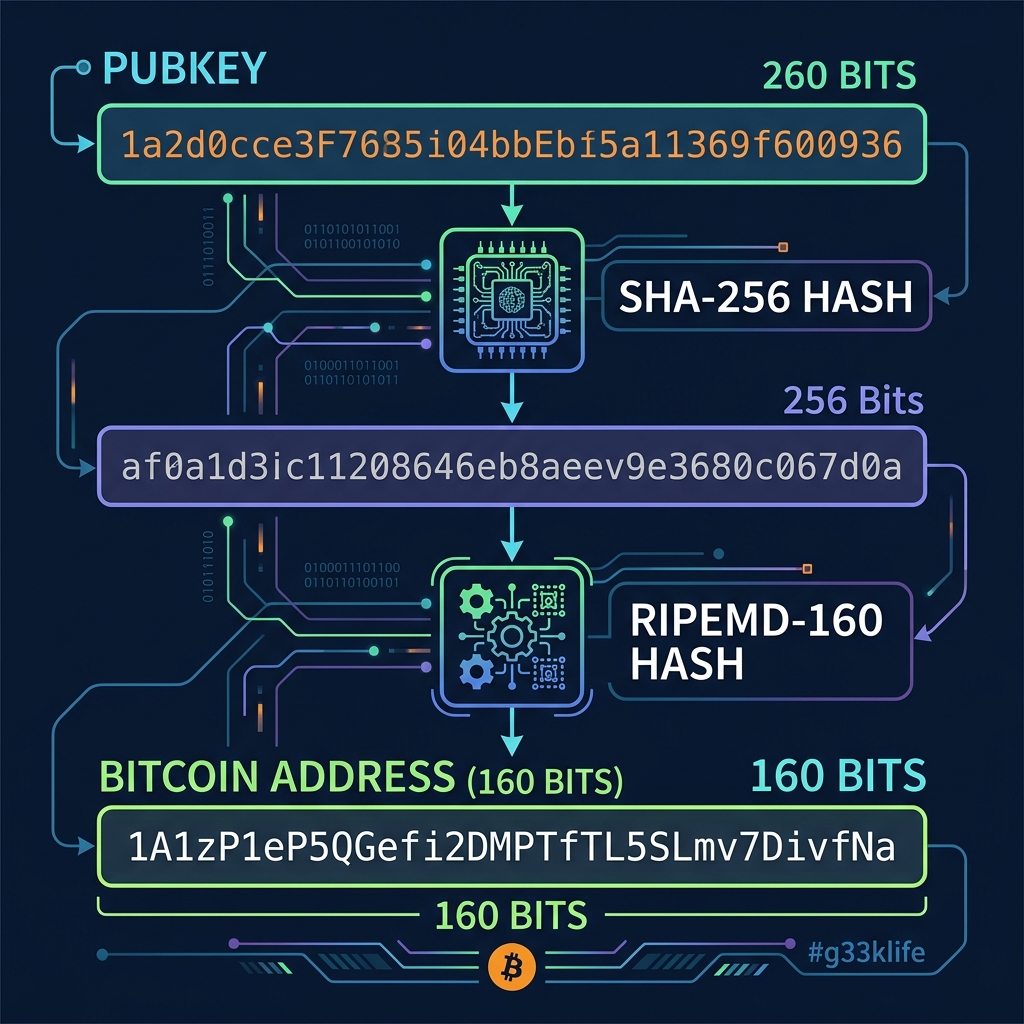
1A1zP1eP5QGefi2DMPTfTL5SLmv7DivfNa, the address this graphic uses to show off the double hash, is Satoshi Nakamoto's genesis address. Its public key has sat in plain view in Bitcoin's first block since January 3, 2009, printed with no hash at all. Hash that key with SHA-256 and RIPEMD-160 and you get this exact address.
Two hash layers guard a public key only until it shows up. Shor's algorithm, the quantum method that breaks Bitcoin's signatures, starts from the public key and skips the hash entirely.
More than 67,000 transactions have sent coins to that address. None of those coins has ever moved out. All of it sits behind a key the whole world can read.
Glassnode, the on-chain data firm, counted about 6 million BTC in May in the same spot: old pay-to-public-key coins, reused addresses and Taproot. Google's quantum lab estimated in March 2026 that breaking one of those keys could take about 9 minutes on fewer than half a million qubits.
Which coins are exposed, how far today's chips of about 100 qubits are from that, and what Bitcoin developers want to do about the coins nobody can move:
https://t.co/t20O2j2ZSX
A Bitcoin address is only 160 bits, not 256 — your pubkey gets hashed through SHA-256 then RIPEMD-160. Two hash functions, two different designs, so breaking one isn't enough. Satoshi layered algorithms like a security engineer, not a cryptography purist. #g33klife