What if we could build out the solar system in 50 years?
What if we could make scarcity obsolete?
What if space can be turned to a place we don’t just visit rather a place we thrive in as a civilization?
What if we could make the possibility of human extinction a myth?
🤔
Rocket Lab is being added to the Nasdaq-100 Index.
This is a landmark moment for the team. We're incredibly proud of what we’ve achieved, and even more excited about what is still to come.
"The fascination that I have for test flying comes from being able to go into an environment where we have an idea what's going to happen, but then you have to [make it] happen."
Meet the Artemis III crew in this episode of Houston We Have a Podcast: https://t.co/3GEB1Kivpc
We are returning to the Moon, to build something extraordinary and continue mankinds greatest adventure to the stars.
@NASAMoonBase will serve as an outpost for science, technology demonstrations, and the development of capabilities that will shape the future of exploration and prepare us for Mars.
Introducing Artemis III.
Four astronauts. Three launches. Two dockings. One splashdown.
In 2027, the Artemis III mission will practice docking the Orion spacecraft with two lunar landers in low Earth orbit — the capability we need to return humanity to the Moon’s surface.
The headlines after a DeFi hack tend to blame decentralization. @eddylazzarin makes the case for the opposite read:
"Of the hacks that I looked most closely at over the last 30 days, many of them would've been mitigated by more decentralization, not less. In other words, the decentralization part wasn't the bug. The bug was that they were unexpectedly more centralized than many people believed."
"With almost every crypto adjacent hack I've seen, the response has something to do with let's get more parties involved and decentralized and remove single points of failure."
"We have not learned that decentralization is bad. What we've learned is that inadvertent single points of failure is bad, which is a thing that we've always known. In its ideal form, DeFi is still more secure."
A piece from @greg_ip in @WSJ today asks whether stablecoins are a risk to the economy because they are "private money." It's a fair question, but the framing skips over how the US monetary system has actually worked for 160 years.
"Private money" isn't the exception in our system — it's the rule. Roughly 90% of M2 is privately issued: commercial bank deposits and money market fund shares. Each carries different risks and is regulated commensurately — banks by Basel, capital, FDIC, and stress testing; MMFs by SEC liquidity rules; and now GENIUS stablecoins by a purpose-built federal regime.
The right question isn't "public or private." It's whether the regulation matches the risk. GENIUS does.
The tokenized asset market crossed $30 billion last month and has stayed there. Roughly the size of an elite university endowment.
As recently as mid-2024, it was below $3 billion. 10x in under two years.
What changed: the GENIUS Act, mature institutional onchain infrastructure, and a wave of financial institutions moving from pilots to production — all at roughly the same time.
Some of the boldest moves begin with quiet belief.
Across semiconductors, renewables, and AI infrastructure, we have invested in sectors long before they became global priorities, guided by the conviction to keep building before the opportunity is fully visible.
#BoldMoves
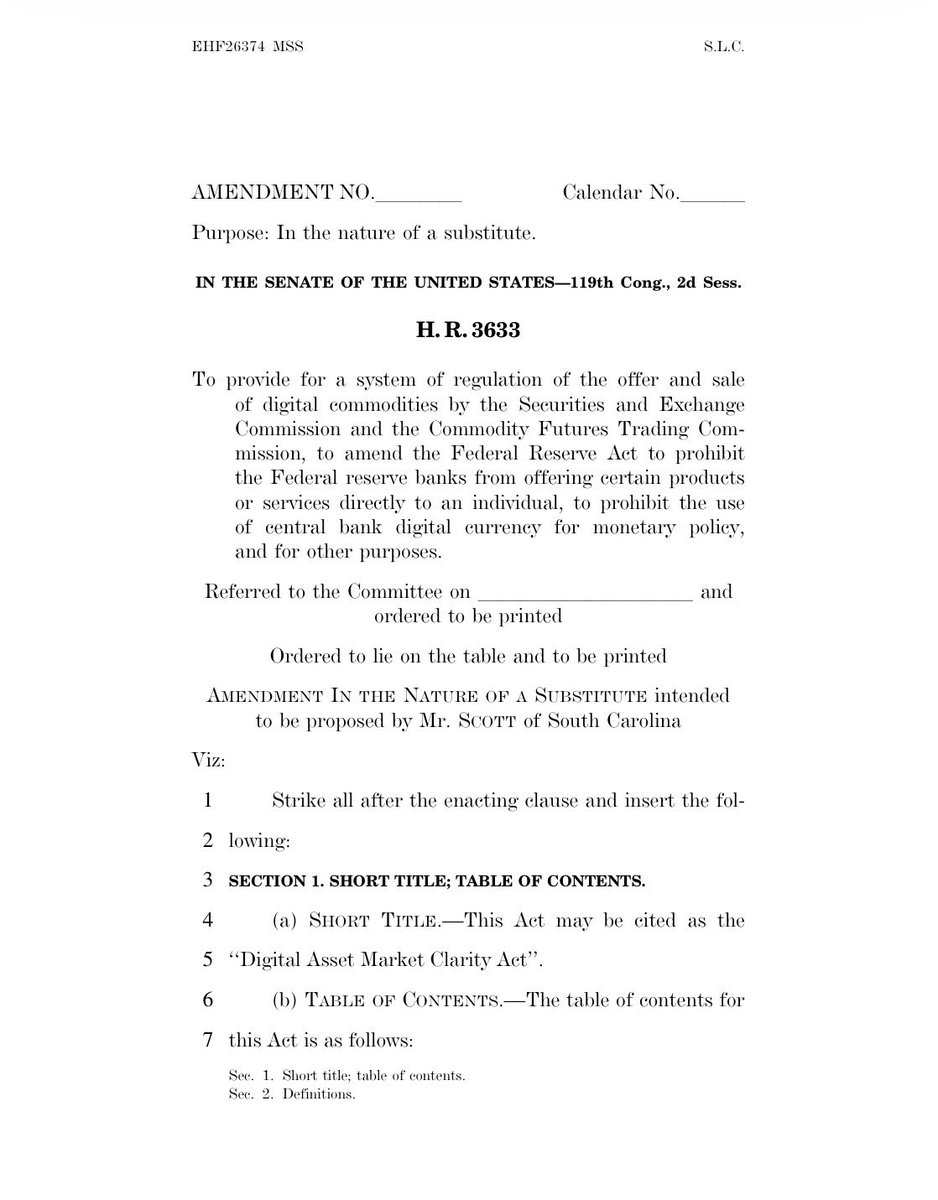
"It's kind of ironic, I suppose, the Clarity Act. At least for this particular section, I think there's still too much ambiguity." That's according to Brook Ybarra from the American Bankers Association https://t.co/Qi9NJBWvUR
Sure you can earn a billion dollars. I've been teaching people how to do it for 20 years. The way you do it is to start a company that grows fast. You don't have to do anything bad to make a company grow fast. You just have to make something people want.
https://t.co/zXWErQqlwV
NEW: 🇺🇸 US Senator Angela Alsobrooks says "we have resolved the yield issue" holding back the Bitcoin & crypto market structure legislation from passing 👀
"I think it can pass, I really do." 🚀




![NASA's tweet photo. "The fascination that I have for test flying comes from being able to go into an environment where we have an idea what's going to happen, but then you have to [make it] happen."
Meet the Artemis III crew in this episode of Houston We Have a Podcast: https://t.co/3GEB1Kivpc https://t.co/YDpC4PWEJf](https://pbs.twimg.com/media/HKox2XrXMAEXN2P.jpg)