Every startup should run cash like a Formula One car. Full speed on the straight. Brake as late and hard as possible into the curve.
The danger does not come from a high burn rate - but from not being able to change it rapidly when things change.
A recent conversation with our portfolio founder on risk and burn management, and the metrics that actually matter:
https://t.co/zjEyfoEHtQ
Very proud to see @onevc_ in the #1 position. Thanks for the analisys @pavelprata.
"Which small, early-stage fund managers consistently back seed-stage companies that go on to raise exceptional Series A rounds – before those outcomes are visible to the broader market?"
Which emerging VCs have the strongest early-stage picking alpha?
Standard emerging manager evaluation still leans heavily on qualitative signals – GP background, thesis articulation, founder references. All useful, but by the time TVPI and DPI tell you something meaningful, you're usually already in or already too late.
So I experimented with a quantitative framework to answer a core LP allocator question: which small, early-stage fund managers consistently back seed-stage companies that go on to raise exceptional Series A rounds – before those outcomes are visible to the broader market?
I started with @harmonic_ai Scout (my fav research tool!) and checked every company globally that raised a first pre-seed or seed round between 2022–2026 (Post-ZIRP). The funnel looks like this:
1/ 55,491 companies raised a pre-seed or seed round – the full opportunity set
2/ 4,368 (7.9%) went on to raise a Series A – the base rate, roughly 1 in 13
3/ 764 (1.4%) qualified as Tier 1 Breakouts – above-median Series A for their vintage year, with at least one top-tier institutional VC (from a defined set of 38 firms: @a16z, @sequoia, @lightspeedvp, @IndexVentures, and peers)
For each of those 1,604 companies, I traced back to every investor who backed them at pre-seed or seed — before the outcome was visible. 4,176 unique investors across the breakout set.
Then I computed a simple ratio for each: breakout companies backed at seed divided by total seed investments in the period. I'm calling this the "Tier 1 Concentration Rate".
After filtering out mega-platforms, accelerators, CVCs, and angels and requiring a minimum of 10 seed deals – 20 emerging managers (sub-$250M AUM) surfaced with notably high concentration rates.
A few things stood out:
1/ Several micro-funds under $100M were placing 25–35% of their seed bets into companies that later raised from @Sequoia, @a16z, @lightspeedvp – consistently, not as one-off flukes.
2/ Participant concentration and lead concentration are different signals. Participant = network and access. Lead = independent conviction before consensus forms. For LP diligence, these deserve to be evaluated separately.
3/ The data has real limitations: ~12% of breakout companies had no named seed investor in the database, we can't cleanly separate Fund I from Fund III for a given manager, and small sample sizes mean some high concentration rates likely reflect luck rather than repeatable skill.
But the core idea holds. "Tier 1 Concentration Rate" is an early, measurable signal of picking ability – observable years before fund-level metrics tell you anything.
For LP allocators evaluating Fund I–III managers, that timing gap is the whole problem. This is one attempt to close it.
What’s your take on this experiment?
Why we killed our CRM and are building our operating system at ONEVC
We’ve spent the last few weeks deep in the trenches building an internal Operating System for @onevc_ . Not because we had to, but because we could.
I’ve been coding since 1998, and for a long time I had what you might call “'developer’s ego”. I believed building internal tools at ONEVC was a distraction. My instinct was telling me: it’s going to create technical debt, need maintenance, and sooner or later one of our off-the-shelf tools will probably ship something similar anyway. Google is spending billions on AI and we already have Google Workspace, so why bother?
Then my partner, Rodrigo Cartolano, showed me the quality of the apps he was building with @claudeai. Seeing a partner without a technical background ship production-ready tools in hours didn't just impress me, but it challenged me. It made me realize that the "Build vs. Buy" dilemma I had lived for decades had finally gone. What we've built in just a few weeks is uncomfortably jaw-dropping. I couldn't sleep well for days, feeling both anxious and excited about what to build next. I finally have my “CTO skin” back.
The shift is fundamental
Off-the-shelf tools are built for the average user. The old paradigm that people and companies would adapt to the software is not true anymore. Software will adapt to people and companies. Switching costs are going to zero. Maintenance costs are going down significantly. If you can describe your intent, you can develop your own infrastructure in a few days/weeks. So we are now killing our external CRM to build something that actually fits us.
This isn't about saving a few thousand dollars
It’s about building something exponentially better than the 'average' CRM tools. As a former CTO, I believe you can't navigate the future of AI from a slide deck. You have to experience the shift firsthand. That's why 100% of the ONEVC team is now building tools, both for ourselves and for the firm.
Why we decided “not to adapt” to the CRM:
CRMs are usually 80% incredible and 20% terrible. That 20% is what bothers me the most:
The search is broken: Why are we still using full-text search? We need vector embeddings to find "similar companies" and “similar founders” across notes taken in two different languages. VCs need a much more advanced search engine than a company running a sales organization that usually matches company names, and not “concepts”.
Context is everything, but it is never in one place. We have data in the CRM, but the most important details are usually in a Slack message or a Notion page. A standard CRM is a silo that doesn't talk to our other tools. By building our own OS, we are creating a bridge between these platforms. Now, we finally have a real-time view of everything we know as a team.
The architecture is rigid: The "People-Companies-Deals" typical architecture doesn't work when you have 5 minutes between meetings and are obligated to fill in “Company” and “Deals", whereas in VC it is the same thing.
Why Now?
There are four main reasons why now is the time to take the courage to build it internally.
1) Maintenance costs are close to zero. Claude is becoming the SRE. It reads server logs, fixes breaking APIs, and configures Vercel at 1% of the cost of a full-time developer.
2) Switching costs are going to be zero: Claude became very good at extracting data out of the CRMs. It reads the data structure of the CRM, proposes a very good database structure customized to our needs, and creates a migration script in just 10 minutes.
3) Zero Latency: We went from "Idea" to "Customized CRM" in 3 weeks of part-time work as Claude became very good at shipping software. We are moving toward a future where the human provides the intent and the AI provides the implementation.
4) 90% cost savings: We are moving from a $6,000/year contract to $720/year in infrastructure (Vercel/Neon/Github/Anthropic). But saving money is a side effect. The real opportunity cost is missing a category-winning founder because we didn't have the right tools to find the signal in the noise.
“But what about security and software quality?”
At the current pace, LLMs will soon take care of the entire quality stack autonomously. Today, I still have to prompt Claude to “write this automated test,” “audit these endpoints,” or “refactor for reusability.” But we are months, not years, away from AI proactively managing these guardrails and even optimizing Vercel infrastructure in real-time.
This is the third time I’ve built a CRM, but it’s the first time I’ve launched test coverage alongside the MVP. Why? Because the cost of "best practices" has collapsed as well. High-quality software used to be expensive and slow; now, a robust testing suite is a single line in a prompt and a couple dollars in token.
“But you've been a CTO and I am not technical”
Well, at the current stage of the LLM tools, having an understanding of software architecture and product management is very helpful, so I would recommend being supervised by a technical person. But in just a few months, a non-technical person will be able to develop delightful customized CRMs without touching a single line of code or knowing the database that is being used in the back-end. If the product is incredible, safe, cheap, and the user experience is awesome, does it even matter whether it is Postgres, MongoDB, or pgvector? It doesn't. Having said all that, I would still be concerned about the security of applications developed by non-technical people, so be careful!
The world we are living in makes us excited and anxious at the same time. But denial is not a strategy. Get your hands dirty. There is no better way to understand the opportunity of AI than to feel what is now possible when you are actually building.
At ONEVC, we aren't just investors; we are builders. If you’re pushing the limits of what’s possible with the modern stack, let’s talk!
We’re excited to announce Enter's Series A, co-led by Sequoia Capital and Founders Fund. We are proud to have backed Enter since the ideation phase.
@onevc_
https://t.co/X5fE2I2ZOw
With AI reshaping the browser, what’s the next wave of innovation for startups?
The browser wars have resumed after a decade, and for the first time, EVERYTHING can change.
https://t.co/ATFzQU7EH9
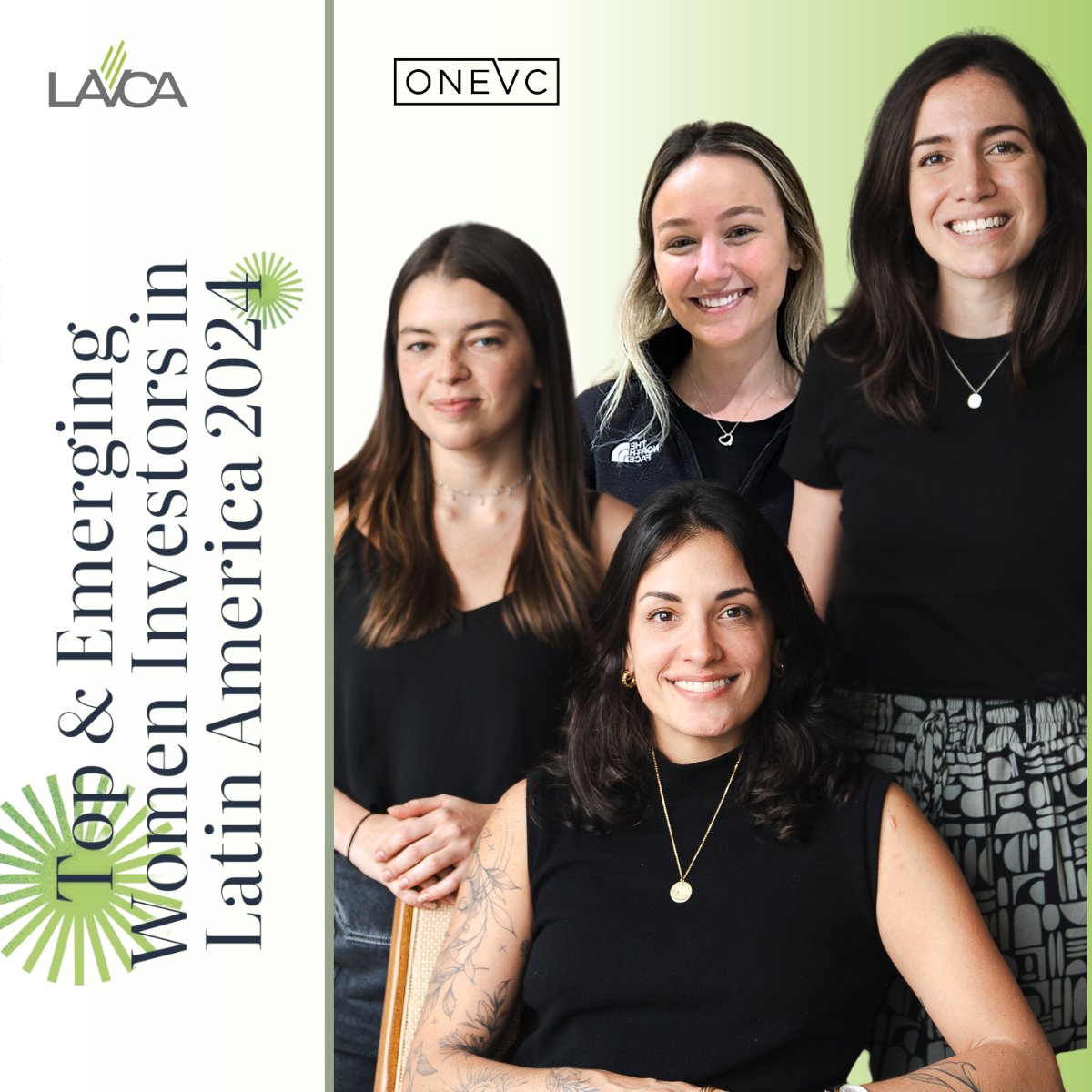
Shout out to the ONEVC women! They have helped shape our culture, strengthened our investment approach, and enhanced the way we support our founders.
We are incredibly proud of their impact not only at ONEVC but in the LATAM tech ecosystem — let's keep growing together!
Today @hellorightfoot announced our $15M Series A raise, and unveiled Connect Magic, our zero-login, consumer-permissioned financial data platform.
We believe in a world where consumers can securely permission their data — with zero friction. (1/5)
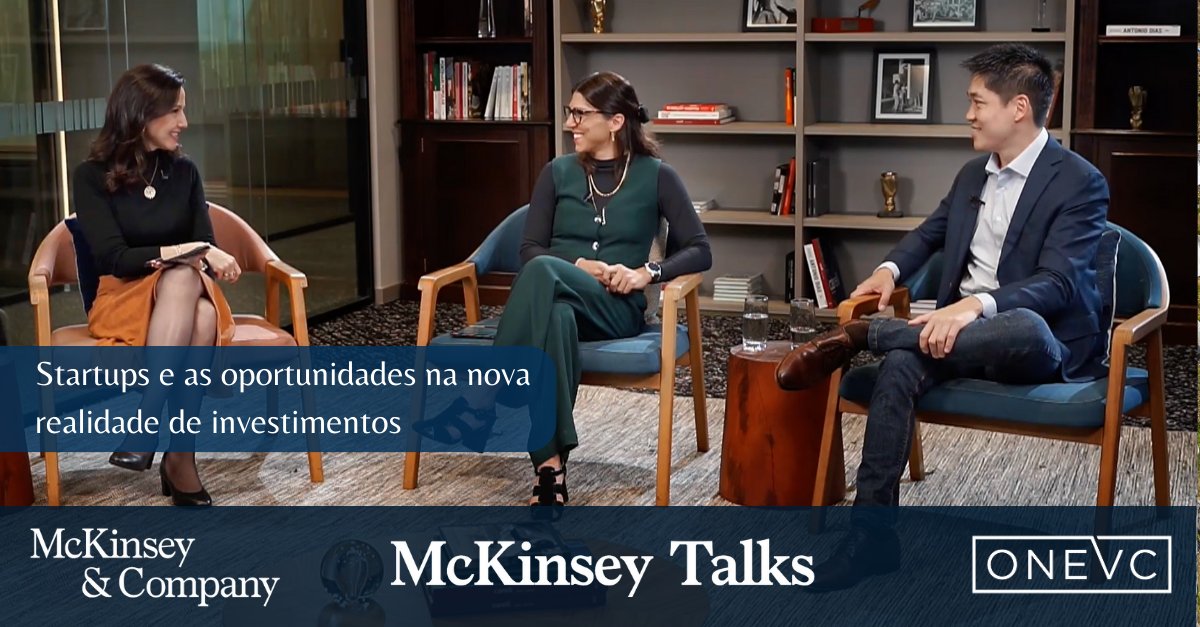
Assista ao episódio "Startups e as oportunidades na nova realidade de investimentos" do McKinsey Talks com a participação de Marina Mansur, sócia da @McKinsey, e @brunoyoshimura, sócio da @onevc_ https://t.co/ZS0C5El30Q
Nesta sexta-feira às 8:30, nosso sócio @brunoyoshimura estará na McKinsey Talks com a Marina Mansur, sócia da McKinsey, para falar sobre o momento atual do mercado de startups https://t.co/AS4MIE50Jr
Introducing #CapchasePay: The buy now, pay later solution for #SaaS.
Now you can collect your full contract value upfront, while still offering customers flexible payments.
Ready to hit your sales targets out of the park?
https://t.co/KDplJ5I8Pq