Conclave is out. Free and open source.
Back in September I said I was bringing it to the public. Here it is.
Every AI model has blind spots. So Conclave asks up to 13 of them at once (@claudeai, @ChatGPT, @GeminiApp, @grok, @deepseek_ai, and more). An independent Synthesizer weighs their answers into one stronger response, then a model from a different company audits it for mistakes before you ever see it.
You see the sources, the audit, and the cost. Nothing hidden.
It runs on your own computer with your own API keys. No account, no subscription, no middleman. You only pay the AI companies for what you actually use. Windows for now.
Better answers come from disagreement, checked.
Link below 👇
Mariko Mori has pushed the boundaries of art for three decades. For her retrospective "All That Shines," she used Claude to write code for a computer-generated animation, presented as a new video installation.
I've been going back and forth on whether I should subscribe to Google's Pro tier. Honestly, I couldn't care less about the newer models like Argon and Carbon. As Ken said, 'If you have all these other models available (Opus, Fable, Sol, Astra) with way more flexibility, why even bother?' Unless you're fully invested in the Google ecosystem, it doesn't make much sense.
I use their Plus tier and pay annually, which is pretty reasonable (and offers slightly more storage). That still gives me some AI capabilities, since I use Google for certain things here and there. It's nice to have their basic models for simple tasks or when I'm feeling lazy.
To be completely honest, the only reason I'd upgrade to Pro is to try their personal agent, Spark. But since I already have free access to Meta's Muse AI personal agent, it seems redundant to even give it a try. I'm already scaling back my experimental use of Claude Duet, since other personal agent platforms simply offer more. Given how invested I am in ChatGPT Dot and Grok Bot, I've been hesitant to bother testing Google's Spark at all.
it’s really difficult to love google’s AI effort right now
their subscription terms is the most hostile one to the ecosystem among all the labs
if you subscribe to google AI, you can pretty much only use antigravity. they require all prompts to antigravity to come directly from the user, not an orchestrator or loop. many users got banned for using it in other ADEs and orchestrators
claude, codex, grok - they are all a lot more flexible in all kinds of integrations
there’s only one reason google needs to be this restrictive about requiring direct user prompts to antigravity - it’s harvesting user data for model training
but it’s not really panning out, is it? their models have been improving but still far behind. as of now, there’s just no practical reason to use any of the latest gemini models when i have opus and fable
relying so heavily on data collection also indicates their training pipeline is still in the last era of SFT and they haven’t actually nailed RLVR like the other labs have
i think google really needs to revisit their AI strategy. this is just not working
Salute to the men and women who put service before self — who stood up, raised their hand, and sacrificed for something bigger than themselves. We owe you more than one day a year. Thank you. God bless America. 🇺🇸
I own rentals and manage properties, I NEED a truck on my day to day. It is paramount. I was really looking forward to owning a Tesla truck in the near future and experiencing all the technology and self driving capabilities. I’ve never owned a Tesla and probably won’t now for a long time. Really a shame - reconsider the design if you ever plan to produce another truck perhaps. I think the shock the general populous experienced when seeing the cyber truck for the first time could have gone both ways. If sales and interest were greater than they are now, would you still be making this decision? Long live the Tesla truck, I still have faith, always! @elonmusk@SawyerMerritt
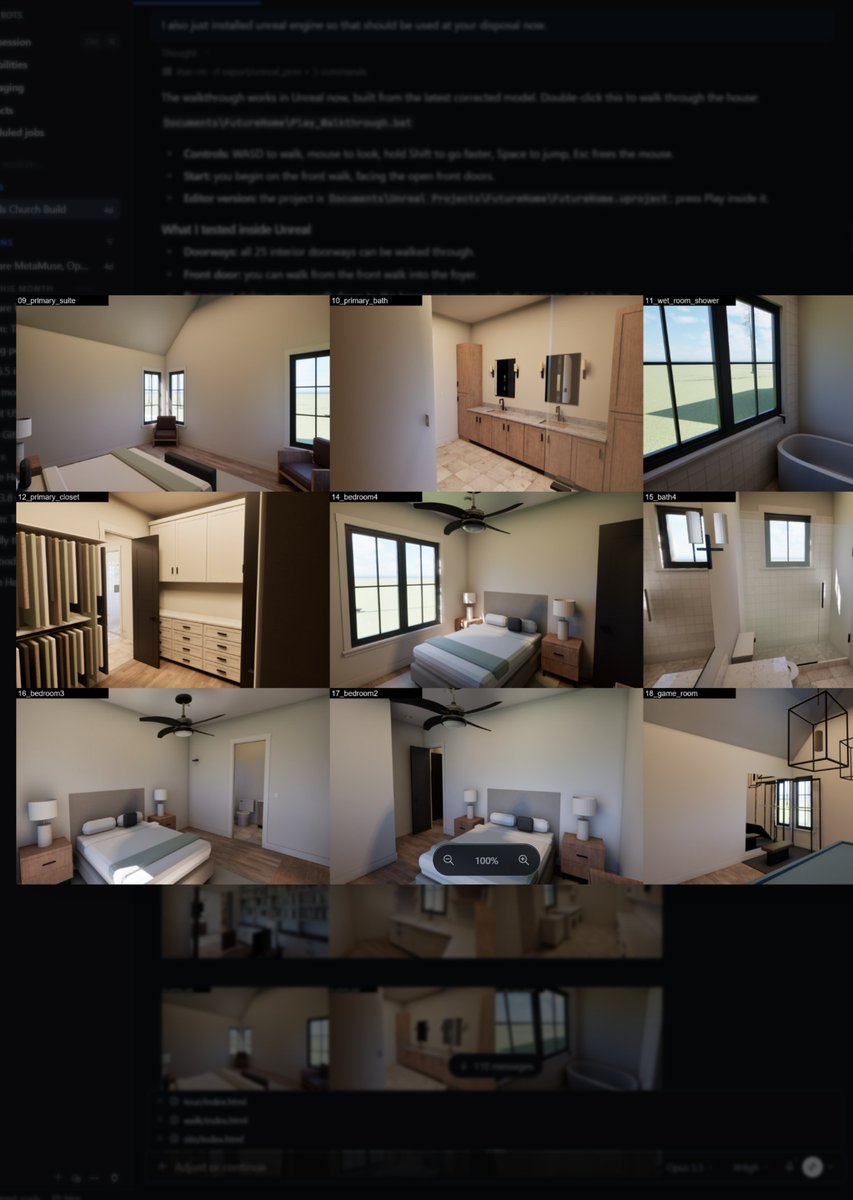
Using @claudeai Opus 5.5, @NousResearch Hermes Agent, @UnrealEngine, and @Blender, we created an incredibly accurate and fully textured 3D walkthrough model of our future home. With only sample plans and blueprints to work from, we still managed to pull it off. Incredible.
@mxstbr the plugin lists are getting a bit out of control. Just the sheer number of options is fairly overwhelming. I love the idea of having more - more plugins for those with specific needs. But if this continues, I fail to believe the scrolling will ever have an end in sight.
@thsottiaux I’m curious to see how this will affect Instinct AI. This feature alone could be the deciding factor in whether Instinct succeeds or not. I’m genuinely interested to see how agent texting between services evolves in the future. A strong competitor that was just a matter of time.
The majority should and will likely be combined. The prompt itself should be specific enough to fuel and enable the tools and mechanisms used to satisfy the result of the requesting user. We’ll likely move away from choosing between chat and work or chat and cowork or grok chat and grok bot etc. The coding layers of these platforms ie grok build, Claude code, codex etc. might eventually become apart of the entire complex in itself and will decide itself or per the user, per the prompt, how the output should be delivered.
The majority should and will likely be combined. The prompt itself should be specific enough to fuel and enable the tools and mechanisms used to satisfy the result of the requesting user. We’ll likely move away from choosing between chat and work or chat and cowork or grok chat and grok bot etc. The coding layers of these platforms ie grok build, Claude code, codex etc. might eventually become apart of the entire complex in itself and will decide itself or per the user, per the prompt, how the output should be delivered.
@theo Soon it won’t matter what you use. The intelligence race among providers will be so monumental that you won’t distinguish their intelligence levels or outputs, as they’ll overwhelm your own. Grok 4.8 should release fairly soon.
Great question. The auditor is a model from a different company than the Synthesizer, so it doesn’t share the same blind spots.
It doesn’t trust the draft’s confidence. It gets the same source answers the Synthesizer used and checks the draft claim by claim against them: anything unsupported, contradicted, misread or just wrong gets flagged.
If it finds a real problem, the Synthesizer has to respond to every point (fix it, push back with evidence, add a caveat, or mark it unresolved) and rewrite the answer. You see the audit and the response under the final answer.
One more guard: before seeing anyone else, the Synthesizer writes its own answer, which then goes into the pool anonymously, so it can’t quietly favor itself.
Honest limit: if every model shares the same wrong belief, the audit can miss it. Turning on web search helps there.
Conclave is out. Free and open source.
Back in September I said I was bringing it to the public. Here it is.
Every AI model has blind spots. So Conclave asks up to 13 of them at once (@claudeai, @ChatGPT, @GeminiApp, @grok, @deepseek_ai, and more). An independent Synthesizer weighs their answers into one stronger response, then a model from a different company audits it for mistakes before you ever see it.
You see the sources, the audit, and the cost. Nothing hidden.
It runs on your own computer with your own API keys. No account, no subscription, no middleman. You only pay the AI companies for what you actually use. Windows for now.
Better answers come from disagreement, checked.
Link below 👇
https://t.co/2XcrXNSrjE
All you need is a Windows PC and an API key from at least one AI company. The page walks you through setup in a few minutes.
Start on the Light preset — a typical question costs just a few cents.