For my first post, I want to show one of our videos, and how we made it. It's a little rough. We've gotten better since, but this one holds a special place: it was the first one we made for a client.
It's an 18-second World Cup spot we made at @plexiz for El Poder de la Nuez, the American Pecan Promotion Board's campaign in Mexico. The star is Pepecano, a squirrel our team designed as the campaign's new character.
The idea: Pepecano is watching the game with a giant bowl of pecans. Goal. He jumps, the bowl flips and every pecan goes flying. Slow motion, pure panic, then squirrel super-speed to save them all. This was right in the middle of the World Cup madness in Mexico. It was awesome.
Tools used:
• Seedance 2.0 in Higgsfield for every shot. In the final version, each prompt carried three reference images (the living room, the exact pecan and the character) plus a beat-by-beat timeline down to half a second.
• ElevenLabs to test voices. The final voice is the campaign's real spokesperson.
• https://t.co/1AvdGl8aUz for review notes.
• A traditional edit for the cut, the sound and the animated end card.
Things we had to overcome:
• World Cup IP rules. The match on the TV is invented and blurred: no logos, no scoreboard, no real teams. No famous commentator either, just the crowd roar.
• Scale. Seedance 2.0 struggles with object size. After a whole night of digging, the only tip I found was to feed it a size comparison photo.
• Round 1 of client feedback: the pecans looked too dark, the one in his hand looked like a coffee bean, his back stripe was the wrong color and the jersey on the TV couldn't look like any real team's. Color and scale were baked into every clip, so we got the pecan color and size approved first and regenerated the whole spot from zero.
• Round 2: the client caught Pepecano picking pecans up off the floor. They wanted every one caught mid-air. The prompt got one hard rule: pecans never touch the floor or the couch. It took me 10+ generations, and the fixed cut was ready about an hour after the note.
Lesson: lock the character and product references with the client before you generate anything.
24 days from first draft to approval. It went live that same day on YouTube, Instagram and TikTok.
Today we’re open-sourcing Inworld's Voice Isolator and SAVA (Semantic-Acoustic Voice Activity) models, and publishing the technical report behind Realtime TTS-2.
1/ Voice Isolator: preserve the speaker’s voice.
It removes background chatter, music, and noise while retaining the laughs, breaths, and character of the original recording. It works at 48 kHz, with an offline model for recordings and a realtime model that streams with 20 ms of lookahead.
2/ SAVA: give people room to finish their thought.
Our Semantic-Acoustic Voice Activity model uses both the sound and meaning of speech to detect when someone is speaking and when their turn is complete. It already runs in our voice products and fits on a single laptop CPU thread. In our tests on real meeting recordings, it detected completed turns in a median of 71 ms, compared with 210 ms for the open-source model we tested against.
3/ TTS-2 technical report: share how we built the voice on the other end.
We explain how we trained TTS-2 to follow instructions about delivery, use the same reference voice across languages, and generate streaming speech. We also cover the work behind Flash’s faster, more efficient serving, with training methods, evaluation results, and lessons from failures during development.
Voice Isolator and SAVA include code and model weights under Apache 2.0.
Explore the releases and try them on your own audio here: https://t.co/d6Wzu8aboi
Canvas gives you the freedom of exploration. When we talk about control, we first think about pixel level of correctness but we should also talk about the visibility of thoughts, choices and iterations.
ICYMI: LongCat-Video-Avatar-1.6 just landed on @huggingface 🔥
upgrades vs v1.5:
> more natural lip animation & improved audio synchronization
> better for long video generation
> new optimizations for faster inference
took it for a spin with portraits from a funky Krea 2 LoRA by @akatz_ai + audio by Drama 3
weights: https://t.co/VSc7A1OjVw
space: https://t.co/DoAkSWfl6b
i built a 100-foot walking robot in Blender, entirely from code, using AnyMachine:
https://t.co/omB0ehdlsD
anymachine starts from a single reference image. from that it generates more references: frontal, side, top, three-quarter, then a close-up of every joint.
Fable 5.2 then takes those and builds it out completely, not as one mesh but as individual parts. for my stilt walker that was 160 unique parts, a fully working hydraulics, a full rig and a walk cycle.
the real work was the pipeline: references good enough to model from, and checking every part against them. the whole method is in the repo.
point your agent at the repo and it can build out any machine far more reliably. i’ve seen it generalize really well to other machines!
Just pushed an update to my skills repo.
All 19 skills have been improved with a total of 185 changes across them.
Rerun the install command to update.
https://t.co/wSHp04WM3s
can you tell which one is real?
84% couldn't
introducing Avatar 6, #1 on New Measure's Avatar Arena
what's new:
realism - passes for the real you
context-aware gestures - matches what your script means
reference - up to 30 secs of video + a photo
try it now ↓
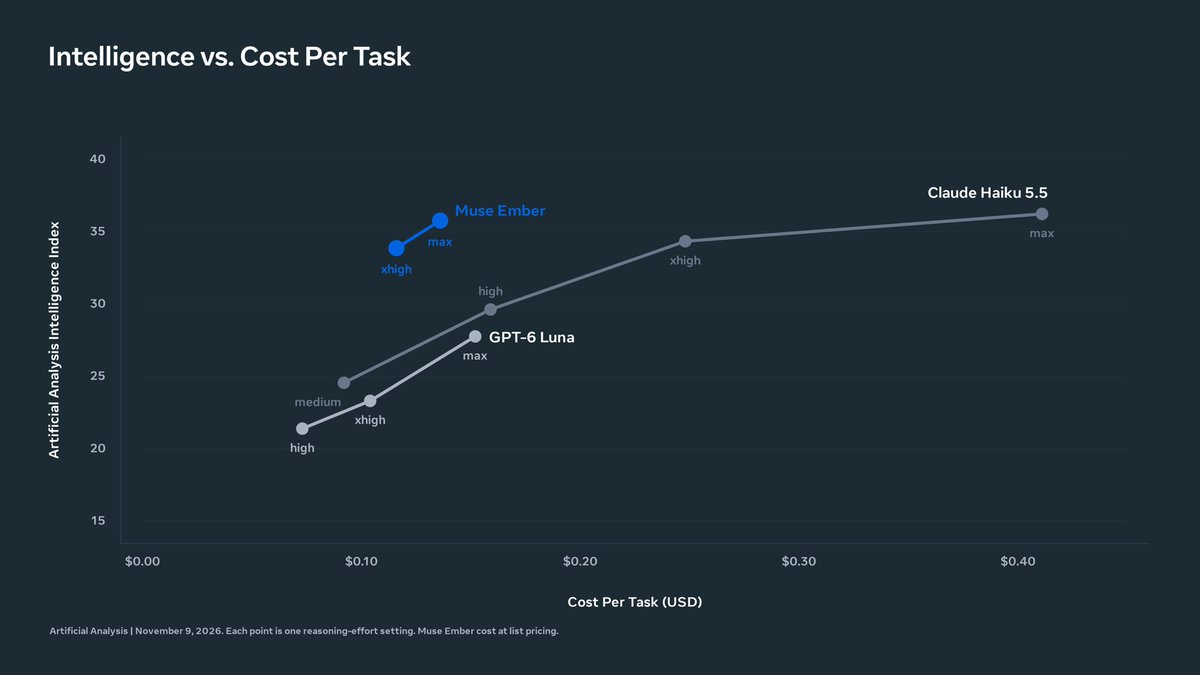
1/ announcing our smallest, most efficient little model is here: muse ember 🔥
built for work that agents repeat all day, it gets you more intelligence per dollar than Haiku, Luna, and all other flash models at any reasoning setting and does it at a third of the cost or less!