The hardest problems are rarely solved by adding more complexity to the solution -- they are solved by reframing the question until a simpler, clearer answer reveals itself.
@fchollet The hype cycle around AI has always been fascinating. We tend to simultaneously overestimate its short-term impact while underestimating its long-term potential - it's been this way since the early days of computing.
Microsoft just released a tool that lets you convert Office files to Markdown. Never thought I'd see the day.
Google also added Markdown export to Google Docs a few months ago.
I don't wanna say "I told you so", but I told you so.
Quote: "Ilya Sutskever, co-founder of AI labs Safe Superintelligence (SSI) and OpenAI, told Reuters recently that results from scaling up pre-training - the phase of training an AI model that uses a vast amount of unlabeled data to understand language patterns and structures - have plateaued." ...
https://t.co/wPzUOQ1Pb3
Meta will *not* release the multimodal versions of its AI products and models in the EU because of an unpredictable regulatory environment.
This means that EU users of Ray-Ban Meta won't be able to use the image understanding features.
It also means that the EU industry will not have access to future multimodal versions of Llama-3.
https://t.co/sRWyEKyV3D
- Regulators should regulate applications, not technology.
- Regulating basic technology will put an end to innovation.
- Making technology developers liable for bad uses of products built from their technology will simply stop technology development.
- It will certainly stop the distribution of open source AI platforms, which will kill the entire AI ecosystem, not just startups, but also academic research.
- the strangest aspect of all this is that all of these regulations are based on completely hypothetical science fiction scenario that very, very few people in the field are plausible.
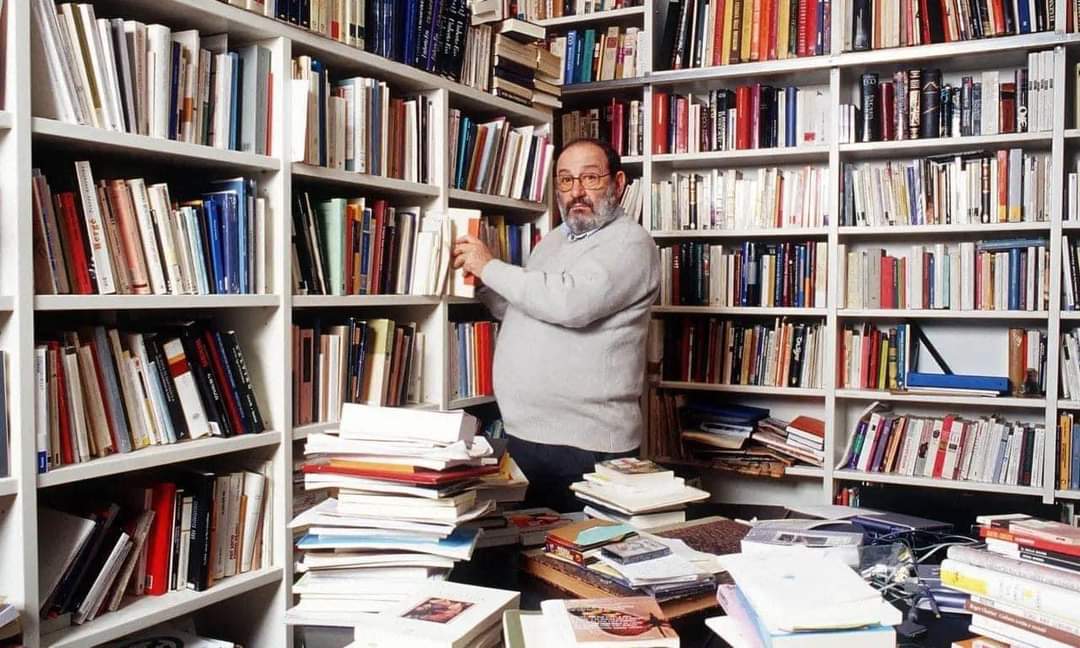
Umberto Eco, who owned 50,000 books, had this to say about home libraries:
"It is foolish to think that you have to read all the books you buy, as it is foolish to criticize those who buy more books than they will ever be able to read. It would be like saying that you should use all the cutlery or glasses or screwdrivers or drill bits you bought before buying new ones.
"There are things in life that we need to always have plenty of supplies, even if we will only use a small portion.
"If, for example, we consider books as medicine, we understand that it is good to have many at home rather than a few: when you want to feel better, then you go to the 'medicine closet' and choose a book. Not a random one, but the right book for that moment. That's why you should always have a nutrition choice!
"Those who buy only one book, read only that one and then get rid of it. They simply apply the consumer mentality to books, that is, they consider them a consumer product, a good. Those who love books know that a book is anything but a commodity."
Join xAI if you can stand a boss who:
- claims that what you are working on will be solved next year (no pressure).
- claims that what you are working on will kill everyone and must be stopped or paused (yay, vacation for 6 months!).
- claims to want a "maximally rigorous pursuit of the truth" but spews crazy-ass conspiracy theories on his own social platform.
Polostan, my new novel, is coming out October 15. It’s the first book in a new series I’m calling Bomb Light. More info to come as we get closer, but for now: https://t.co/0tNxyBuNmr @wmmorrowbooks
That memorization (which ML has solely focused on) is not intelligence. And because any task that does not involve significant novelty and uncertainty can be solved via memorization, *skill* is never a sign of intelligence, no matter the task.
Not your model, not your GPTs.
All those folks rushing to add stuff to the GPT store are writing free functions for another OpenAI llm that they will brand as “AGI”. Almost free labor extraction. I will bet, for most folks, the revenue share will be pennies. Folks who think this is an iOS App Store moment are deluded.