CISA’s BOD 26-04 changes how federal agencies decide what to patch first, and it takes effect December 7. A CVSS score no longer sets the order. Agencies now have to rank vulnerabilities by four questions: is the asset exposed, is the flaw being exploited, can it be exploited automatically, and how much control does it give an attacker. The riskiest ones have to be fixed within three days.
The directive also covers the cloud services agencies rely on, and FedRAMP is requiring providers to adopt matching vulnerability rules by the same date, so provider findings and the agency’s own findings run on the same clock.
Most agencies can’t rank risk that way today because the context lives in different places. The asset inventory has gaps, scan results come with a severity score and not much else, and nobody can quickly say which mission service a vulnerable server keeps running.
At C1Secure, we help agencies close that gap in @ServiceNow. Armis finds every asset, including the ones that never made it into the CMDB, and VIPR ranks findings by attack path and by where the asset sits in the environment. Extending the CMDB to CSDM ties each asset to the mission service it supports, so teams know which fixes matter most. ServiceNow USEM then tracks every fix against its 26-04 deadline, alongside the provider reports coming in through C1 Trust Exchange.
If your agency is working through BOD 26-04, comment for a free BOD 26-04 Readiness Review.
#ServiceNow #C1Secure #BOD2604 #Armis #FedRAMP #VulnerabilityManagement #Cybersecurity
If you sell a FedRAMP cloud service to more than one agency, you know the routine. Every agency asks for your security package, someone on your team pulls files together from several tools, and by the time it’s emailed, it’s already out of date.
FedRAMP’s new rules are ending that routine. Agencies are now expected to review your security record live from your own trust center instead of waiting on files.
The C1 Federal Trust Center gives you that in one place. Your evidence and controls flow in from the tools you already use, and every agency sees the same current record. They can review it in a portal, download the full package, or pull it straight into their own systems. Your team stops answering the same request over and over, and agencies stop working from stale files.
The trust center doesn’t need its own FedRAMP authorization, and if you want, we’ll run it for you as a managed service.
If your team is still emailing packages to agencies, comment for a free consultation.
#FedRAMP #CR26 #TrustCenter #CloudSecurity #ServiceNow #C1Secure
A question we keep hearing from FedRAMP providers: do we need to move to 20x?
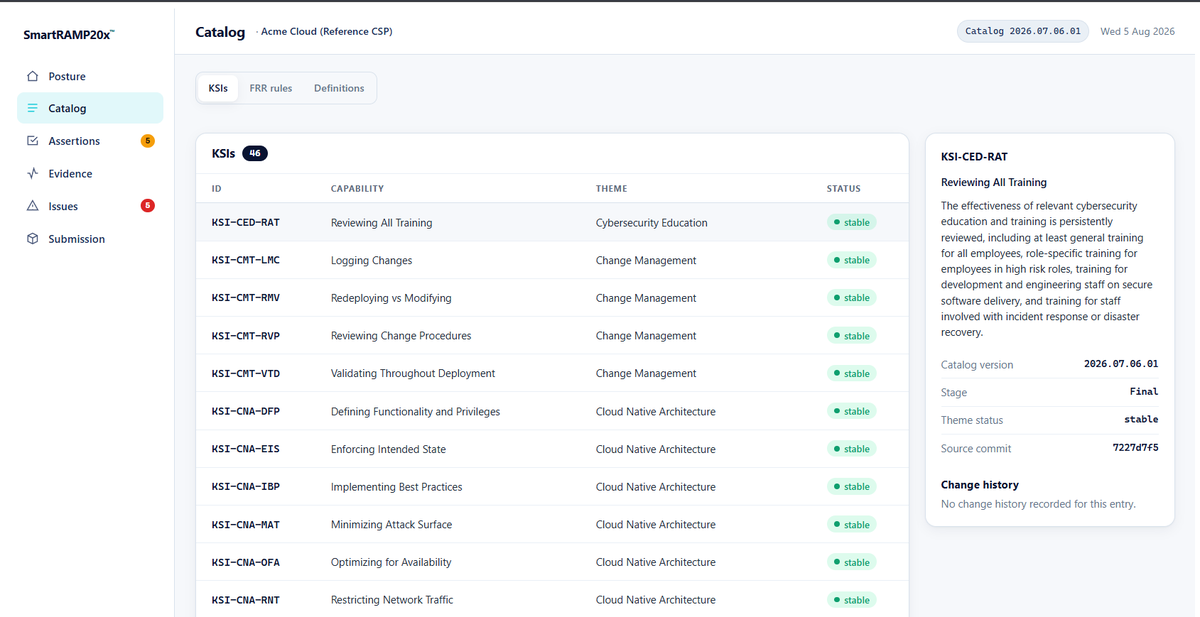
For most Rev5 providers, the answer is not yet... but the clock is ticking. 20x is one of two tracks inside FedRAMP’s new CR26 rules, and most of the rules are the same on both. The difference is how you prove security. Rev5 uses NIST controls, while 20x uses 46 Key Security Indicators that are mostly checked automatically.
FedRAMP®’s Director has said Rev5 will be around through at least 2028, and the path from one track to the other hasn’t been written yet. So for the next few weeks, the priority is getting December 7 right on the track you’re already on. 20x can come on your own timeline.
We run both solutions: C1 SmartDACM handles Rev5 and SmartRAMP 20x handles 20x, with one C1 Federal Trust Center publishing either kind of package.
If you’re deciding which track fits your next package, comment below for a free consultation.
#FedRAMP #FedRAMP20x #CR26 #ServiceNow #CloudSecurity #C1Secure
The Department of Defense suspended CMMC Phase 2 in July, and in September a class deviation removed third-party assessment requirements from contract clauses. While that pauses third-party certification, the requirements underneath it haven’t changed.
NIST SP 800-171 is still a contract requirement, and contractors still submit and maintain their self-assessment scores in SPRS. With no assessor reviewing those scores, the False Claims Act has become the main way they get enforced.
Last week, the Department of Justice announced a $13 million settlement with a defense and aerospace contractor over allegations that it billed the Army, the Missile Defense Agency, and NASA without meeting the cybersecurity requirements in its contracts. According to DOJ, the company didn’t have a current 800-171 assessment on file with DoD and stored CUI with a cloud provider that didn’t meet required security standards. The case was filed by the company’s former Director of Cybersecurity.
If it’s been a while since your last SPRS submission, now is a good time to confirm your system security plan and POA&M still reflect how your environment runs today. At C1Secure, we help defense contractors do that and keep it current as part of a continuous compliance program.
If you’d like a second set of eyes on where your program stands, reach out to Will Thomson or Maggie Davis.
#CMMC #NIST800171 #DefenseIndustrialBase #Compliance #Cybersecurity #C1Secure
Most of the CR26 conversation so far has been about cloud providers: what they publish, in what format, and by when. Agencies have gotten much less guidance, even though the new rules land on them too.
FedRAMP’s new vulnerability rules (VDR/VER) take effect December 7, a date tied to CISA’s BOD 26-04. FedRAMP is giving providers time to finish adopting them, but FedRAMP’s grace period isn’t an agency’s grace period. Each agency still decides what it will accept from the providers it relies on.
Under the new rules, a provider can accept a vulnerability on its own, with no agency approval. The agency sees that in the provider’s reports and decides how to respond, including whether to keep using the service. For an agency that relies on dozens of providers, those decisions arrive constantly and on different schedules.
Here’s the plan we’re recommending to agencies:
1. Inventory: list the FedRAMP providers you rely on and what you need from each.
2. Connect: bring provider packages and reports into @ServiceNow CAM or the GRC tool you already run.
3. Monitor: score each provider and flag what changed, what’s missing, and what’s been accepted.
4. Act: review provider reports and decide your response in your own workflows.
C1 Trust Exchange is built to run this plan, and our team helps you get it set up. We’ve run FedRAMP and DoD programs for cloud providers and kept building as CR26 and 20x changed the rules, so we know what’s coming through those feeds.
If your agency is working out its CR26 plan, set up a free consultation with Will Thomson or Maggie Davis.
#FedRAMP #CR26 #BOD2604 #GovTech #ServiceNow #C1Secure
ServiceNow surveyed more than 3,700 security leaders for its State of Agentic Security 2026 report, and 29 percent said they found AI agents running in production this past year that they didn't know existed. Only 34 percent register new agents automatically.
The risk with an agent mostly comes down to the identity it acts under. Every agent runs as either the person who invoked it or a service account set up for it. Without a rule for how those identities get created and owned, organizations end up with several agents sharing one account, and nobody can say which one did what or who's responsible for it.
Governing that takes a few pieces working together on @ServiceNow. The use case gets approved first in the Super Intelligence Control Tower (formerly AI Control Tower), aligned with Enterprise Architecture, which records what the agent is for, who owns it, and which systems it touches. The identity it runs under then gets onboarded like any other account, with a named owner, only the roles the work requires, a way to shut it off without disrupting anything else, and a review cycle until it's retired. ServiceNow's newly announced AI Passport carries the approved scope into runtime, so the agent is checked against it while it works. Veza shows what each identity can actually reach, so access that drifts past what was approved gets caught.
The onboarding step is where C1Secure's SmartOnboarding fits. It uses the same role-based model we already use to onboard people: the identity gets a role, the role is approved for specific systems, and checklist items carry the requirements. With all of it in place, you can answer a question most organizations can't today: what AI is touching this system, under which accounts, and who owns them?
If you're working through how to govern the agents already running in your environment, reach out to Will Thomson or Maggie Davis to set up a free consultation.
#ServiceNow #C1Secure #AIGovernance #AgenticAI #IdentitySecurity #Cybersecurity
What a week at ServiceNow Nexus Security & Risk.
Risk, security, and AI are no longer separate problems. Until recently they sat with separate teams, and this week they became one conversation. ServiceNow's direction is clearly built around bringing them together, and it's an exciting time to be doing this work on the platform. The organizations that run risk, security, and AI as one program will be the ones that can move fast with AI and still stay in control.
Thank you to @ServiceNow and the product management team for putting on such a well-run event, and to everyone who stopped by our booth. A special thanks to everyone who came out for our session with Tom Thomson and Charlie Benting, "From Compliance Debt to 'Attest Once, Apply Many': An IRM Maturity Journey with ServiceNow." The turnout was fantastic.
We're leaving Santa Clara more excited than ever about the future of risk and security on ServiceNow, and proud to be part of it. If you missed us at Nexus and want to keep the conversation going, reach out to Will Thomson or Maggie Davis.
#ServiceNow #C1Secure #ServiceNowNexus #AIGovernance #Cybersecurity #RiskManagement
Nexus is next week and we can't wait to get to Santa Clara! Find the C1Secure team at Booth 4 at ServiceNow Nexus for Security and Risk, October 13 to 15.
We'll be talking with security, risk, and compliance leaders about how they're running their programs on ServiceNow, from Integrated Risk Management and Security Operations to AI Control Tower. Everyone on our team has run these programs themselves, through managed services for federal customers, implementation and consulting, and the SmartApps we build on the platform.
Want to lock in time? Message Will Thomson or Maggie Davis, or just swing by. See you there!
#ServiceNow #C1Secure #Cybersecurity #RiskManagement #AIGovernance #Compliance #Nexus
Everyone wants to move faster on AI, but do you actually know what's already running in your environment, or what it has access to?
For most teams the honest answer is no, largely because the data AI depends on is messy and unstructured to begin with. Once that's cleaned up, @ServiceNow brings it together with Armis for visibility into every asset and exposure, Veza for who and what has access to what, and AI Control Tower for finding and governing every model and agent. That puts your security, risk, and compliance teams on the same picture instead of separate spreadsheets.
We wrote about it in a new eBook with CIO Online and @WeUseServiceNow. Give it a read: https://t.co/bkZp9oBOVQ
#ServiceNow #C1Secure #AIGovernance #Cybersecurity #RiskManagement #Compliance
For most organizations, compliance is the last stop before a deal closes. Too often, that's also where deals stall.
Tom Thomson's Knowledge 2026 conversation with Elisha Harrington is now featured on Workflow, ServiceNow's editorial site, alongside a new article from Elisha and John Licata on how leaders are turning risk signals into faster action. Both make the case that compliance can work for the business instead of against it.
"With the right approach, you can turn the compliance function into the wind at a business's back instead of being a barrier to accelerated growth." – Tom Thomson
When governance is built into the work people already do, every cycle makes the next one faster. Evidence is captured as the work happens, control patterns carry over to new systems, and the compliance team spends less time waiting on answers and more time helping the business move.
In the session, Tom walks through a government contractor managing CMMC across more than a thousand systems, where we brought a 50-day attestation cycle down to five. The bigger result came after, when compliance went from slowing new business down to helping win it.
He also gets into AI governance, and how IRM, SecOps, AI Control Tower, Armis, and Veza working together on one platform give organizations clear visibility into their AI, their assets, and every identity with access to them.
Thank you to ServiceNow, Elisha Harrington, John Licata, and Matt Tobin for featuring our work.
If you're looking to make compliance an advantage for your business, reach out to Will Thomson or Maggie Davis.
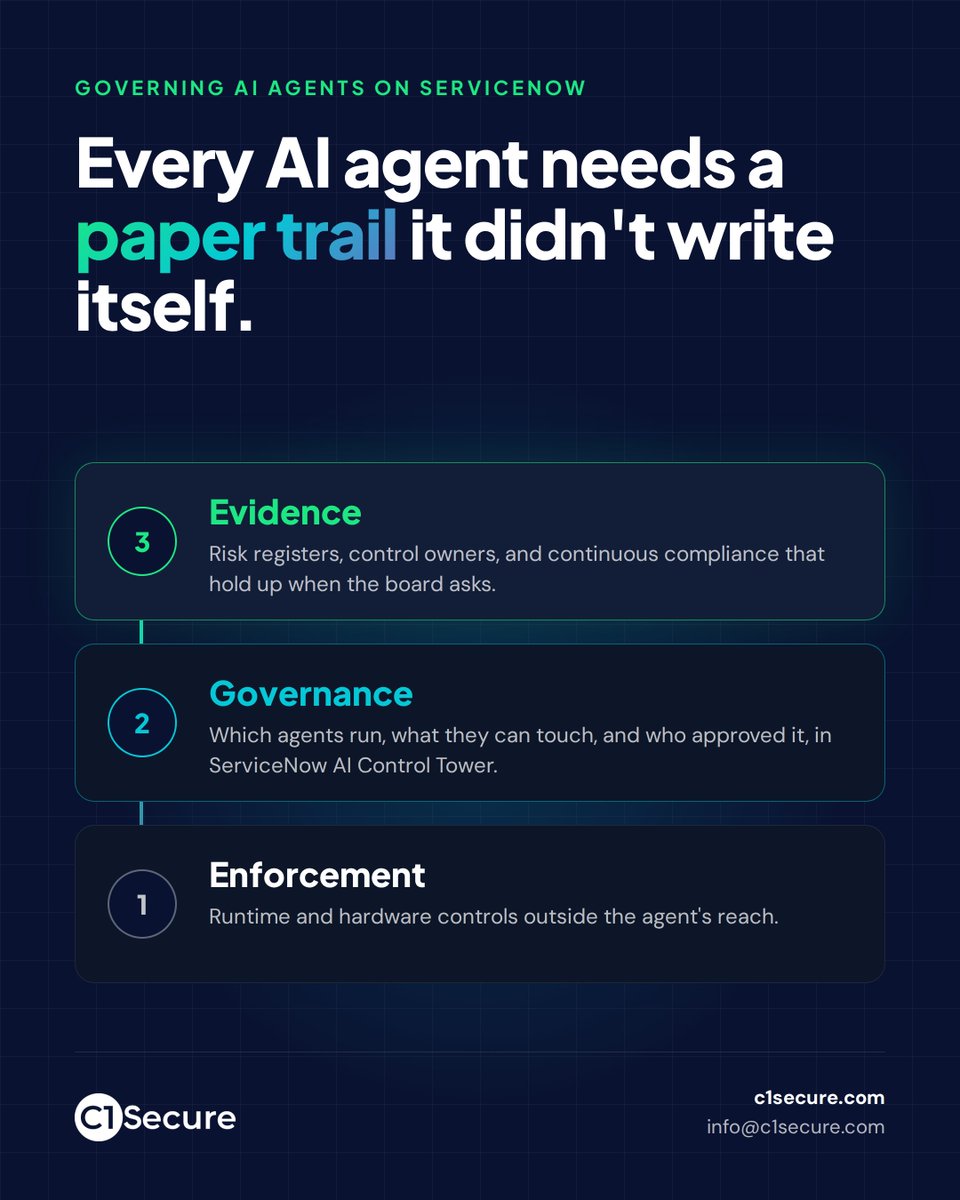
Every AI agent in your enterprise needs a paper trail it didn't write itself.
This week @nvidia launched the Open Agent Safety Platform with more than 100 partners, including @ServiceNow . The principle behind it is one security teams already live by: don't ask the system being watched to watch itself. Controls sit outside the agent, at the runtime and in the hardware, where the agent can't reach them.
That's a big step for the whole ecosystem, and it brings the next set of questions to the business. Which agents are running? Who approved what they can touch? When an agent changes a firewall rule or onboards a supplier, who signed off, and where's the record?
That's the layer ServiceNow AI Control Tower and IRM are built for, and it's where we spend our days. We run risk, security, and compliance programs on ServiceNow, from commercial IRM implementations to managed services in the Government Community Cloud. The lesson from every one of those programs applies to agents too: a control only counts if you can prove it. That means tying agent activity to risk registers, control owners, and continuous compliance evidence that holds up when an auditor or board asks.
If you're working through how to govern agents across your enterprise, reach out to Will Thomson or Maggie Davis.
#ServiceNow #C1Secure #AIGovernance #AgenticAI #AIControlTower #Cybersecurity #ContinuousCompliance #NVIDIA
We built the full path for FedRAMP on @ServiceNow: earning certification, holding it continuously, and proving it to agencies in real time.
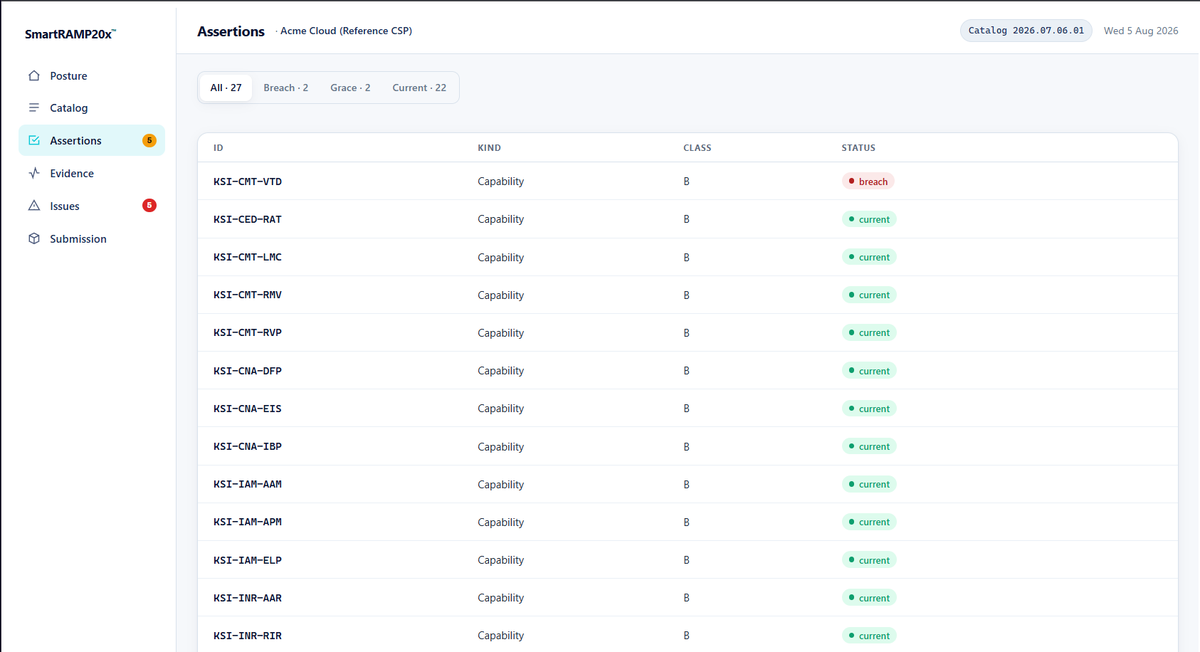
SmartRAMP 20x runs the 20x path on FedRAMP's own published structure. Key Security Indicators, rules, and definitions land as what they are. When FedRAMP changes something, it shows up as a flagged difference already mapped to what it touches. No rebuild, no scramble, no finding out during assessment.
SmartDACM runs Rev5 on the same foundation, with years of authorizations behind it. It carries Rev5, GovRAMP, DoD RMF, and CMMC programs from first authorization through everything that comes after: SSP development 40-60% faster, evidence collection 50-70% faster, and ATO timelines cut from months to weeks. Authorization, inventory, controls, policies, and vulnerabilities stop being a folder of files and start generating the package themselves. One program, both paths, one source of truth.
C1 Federal Trust Center is what agencies see. FedRAMP is retiring the repository they used to pull packages from, which means every provider now serves its own data, continuously, with no approval queue and no NDA in the way. The Trust Center does it from inside the provider's own ServiceNow instance. Nothing leaves the tenant. Agencies get live posture the moment they ask.
No trust center, no certification. That is the new floor.
Built on ServiceNow, in the government community cloud, by a team that has run these programs for years.
Comment below for a free consultation on your FedRAMP program.
#FedRAMP #CR26 #CloudSecurity #ContinuousCompliance #ServiceNow #C1Secure
The conversation about AI risk has gotten serious, and it is coming from people close to the technology.
Every serious answer to risk starts the same way. You have to know what is there, know what it can reach, and be able to prove what it did. That is true at the frontier and it is true inside a single company running AI in production.
Most organizations are not there yet. AI is deployed across the business faster than anyone can account for it, and the basic questions take a scramble to answer. Nobody can say with confidence which systems are running, what data and infrastructure they touch, or who signed off on any of it.
Control is not a brake on adoption. It is the thing that makes adoption defensible.
The pieces are coming together on @ServiceNow. Armis surfaces what is actually in the environment rather than what the asset inventory claims. Veza shows what those systems and identities can reach. AI Control Tower gives organizations one place to see AI across the enterprise and govern it under policy. We build on that to carry it into continuous assurance, so what is running and under what controls stays evidenced as systems change rather than reconstructed once a quarter.
The risk conversation will keep going. The work in front of us is the same either way.
If you are thinking through what oversight looks like in your environment, Will Thomson and Maggie Davis are the people to talk to.
#ServiceNow #C1Secure #AIGovernance #AIControlTower #ContinuousCompliance #CISO
CMMC compliance now comes with a signature, and the person signing is a named senior executive.
That affirming official has to attest in SPRS that your organization has implemented and will maintain every applicable security requirement. The official signs it when you first achieve status, again at every POA&M closeout, and every year after, and a current signature is a precondition for contract award.
When it is false, that attestation becomes a False Claims Act exposure point, and the Department of Justice is already acting on it. In fiscal year 2025, the DOJ recovered more than $52 million across nine cybersecurity-related fraud settlements, including its first enforcement action against a subcontractor. Because a new affirmation is filed every year, each one is a fresh certification to the government, and a fresh point of exposure whenever the posture behind it has slipped.
The uncomfortable question for most leaders: when your senior executive signs this year, do you actually know it matches reality?
At C1Secure, we help defense and public sector organizations run CMMC as a continuous program inside @ServiceNow, so the affirmation an executive signs reflects the controls that are actually in place.
If someone at your company is signing that affirmation, make sure it holds up. Comment below or reach out to Will Thomson or Maggie Davis for a free consultation.
#ServiceNow #C1Secure #CMMC #Cybersecurity #Compliance #FederalContracting
ServiceNow's new release of AI Control Tower is now generally available, a real step forward for seeing and controlling AI across the enterprise.
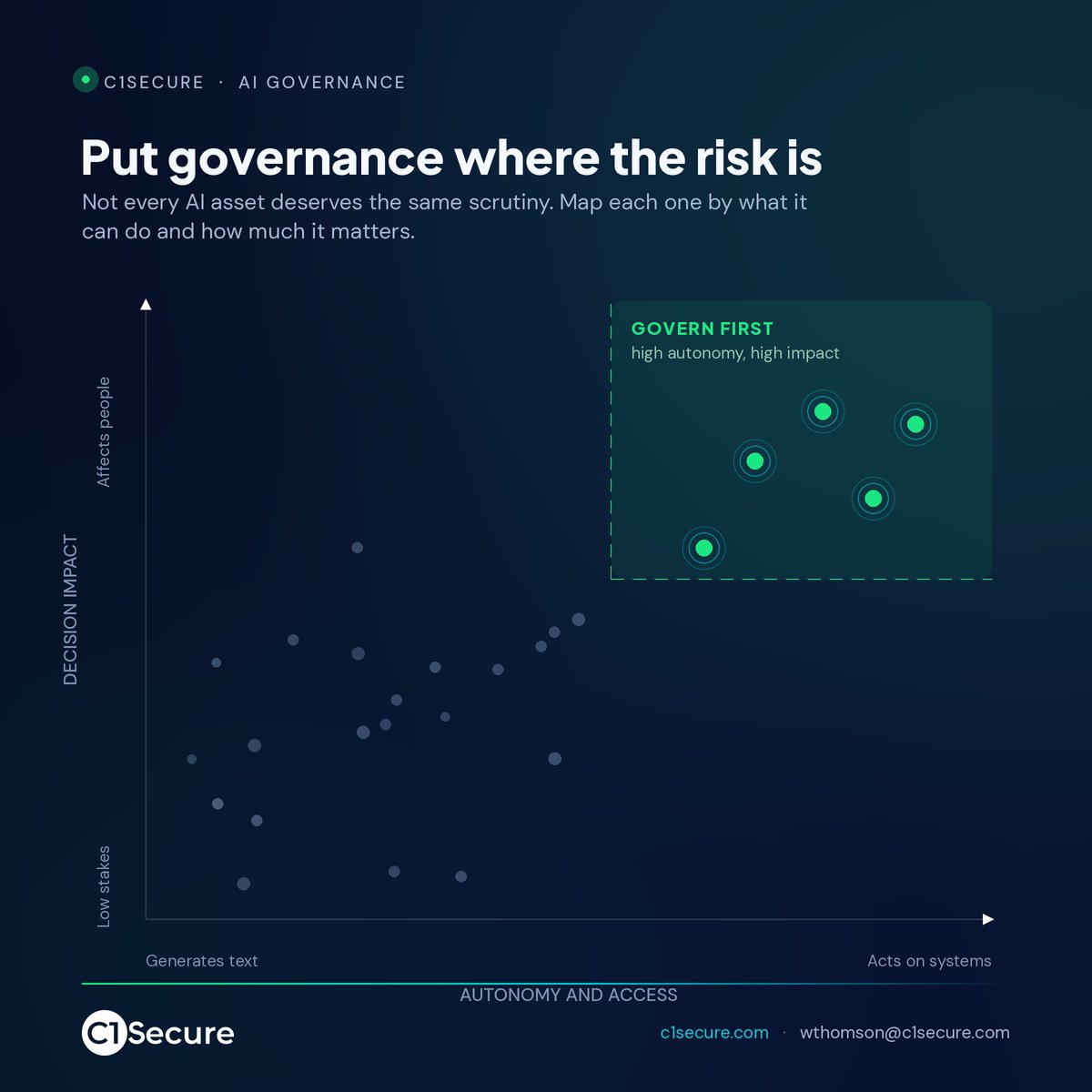
AI governance strategies are still written as if AI is something you are about to roll out and can gate on the way in. In reality, the horses are out of the barn. AI is already running across every department, put there by people who were never going to wait for a governance program to catch up.
That is a different problem than most programs were built for. The old model, where a central team assesses every system before it gets approved, moved at the speed of quarterly reviews. AI does not, and trying to inventory and assess your way to control after the fact is how good teams fall permanently behind.
The organizations getting ahead of it are changing the question from "how do we review everything" to "who owns this, and how much does it matter." They put governance where the risk is instead of spreading it evenly across everything that moves. AI Control Tower gives them the platform to see the whole footprint; governing by ownership and impact is what makes it manageable.
The new release brings a kill switch that can stop a rogue agent across environments, not just inside ServiceNow, and real-time monitoring of what your agents are doing. Strong capabilities, but they still land in an environment where AI is already everywhere, where ownership and impact decide whether you stay ahead.
We have deep experience helping organizations govern AI on @ServiceNow . If you want to talk through what that looks like in your environment, reach out to Will Thomson or Maggie Davis for a free consultation.
#ServiceNow #C1Secure #AIGovernance #Cybersecurity #Compliance #RiskManagement
Most FedRAMP CSPs are planning for a January 1, 2027 CR26 deadline. There's an earlier one they're missing.
FedRAMP aligned its new vulnerability detection and reporting rules to CISA's BOD 26-04, which pulled that piece of the compliance calendar forward by roughly six months. The real date for VDR and VER is December 7, 2026.
If your current templates only capture a CVSS score, they can't answer what the new rules actually require: is the finding internet reachable, is it in the KEV catalog, can the exploit be automated, and what does an attacker gain if it works. Four factors per finding, not one number.
The teams that get ahead of this are treating it as an evidence-structure change now, not a documentation scramble in November.
Set up a free consultation to see how @ServiceNow and C1Secure can get you compliant well ahead of the deadline.
#FedRAMP #CR26 #ServiceNow #Compliance #CyberSecurity #C1Secure
OpenAI previewed a system this week that flags AI misuse without retaining customer prompts or responses. It watches how a model is used without holding the underlying content.
Set aside which provider is ahead. The more useful signal is where AI data governance is heading.
For years, oversight and retention meant the same thing: to prove how a system was used, you kept everything. That default is breaking, and less data is only the visible part of the shift. The more important change is toward better supervision: seeing how agents and models are actually used, and catching misuse as it happens rather than reconstructing it later from a warehouse of logs that has become its own liability.
This is the problem AI Control Tower was built for. It gives you governed visibility across agents, models, and providers, without depending on any single provider's retention policy or hoarding every prompt yourself. The same principle @OpenAI is applying at the model layer, moved up to where the enterprise carries the risk.
The next frontier is proactive: not just supervising for the misuse you already know to look for, but assessing the triggers that surface it and tuning them to new use cases the enterprise has not considered yet. Misuse rarely lives in a single prompt; it emerges as a pattern across many, which is exactly what supervision at this layer is meant to catch.
From there, evidence becomes a continuous signal. Scoped to what governance requires, generated as the work happens, and turned into continuous compliance on @ServiceNow. That is what we operationalize at C1Secure.
Curious how others are seeing this. Is proactive supervision part of your AI governance model yet, or is it still retain and review after the fact?
#ServiceNow #C1Secure #AIGovernance #DataGovernance #ContinuousCompliance
Federal vulnerability management rarely lives in one place.
Host scans, application scans, container scans, and configuration compliance each produce their own findings, and every one of them has to roll up into the same FedRAMP authorization package. Most teams manage that across separate tools and spreadsheets, then burn the authorization cycle reconciling it by hand.
We built SmartDACM to close that gap on @ServiceNow. It manages Host, Application, and Container Vulnerability Response together with Configuration Compliance, so the full set of scanning disciplines a FedRAMP authorization demands runs in one system of record.
The apps are modular and independently scoped, so customers layer in only the capabilities their environment requires. Every finding, whether host, application, container, or configuration, consolidates into a single POA&M and deviation workflow following the standard SCA, AODR, and AO approval chain.
It supports FedRAMP Rev5, CR26, and DoD requirements, so teams stay in one place regardless of the authorization path.
One platform, one authorization package, and complete vulnerability and compliance coverage inside ServiceNow.
If you own a FedRAMP authorization and want to see how this runs, message Will Thomson or Maggie Davis.
#ServiceNow #C1Secure #FedRAMP #ATO #ContinuousCompliance #FederalIT
Compliance attestations are one of the slowest processes in a regulated business. For one organization managing over a thousand systems, a single attestation cycle was taking 50 days.
The holdup was the control attestation itself. Control owners had to write and map their control statements, then pass them to the compliance team to review, and that exchange ran through spreadsheets and email across dozens of systems. Every round of edits added days.
Through our SmartCompliance Suite, we built AI directly into that step on ServiceNow. It guides control owners as they draft and map their statements, checks the work in real time, and hands compliance something clean to review the first time. The back and forth that used to eat weeks mostly disappears.
That 50 day cycle now runs in five.
When attestation moves that fast, compliance stops being the thing that holds the business back and starts being something it can move with.
In his Knowledge 2026 session, our CEO Tom Thomson sat down with ServiceNow's Elisha Harrington to walk through how this played out, and where the platform is heading next.
Want the full conversation? Comment below and we'll send it your way.
#ServiceNow #Knowledge2026 #AIGovernance #RiskManagement #C1Secure #Compliance
FedRAMP 20x moved authorization from a document you submit to a state you maintain, replacing the point-in-time package reviewed once a year with continuous, machine-readable validation against a running system.
That reads clean on a slide, but keeping it green in production is the hard part.
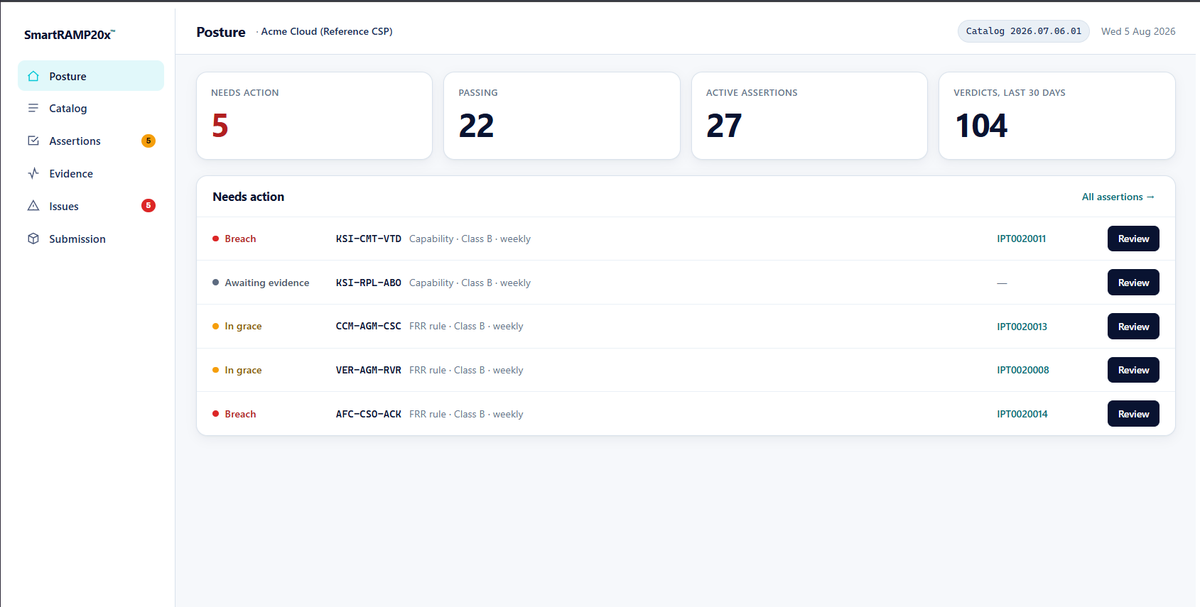
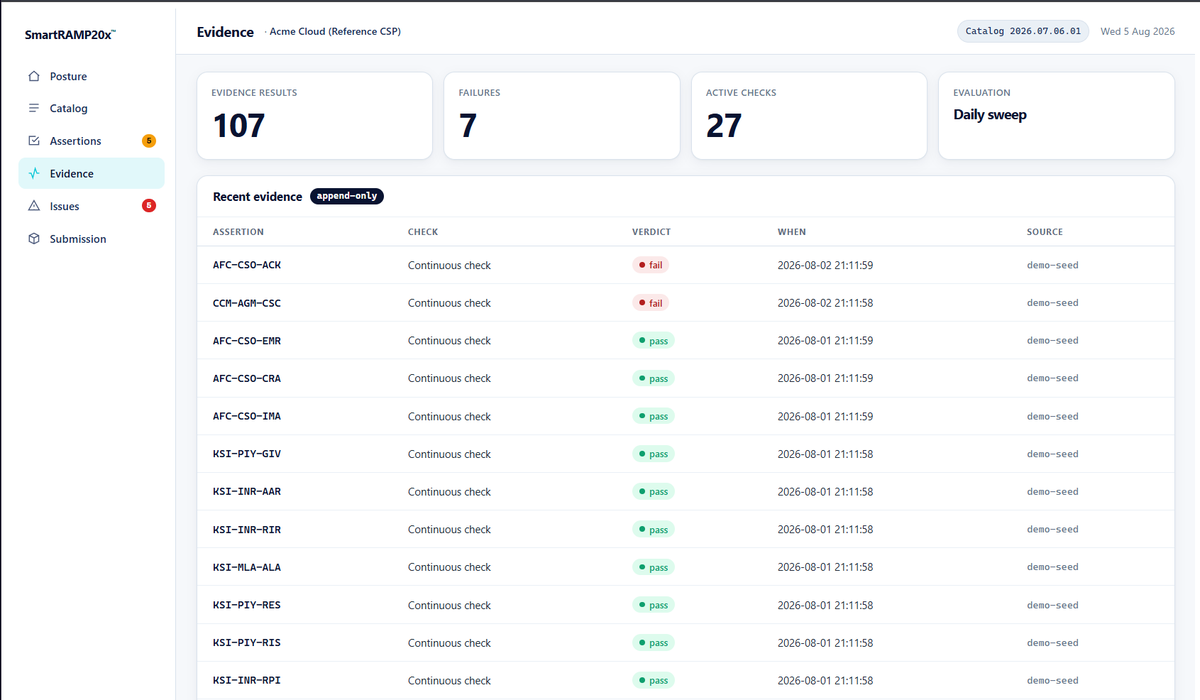
Every Key Security Indicator has to stay validated on FedRAMP's cadence. When a check fails, it surfaces as a live compliance event the moment it happens, months before your next audit would have caught it. Providers are standing up identity, logging, evidence emission, and remediation workflows from scratch to hold that line.
We built SmartRAMP 20x on @ServiceNow to hold that line on both sides. For the provider, it watches every Key Security Indicator continuously, flags a failure the moment it happens, and opens and closes the remediation work on its own as evidence changes, so authorization posture stays current without a team manually chasing it. For the authorizing agency, that same live evidence shows up in ServiceNow's continuous monitoring view, so the sponsor is looking at real-time posture instead of waiting on a point-in-time report.
Continuous compliance stops being a diagram and starts being a system you can watch.
CR26 is finalized, so this is the model both providers and agencies are now bound to, with machine-readable packages coming due at the end of September and mandatory adoption on January 1. If your team is working out how to hold continuous authorization, we would like to walk you through it.
#FedRAMP #FedRAMP20x #ServiceNow #ContinuousCompliance #C1Secure