#UoNTeach#Challenging@RowenShunmugam I find Twitter challenging as I have so much to say. Limited by 280 characters really makes you choose your words more carefu
I agree @c3281424, additionally by taking the learning outside we can provide students with learning opportunities focused around Indigenous perspectives.
Outdoor learning allows children to engage with the world around them, geographical fieldwork ensures students are outdoors engaging with their local environment (Dolan, 2015). #UoNTeach
When I started, I was hesitant how useful Twitter would be as a professional platform. 20 tweets/retweets later it has helped developed and focused my project-based assignment, while also providing quality resources to be incorporated into the project. #UoNTeach
Twitter has provided some insightful thoughts, backed up with current research into the matter of diversity (a possible focus for my project at the start). The amount of quality resources shared was quite impressive, I will need to use Twitter more in the future. #UoNTeach
I agree @AshFalconer1, learning focused around cultural diversity needs to be connected directly to students and their community. Involving community knowledge and assets provides a more relevant and meaningful learning experience.
This is a good hands on, creative approach to understanding diversity. Good find @c3253962, this activity is nice way to involve parents to share their culture with other people in a respectful way.
@cardistephen_ This does not involve other cultures however, this would be a great visual aid for students across all stages to create other ways of understanding social distancing.
@c3253962 I completely agree @c3253962, a great song promoting equality and diversity within Australian. It is a great resource to show students, making them aware that being different is something to be proud of.
A great book by Mem Fox, showcasing diversity in Australian society. Providing students an opportunity to connect to other cultures besides their own. Opening the door to discussions about 'inclusion' and the positives of having such a diverse community. #UoNTeach
Family involvement can improve a child’s development at school, working with families forms an inclusive learning environment. Cultural perspectives can then be shared and understood by everyone (Goodman & Hooks, 2016). #UoNTeach
Dolan (2015) explains learning should take place outside, utilising assets on school grounds and the local area. This way of learning supports student engagement and collaboration, as well as including cultural perspectives present in the local area. What do you think? #UoNTeach
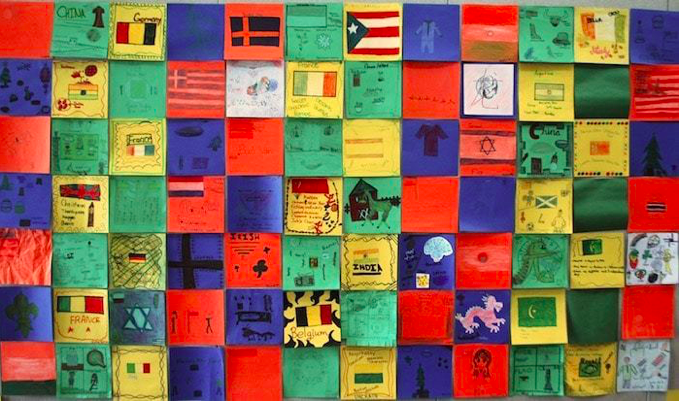
A great activity showing diversity and respect for other cultures. This could be a nice way of involving community members to share this being created.
Basically, the students create a quilt square about an aspect that relates to their family including what they celebrate, what is important to them, their values and symbols that represent them. What a great way to engage students with other cultures. #UoNTeach
Teachers need to understand how to care ‘for’ students, instead of ‘about’. All students deserve respect and involvement in the teaching and planning process. They shouldn’t be labelled based on their cultural background when they arrive at school (Vass, 2017). #UoNTeach
This is a great visual aid to assist students understand other cultures, it also provides an opportunity for self-reflection about one's own culture. Through the less visible characteristics, connections between differing cultures are made.
Teaching culture in the classroom can be quite complex. The cultural iceberg model can be used to help students gain an understanding of the visible and less visible characteristics and values of culture (Ogay & Edelmann, 2016).#UoNTeach
Cultural and linguistic diversity is a valuable resource within all schools. Through integrating culturally appropriate and ethics-based teaching approaches, teachers can improve the education of all students (Shevalier & McKenzie, 2012). What do you think? #UoNTeach
A great way to involve the local community within the classroom. Providing a genuine learning experience for all students. Following correct protocols the next step could be incorporating learnt language into their writing? #UoNTeach
One way of integrating Aboriginal education I have experienced whilst on practical placement was all students learning the local Wiradjuri language from a local community member. What are other ways we could implement this into our classrooms? #UoNTeach
Nielsen, Samuel, Wilson & Vedel (2020) express how the arts can lead to enriched learning conditions for students. Children understand more about their learning environment, thus creating opportunities to engage with other cultures and foster a sense of belonging. #UoNTeach
https://t.co/asPYl8hNFg
By incorporating the Aboriginal Eight Ways of Learning into our pedagogy, we can explore cultural diversity and identity within our classroom. More importantly it would foster a sense of respect towards cultural diversity within the classroom #UoNTeach
Just one example, how engaging and working with the local community can impact positively on the education of students from a different cultural background. It is a long video but worth a short watch at least.
Bush School https://t.co/Aj8fNnes1i via @YouTube#UoNTeach
Sharkey, Clavijo Olarte & Ramírez (2016) discuss the positive impact that community-based learning has on students. Benefits include increased student engagement and motivation to learn. Never underestimate the impact the local community can have within the classroom #UoNTeach