I’m an AI PhD at Oxford wanted to move to the US for years, but it never worked out. Maybe I can share why.
To me, it feels like the US is making it harder and harder for Chinese talent to come or stay.
First, Trump signed PP10043, which meant I couldn’t go to the US for any graduate school. That’s why I had to turn down my Stanford offer and come to Oxford.
Later, I qualified for an EB-1A (the extraordinary ability green card). But because I was born in China, I’m stuck in a country-specific backlog that could take another 4–5 years.
Meanwhile, on the other side, I’m getting 3–4 emails from China almost every week. They offer high salaries, free housing, generous research funding, and even offered an astonishing amount of money just for me to come back and have a conversation.
I’ve always loved the American spirit. I truly believe my abilities could have a bigger impact there. But honestly, the whole process has been incredibly frustrating.
All of this makes me wonder whether I should just give up.
Why am I spending so much energy trying to go to a country that doesn’t seem to want me, when another country is doing everything it can to bring me back?
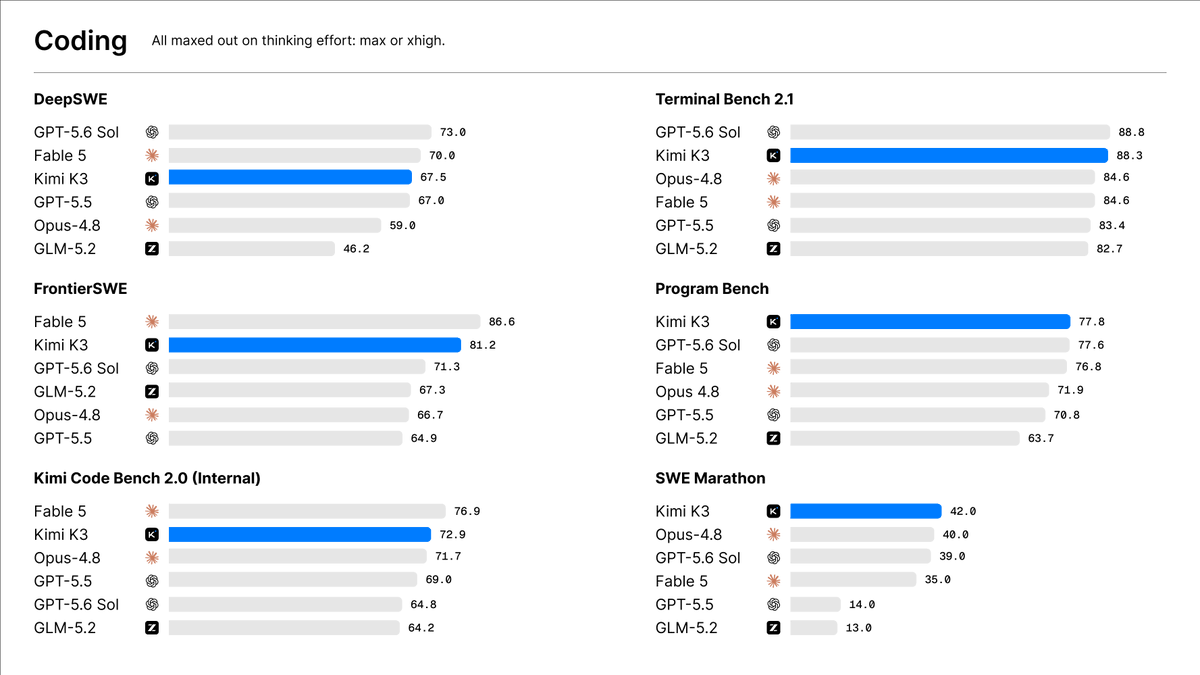
Introducing Kimi K3: Open Frontier Intelligence
🔹 2.8 Trillion Parameters, 1 Million Context, Native Multimodal
🔹 Kimi Delta Attention enables up to 6.3x faster decoding in million-token contexts
🔹 Attention Residuals deliver ~25% higher training efficiency at <2% additional cost
🔹 Built for long-horizon agentic coding and self-evolving workflows
Kimi K3 is now live on on https://t.co/zrk6zZxZUo, Kimi Work, Kimi Code, and the Kimi API.
Open Weights by July 27, 2026.
🔗 API: https://t.co/XCrgjXAqMw
🔗 Tech blog: https://t.co/YTfiMSNM1f
Today, we are introducing Inkling.
Inkling reasons efficiently across text, image, and audio modalities. We are making the full weights available.
https://t.co/Ghebq5mG30
Available today for fine-tuning on Tinker. Play with it in the Inkling Playground. 🧵
Thrilled to see Seedream 5.0 Pro debut at #2 on @arena ’s Multi-Image Edit leaderboard.
It’s especially encouraging to see the leap from #11 with Seedream 4.5 to #2 with Seedream 5.0 Pro. Independent community evaluations like Arena help push everyone to build better models.
Congratulations to the incredible research and engineering teams behind Seedream, and thank you to @arena for including us in the benchmark. Looking forward to what’s next.
Can an image be "Too Perfect"?
Creatives judged @BytePlusGlobal's Seedream 5.0 Pro blind against:
>@OpenAI's ChatGPT Images 2.0,
>@GeminiApp's Nano Banana Pro, and
>@bfl_ml's Flux 2.
It won photorealism outright.
But, it got dinged for feeling too perfect.
Some insights 🧵
We built the entire Muse-Image/Video post-training stack in just a few months, and we are amazed everyday by how well everything scales for multimodal generation, beyond language. 😎
Super grateful to work in such a talent-dense team!
https://t.co/FTUlYQgKup
Dola Seedream 5.0 Pro API is now available on BytePlus.
AI image generation is evolving beyond creating a single image.
Edit with precision. Visualize complex information. Render realistic images and portraits. Create across languages.
Create production-ready visual assets for enterprise workflows.
my paper won an award at icml 😁
some thoughts:
• this work was rejected from NeurIPS. i cleaned it up a small amount and it got great reviews from ICML! don't give up
• ICML received 24k submissions and only gives out 7 awards, which is crazy. feeling grateful
• i distinctly remember sitting at my desk two winters ago wondering if i would ever finish this project. most of all this is the product of sitting down and forcing myself to keep working for several months straight. the results emerged from running the experiments over and over and fixing a long sequence of tiny details. eventually, the curves looked like that 👇
• also happy that the insights in this paper are becoming more widely accepted: 3.3 bits/param, thinking about capacity "LLM as flashdrive" mentality
• the method here is used successfully for selecting midtraining data at least one frontier lab, which is cool!
• i am grateful to my collaborators, but Meta is no longer a great place for academic research imo and this almost never got published for a number of reasons. i shall not elaborate further
• for future work, i think analyzing the implications of on-policy algorithms on capacity, as well as LoRA and things like it, are fruitful potential research directions
• sadly i'm not in Korea but am following the conference online from california and happy to chat!
a nice end to one phase of my research career :)