@jenidesignns@mavestudiox Btw, this came out of building Helm - my open-source ops hub for indie app portfolios. Revenue, users, crashes and reviews from RevenueCat, AdMob, PostHog and Sentry in one dashboard + iOS widget:
https://t.co/TcCnqk7e4c
@Abdulmanan73396 Either way, the default is the merged feed, but the property switcher scopes everything (list, averages, distribution) to a single app when you want to focus. Same on mobile.
Every indie dev I know has 4 apps and 6 dashboards. RevenueCat here, AdMob there, Sentry somewhere else.
I built Helm: one Supabase hub pulling revenue, users, crashes and reviews into a web console + an iOS app with a home screen widget.
Open source, AGPL.
Repo: https://t.co/TcCnqk7e4c
Bring your own Supabase project: apply the migrations, deploy the edge functions, connect your sources (RevenueCat, AdMob, App Store Connect, PostHog, Sentry). Your data stays in your own instance.
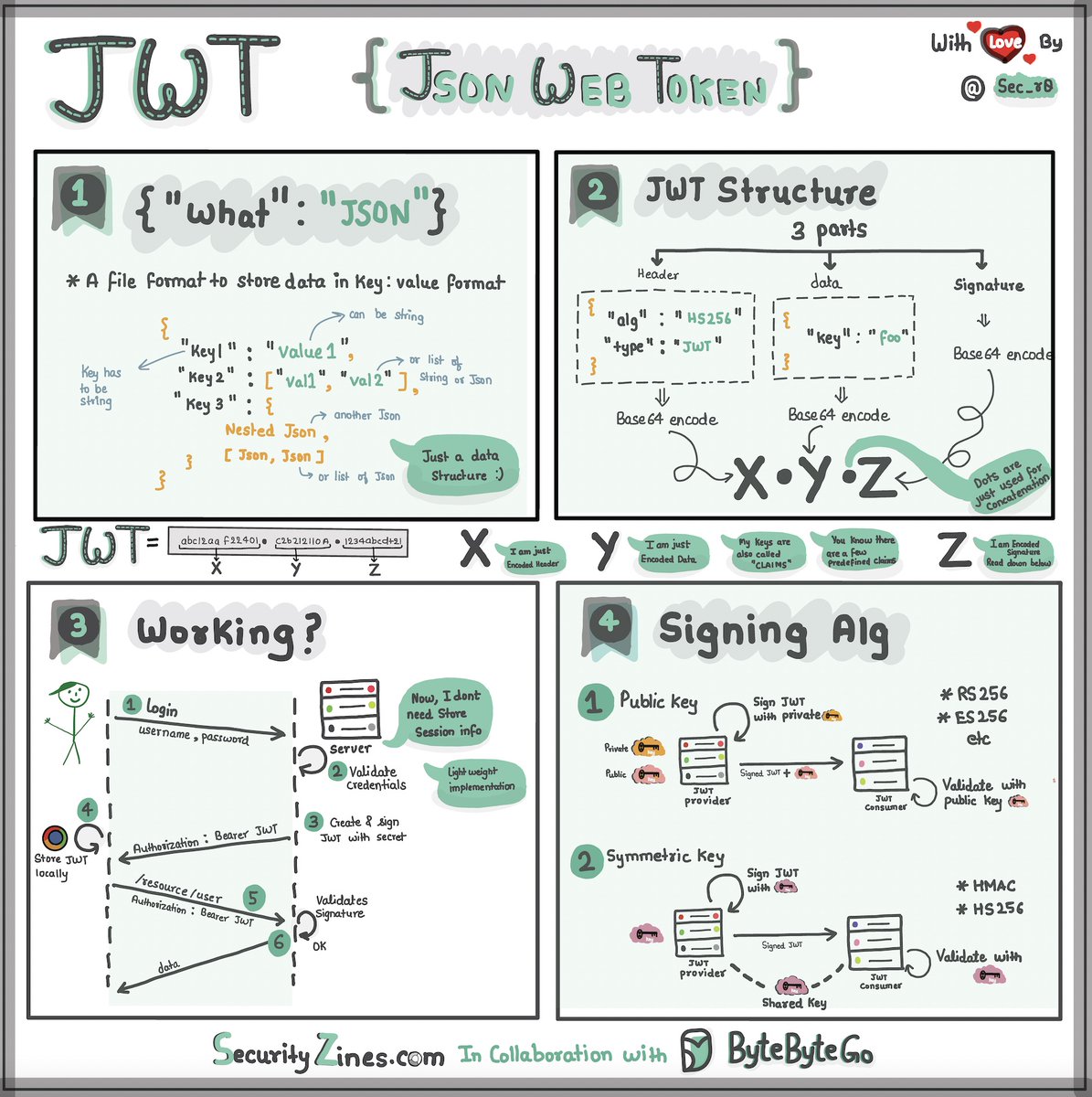
Explaining JSON Web Token (JWT) to a 10 year old Kid.
Imagine you have a special box called a JWT. Inside this box, there are three parts: a header, a payload, and a signature.
The header is like the label on the outside of the box. It tells us what type of box it is and how it's secured. It's usually written in a format called JSON, which is just a way to organize information using curly braces { } and colons : .
The payload is like the actual message or information you want to send. It could be your name, age, or any other data you want to share. It's also written in JSON format, so it's easy to understand and work with.
Now, the signature is what makes the JWT secure. It's like a special seal that only the sender knows how to create. The signature is created using a secret code, kind of like a password. This signature ensures that nobody can tamper with the contents of the JWT without the sender knowing about it.
When you want to send the JWT to a server, you put the header, payload, and signature inside the box. Then you send it over to the server. The server can easily read the header and payload to understand who you are and what you want to do.
Over to you: When should we use JWT for authentication? What are some other authentication methods?
–
Subscribe to our weekly newsletter to get a Free System Design PDF (158 pages): https://t.co/uc5M7CdXXC
Design is hard.
Here are the best design resources you should bookmark:
Logos → https://t.co/SRs7BY8mon
3dicons → https://t.co/cQ82o8VRLy
Inspiration → https://t.co/hXBjIFpHuT
Fonts → https://t.co/v1AqIHdnJD
Gradients → https://t.co/QibcyrXFD3
Illustrations → https://t.co/AAn9Kygi1I
Minimal design → https://t.co/aJPhiDf0Zw
App store design → https://t.co/7GP1o4oh5K
Apple bentos → https://t.co/6Zi8dNqNIE
Kaggle offers top-notch courses in Data Science, and surprisingly, many of us haven't heard about them.
Some of the salient features:
- No pre-requisites
- Completion time: 3 to 5 hours
- Guided projects for hands-on learning
- Comprehensive coverage of all topics
Now, let's take a look at the topics covered in these courses.
1️⃣ Python
Two courses, one for absolutes beginners & other dedicated to Python for Data Science
2️⃣ Machine Learning
Learn the core ideas in ML & build your first ML model, focused on classical Machine Learning.
3️⃣ Data Analysis
This course covers the basics of data wrangling using pandas and data visualization. It also includes short hands-on challenges.
4️⃣ Feature Engineering
Better features make better models, the course teaches you to discover how to get the most out of your data.
5️⃣ SQL Intro & Advanced
Learn the basics of SQL to work with databases & the take your SQL skills to next level in the advanced course
6️⃣ Intro to Deep Learning
Use TensorFlow and Keras to build and train neural networks for structured data.
7️⃣ Computer Vision
Learn how to build convolutional neural networks using TensorFlow and Keras.
8️⃣ Time Series
This course teaches you how to apply machine learning for real-world forecasting. Topics covered include time series data manipulation, feature engineering, and model evaluation.
9️⃣ Intro to AI Ethics
With advancing artificial intelligence (AI), it's crucial to align its design with moral and ethical principles. This course offers practical tools for morally designing AI systems.
🔟 Intro to Game AI & Reinforcement Learning
Build your own video game bots, using classic and cutting-edge algorithms.
Find all these course here: https://t.co/AjNnCQSPRi
That's all, if you’re interested in:
- Python 🐍
- ML/MLOps 🛠
- CV/NLP 🗣
- LLMs 🧠
Find me → @akshay_pachaar ✔️
Newsletter → https://t.co/Nm43nqDnpG
Everyday, I share tutorials on above topics!
Cheers!🥂
MIT university is offering FREE education in Data Science.
Courses cover:
- Python
- Data Science
- Machine Learning
- Statistics
- Linear Algebra &
- Deep Learning
Learn from the best at a free of cost!
Thread🧵👇
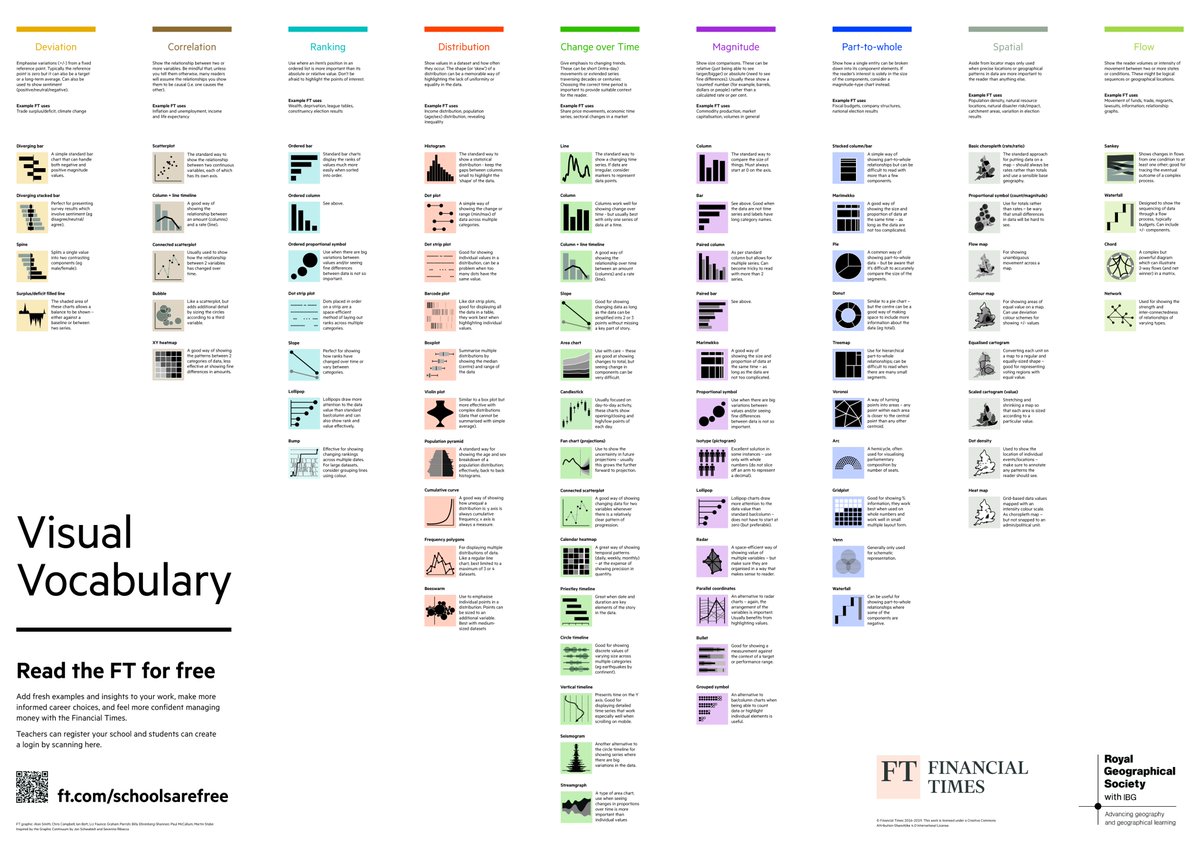
I just discovered this Financial Times Visual Vocabulary poster. This is a solid reference for any devs doing Data Visualization work.
Approaches for communicating:
🎯 Distribution
🤡 Deviation
🎭 Correlation
🚿 And even Flow
Full poster. Thanks to @AJack for showing me this.