Trading & investing. CMT + CFA survivor. Author a weekly review of QQQ on Substack, link below. Repost a lot for my own reference. Not investment advice.
It's early to be writing semiconductor's obituary. The tape just handed bulls a data point. Nearly 87% of semi names were oversold yest - one of the most sensitive triggers we track. A bounce is not a bottom, as we'll reveal in upcoming piece: "When Momentum Runs Hot". $MU $SMH
Buried in Donald Trump’s financial disclosure: Encore Capital Group.
It’s one of the largest debt collectors in America — it buys up people’s defaulted debt for pennies on the dollar, then comes after them for the full amount.
The President owns a piece of it.
He profits when Americans can’t pay their bills.
US households are sitting on a massive cash pile despite record equity exposure:
Household equity holdings are up to a record ~$72 trillion.
This is $18 trillion, or +33%, above its long-term trend from 2009 to 2019.
Household stock ownership has more than doubled since 2020.
Meanwhile, cash and cash equivalent holdings are up to $20 trillion, an all-time high.
This exceeds the long-term trend by $5 trillion, or +33%.
By comparison, households also own a record $11 trillion in debt securities such as bonds, $2.2 trillion, or +25%, above trend.
American households have never had a bigger cash buffer.
See more motivational stuff on fintwit. And the stuff that’s talked about the least is stuff that actually matters. Master classes, interviews, chart peeping, motivational folklore stuff about being in sync with the market.
Speaking from personal experience of years being bedazzled by these concepts. I have determined for myself, there’s a big unspoken sinkhole: it’s easy to confuse yourself that you’re growing as a trader because you read and re read these things.
It’s not a substitute for real work. In fact, I am now of the opinion it is a distraction, folklore, noise…
The most value add thing you can do with every min of your time is:
Define meaningful work -> do the meaningful work.
What is meaningful work in trading?
System definition and design -> this answers to you the question that what you’re doing actually has an edge. Like actually definitively does…..
not “you strongly believe it does cuz <perceived successful trader X> has a service or has done another interview lauding his performance and that’s what he did”.
And then the execution of your system day in day out.
Ed Thorpe pointed out in his 1970s book how shocked he was to discover how few people in markets or finance actually spent time researching what works….
Also, just for perspective:
Let’s pick a sample of 10k traders. Let’s slice top 1% by performance. “Fooled by randomness” is mega underrated in everyone’s mind. It’s quite difficult to accept that most of what your brain is looking at is noise. But it’s true.
In that top 1% unless the dataset is demonstrably accounting for variance eg Market Wizards with decade+ track, and non catastrophic DD…
whoever makes it in 1 year and goes on to do a string of interviews about performance, its under appreciated how much of that is pure randomness.
A specific sequence of trades which crushes a period of time but may otherwise have sub standard returns.
I am not saying it’s not useful or interesting to interview winners. It obviously is.
But what’s lacking in 98% of fintwit is some basic understanding of how much variance (colloquially, “luck” or pure randomness) plays a part in any result. The takeaways from real life is that this part is humongous.
So what is NOT NOISE in this barrage of folklore, endless trader stories and mindset pep talks:
Actual specific tactics or rules or filters or parameters/criteria for situational awareness or context that you can extract to make repeated high quality decisions in trading.
Are there specific criteria that help you profile situations better?
Unfortunately, you don’t know those criteria work. It’s not a confidence problem ok. You just don’t know what you’re doing works. It’s only normal human reaction if you get put into a situation where you’re flying by the seat of your pants, that you’ll find trading “emotional”.
The only way to know is to do comprehensive backtesting. You don’t have to measure everything but you have to track things.
“Backside, front side, confirmation”. These are just labels.
Theres also an interesting assymetry:
What’s easier? (1) or (2)
1) delude yourself into thinking you have a system because you’ve defined some concepts and “setups”. And you see supposed successful traders on fintwit using same concepts so you’re like “this is it, I’m in there”
OR
2) take months of full days work of study which requires brain power, attention to detail, meticulous cleaning and filtering of data, charts, PRs, filings, adjusting and changing…
So 2) is a road travelled by very few.
If you don’t have specific reference points and rules with a historic study of specific parameters actually working, no amount of swing trader masterclasses is going to help.
In a way it’s a dead end beyond a certain point of usefulness.
The rubicon is deep work and practice. It awaits for you and me and all of us every day if you already started, and if you haven’t - it awaits any day you finally decide to take a true path to mastery.
Peter Lynch had a simple way to spot opportunity:
“A quick way to tell if a stock is overpriced is to compare the price line to the earnings line... the chances are you’d do pretty well.”
Well, let's try that.
1. Microsoft - $MSFT In 12 months...
Price line: -23.5%
Earnings line: +29.8%
TRUMP FAMILY FORTUNE HIT AS DONALD TRUMP’S SON’S BITCOIN BET WIPES OUT $600 MILLION
Donald Trump’s son reportedly lost around $600 million from the family’s fortune following a major bet on Bitcoin. The reported loss underscores the volatility of large, concentrated cryptocurrency investments, though it has no direct impact on the broader crypto market or listed companies.
Fed raising interest rates, low priced lottery tickets kind of stocks making triple digit moves in few days, long running momentum leaders having 3 plus volume breakdowns, lots of IPOs of non profitable companies flooding the market.
Breadth-based signals do not work for finding tops. Tops are a very long process; the market can keep going up with fewer and fewer stocks participating in a rally and sector rotation for a long time. Breadth is only good for finding bottoms, as it reacts best to extreme breadth signals.
The VIX sits at 15 while everyone is fully invested. Now look at the seasonal map: volatility bottoms in July, then climbs relentlessly into an October peak. Twenty years of data, same rhythm.
Cheap insurance and a calendar that says the storm season starts now.
Nobody buys umbrellas in the sunshine. That's why they're cheap.
H/t @Mr_Derivatives
One of the biggest hurdles for me early in my trading career was "trying to be right". It took me YEARS to stop trying to be right.
When I first started trading, I thought success meant predicting the market correctly.
If I was right, I won.
If I was wrong, I lost.
That mindset shaped almost everything I did.
I'd hold losers a little too long because I wanted the market to prove me right.
I'd take profits too early because I was afraid they'd disappear.
Every trade became a test of whether I was "right" instead of whether I had managed it well.
Eventually I realized something.
The best traders I knew didn't really care about "being right."
They were obsessed with making good decisions!
They knew a great trade could lose money.
They knew a poor trade could make money.
Their confidence didn't come from predicting the future.
It came from trusting their process.
When it finally clicked, it changed the way I looked at trading forever.
Today, I track my batting average, but I don't judge myself by how often I'm right.
I judge myself by whether I followed my process, managed my risk, and made a quality decision.
Ironically, once I stopped trying so hard to be right...
My trading started getting a whole lot better.
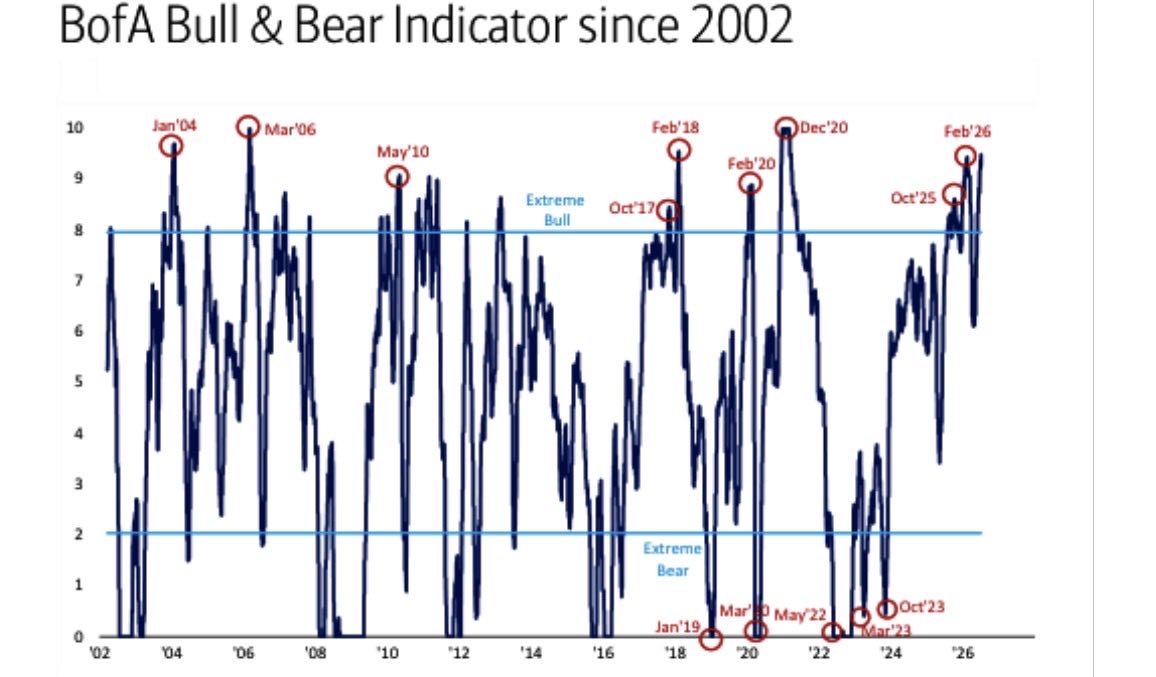
Bank of America Bull/Bear Indicator
Now back to extremes. We are now higher than at our last February peak before our March correction.
Have a Fantastic Friday! 😊
Source: BofA Global Research