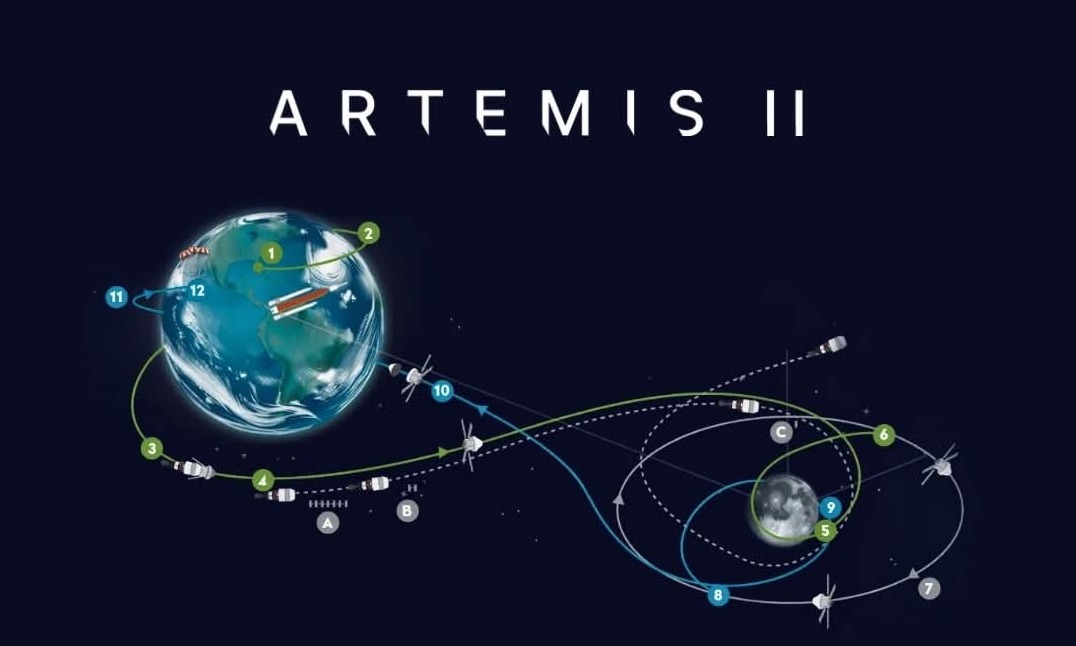
On February 6th, the Artemis II mission will launch. But the most interesting part isn't the rocket; it's the path it takes.
In orbital mechanics, this is called a Free Return Trajectory.
Navigating to the Moon isn't just about pointing and shooting. The launch window is calculated precisely so that the spacecraft enters a specific Figure-8 loop.
Here is the physics:
The spacecraft will use the Moon’s own gravity to whip around the dark side. If the main engine fails completely during this maneuver, the crew is safe. The specific geometry of this path means the Moon's gravity will naturally "slingshot" the capsule back towards Earth without using a single drop of fuel.
It is the ultimate failsafe. We are using the laws of physics as a backup engine.
Sir Isaac Newton published three editions of the Principia during his lifetime (1687, 1713, and 1726). Each edition included revisions and refinements.
Book I: The Motion of Bodies
Newton introduces his Three Laws of Motion, defining how objects move under force, inertia, and reaction. Using geometric proofs, he explores motion in a vacuum, like orbits and projectiles. It’s the theoretical backbone for mechanics.
Book II: The Motion of Bodies (in Resisting Mediums)
This book examines motion through resisting mediums like air or water, testing pendulums and fluid dynamics. Newton refutes Descartes’ vortex theory, proving his laws apply to real-world conditions. It bridges theory and experiment.
Book III: The System of the World
Newton applies his Law of Universal Gravitation to explain planetary orbits, tides, and Earth’s shape. It unifies terrestrial and celestial phenomena, showing one force governs the universe. This is the cosmic payoff.
For years, Betelgeuse has been one of the most closely watched stars in the sky, not only because it’s a nearby red supergiant nearing the end of its life, but because it behaves in ways that didn’t fully add up. Astronomers have long known it pulsates with a regular brightness cycle of roughly 400 days, driven by the star’s own internal motions. But layered on top of that was a second, much slower rhythm: a mysterious variability repeating about every 2,100 days (around 5.7 years), with no clear physical cause.
Now that long-standing puzzle finally has a coherent explanation: Betelgeuse is not alone.
After nearly eight years of sustained monitoring, a team has confirmed that Betelgeuse hosts a close, hidden companion star. The key isn’t that the companion is easy to see directly, on the contrary, it’s buried inside the outer atmosphere of the supergiant, but that it leaves a detectable signature in the gas around it.
The companion, named Siwarha, orbits extremely close to Betelgeuse at roughly 2.3 stellar radii, deep within the star’s extended chromosphere. This is not a normal “binary star” setup where two stars cleanly orbit in empty space.
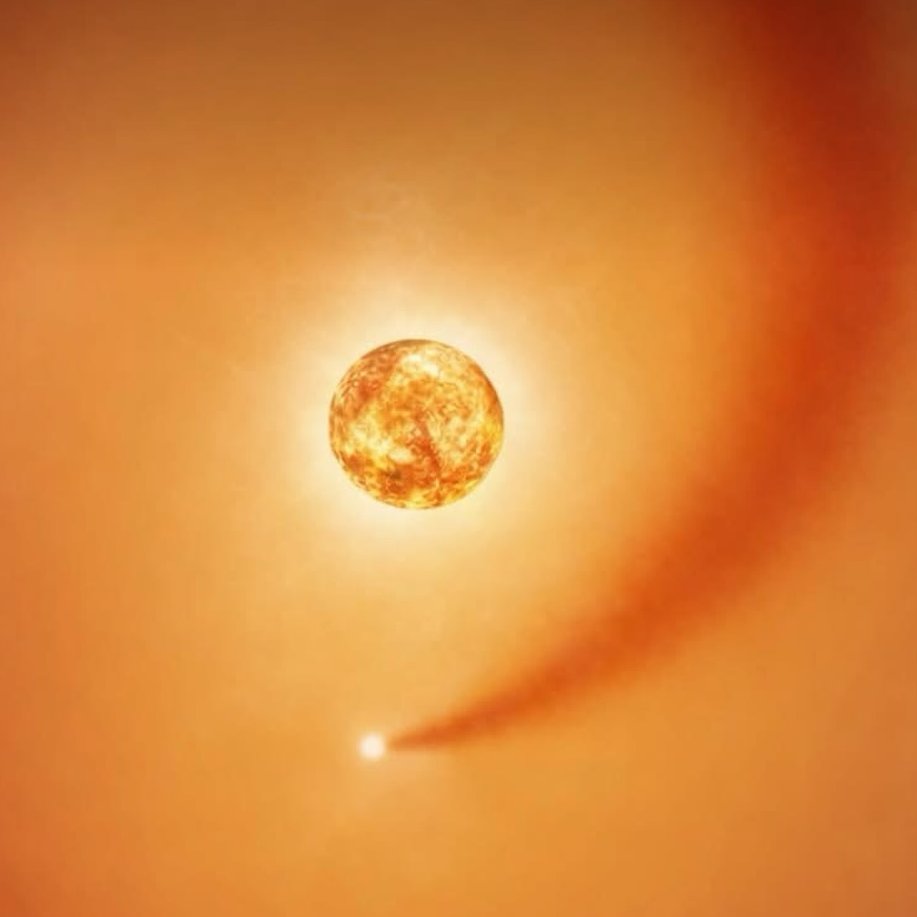
Betelgeuse has such a swollen, structured outer atmosphere that Siwarha is effectively moving through a tenuous but enormous envelope of gas. As it travels along its orbit, it generates a dense wake, a disturbed trail of material that expands and spreads, comparable to how a boat leaves a persistent pattern behind it on water.
What made this companion finally “visible” was spectroscopy rather than imaging. Using @NASAHubble, together with ground-based observations including facilities in Arizona and Spain Roque de los Muchachos Observatory @GTCtelescope, the researchers tracked subtle but repeating changes in Betelgeuse’s ultraviolet and optical spectra. The most diagnostic tracer was ultraviolet emission from ionized iron (Fe II).
Here’s the crucial pattern: when Siwarha passes in front of Betelgeuse from our point of view, the Fe II signal shows a strong blue-shifted component, indicating gas moving toward us. After the transit, the companion’s trailing wake, denser than the surrounding atmosphere, starts absorbing parts of that UV signal, producing a repeatable absorption signature. That cycle lines up beautifully with the long-period ~2,100-day variability that had resisted explanation for so long. In other words, the “mystery dimming” wasn’t just Betelgeuse being erratic; it was Betelgeuse being disturbed, periodically, by a close companion sculpting its outer atmosphere.
This matters for more than solving a curiosity. Betelgeuse is a benchmark object for understanding how massive stars shed mass in their final evolutionary stages. A companion moving through the atmosphere can change the local density, enhance outflows, and imprint structure into the circumstellar environment. And that environment is exactly what will shape the observable signals of the eventual supernova: how the shock interacts, how the early light curve behaves, and what kinds of circumstellar features appear in spectra.
The discovery of Siwarha turns Betelgeuse into something even more valuable than before: a nearby laboratory where we can watch mass-loss physics and atmospheric dynamics unfold in real time.
At the moment, Siwarha is hidden behind Betelgeuse’s disk from our line of sight, but the team expects it to become favorably observable again around August 2027, when targeted monitoring can test and refine the wake model even further.
👉 https://t.co/jHMUx9Fzhv
My friends bought 34 acres of Ohio wilderness.
While hiking one day, they stumbled upon a dark, dripping cavern—and decided to pour their life savings into it.
Today, it's one of the world's most profitable airbnbs. The waitlist is years long.
Here's the story...🧵
11 years ago #Today, @Cmdr_Hadfield recorded this marvel which remains one of the masterpieces of music and astronautics.
Entirely shot on International Space Station, he released it the day before he returned to Earth at the end of Exp. 35.
Here are a couple of closeups. I was surprised that the granularity showed this well despite the wind and high altitude turbulence. Must have had more than a few moments of steady air. I estimate the sunspot complex is over 112,000 miles long or 14 Earths!
calling a good economy bad just because a Democrat's president - by a huge margin - underscores partisan asymmetry
points to growing detachment of Republicans from reason/rationality in favor of raw partisanship as they grow more fearful of losing ground in American society
Ring galaxies are thought to form when a smaller galaxy punches through a larger galaxy at just the right angle. The beautiful ring is made of newly formed stars sparked by the gas and dust pushing outward from the collision. #MondayMotivation#CosmicCollisions
Today is our annual Day of Remembrance.
#NASARemembers the crews of Apollo 1, space shuttles Challenger and Columbia, and all members of the NASA family who lost their lives while furthering the cause of exploration and discovery. https://t.co/fR37ROiL1T
The Winter solstice is not an optimal time to image the Sun due to its low altitude in the sky. I gave it a shot because of a good "seeing" forecast for today. I was rewarded with this view of the very active Sun in h-alpha.
A weak mind must be constantly entertained and stimulated. A strong mind can occupy itself and, more important, be still and vigilant in moments that demand it.
This is John Lyke, who has a very cool niche.
He went to film school and was a pro rollerblader & snowboarder.
This venn diagram of skills makes him an expert “blade camera operator”, a job that involves filming with a $100k camera while on roller blades.
You may have caught his footage in HBO’s fictional re-telling of the 1980s LA Lakers (“Winning Time”).
The basketball scenes are lightly co-ordinated and — to keep the action as real as possible — the players just go hard for 10-15 plays in a row and they take the best footage to edit.
End result is 💯.
Saying #ISRO nailed the landing is a severe understatement!!
The Vikram Lander touched down with a vertical velocity of 0.983 m/s and a horizontal velocity of 0.053 m/s.
Faaar below the maximum 3 m/s which Vikram's landing legs were designed to withstand. #Chandrayaan3