Congratulations to the @accelerated_u team.
We share the same fundamental conviction: AI’s next frontier is not just understanding information, but understanding, simulating and ultimately helping us engineer the physical world.
Physical AI is coming.
A brand new AI startup called Accelerated Understanding just unveiled one of the most revolutionary AI architectures I've seen in a while.
@accelerated_u is building "Physical AI": not an LLM, and not a video world model. Their AI directly simulates physical systems in full 4D, 3D space + time, predicting the entire trajectory in one shot.
The numbers are absolutely insane:
• Models trained up to 1 TRILLION parameters
• Scaling experiments up to 35 TRILLION parameters
• 1T context during training
• More than 5 TRILLION context at inference
• Multiple completely different areas of physics handled by the same model
Even more interesting: the model doesn't just simulate what happens. It can provide a direction for how a design should be changed to improve the result, creating a loop of simulate → improve → simulate.
If this works as claimed, the implications for chip design, robotics, materials, weather, fusion and basically all physical engineering could be enormous.
This is AI moving beyond generating information and toward actually simulating and optimizing the physical world.
A useful principle for physical AI:
Don't ask neural networks to rediscover physics we already understand.
Encode what we know and let learning attack what we don't.
Physics-informed AI learns how cracks propagate
Yizheng Wang and coauthors introduce XDEM, the Extended Deep Energy Method, a physics-informed neural framework for fracture mechanics.
Fracture is particularly difficult for scientific ML because the solution itself contains discontinuities.
Standard physics-informed approaches often compensate by placing many collocation points around crack tips or refining the computational representation as the crack evolves. That can require precisely the prior knowledge of crack geometry that we would like the solver to avoid. XDEM incorporates the relevant physics more directly.
For discrete fracture, the neural representation explicitly includes a crack function describing displacement discontinuities and functions encoding the known asymptotic behavior near a crack tip.
For continuous fracture, the framework couples neural representations of displacement and phase fields. The consequence is that XDEM can work with uniformly distributed and relatively sparse collocation points, while covering both discrete and continuous fracture descriptions within the same general framework.
Across benchmarks involving stress-intensity factors, straight and kinked cracks, crack initiation, inclusions and more complex crack geometries, predictions closely reproduce FEM calculations and experimental crack trajectories. For many mixed-mode cases, the authors report that only a 30 × 30 uniform point distribution is sufficient for high accuracy.
There is a useful lesson here for physics-informed ML. Instead of asking a generic neural network to discover every mathematical singularity from data and a loss function, we can encode the pieces of analytical physics we already understand, and let learning handle the remaining complexity.
Paper: Wang et al., Nature Communications (2026), CC BY 4.0 | https://t.co/WdgKPIxmqr
@nanostacker That's part of what makes verification such an interesting problem. We probably can't rely on collecting enough real-world failure data so the challenge is finding better ways to generate, expose and test the edge cases before they happen in a real system.
They're great co-pilots for engineers. But the fab/factory floor & materials development require AI that understands physics & dynamics: Surrogate models, physics-informed networks & world models or digital twins that let us simulate, predict and optimize before we run wafers
@Colonthreee@CAntkow@claudeai This is the key distinction.
Approximation isn’t necessarily the problem. Deploying an approximation without a clear understanding of where it fails is.
@AnimaAnandkumar 10^7× faster is wild.
The next question is whether we can make that speed trustworthy enough to sit inside autonomous scientific and engineering loops.
This is an important direction for Physics AI.
As ML becomes more capable inside physical systems, the question can’t just be whether a model performs well.
It has to be whether its uncertainty is calibrated, whether it generalizes, how robust it is, and whether its outputs can be validated statistically.
Capability gets the attention.
Verification is what makes it usable.
Benchmarks are incredibly useful for driving progress, but eventually the evaluation has to measure the thing we actually care about.
In science, that means more than getting the right answer.
The process, the failures, the uncertainty and the ability to survive verification all matter.
As AI takes on more of the scientific process, the quality of the evaluation environment may become just as important as the capability of the agent inside it.
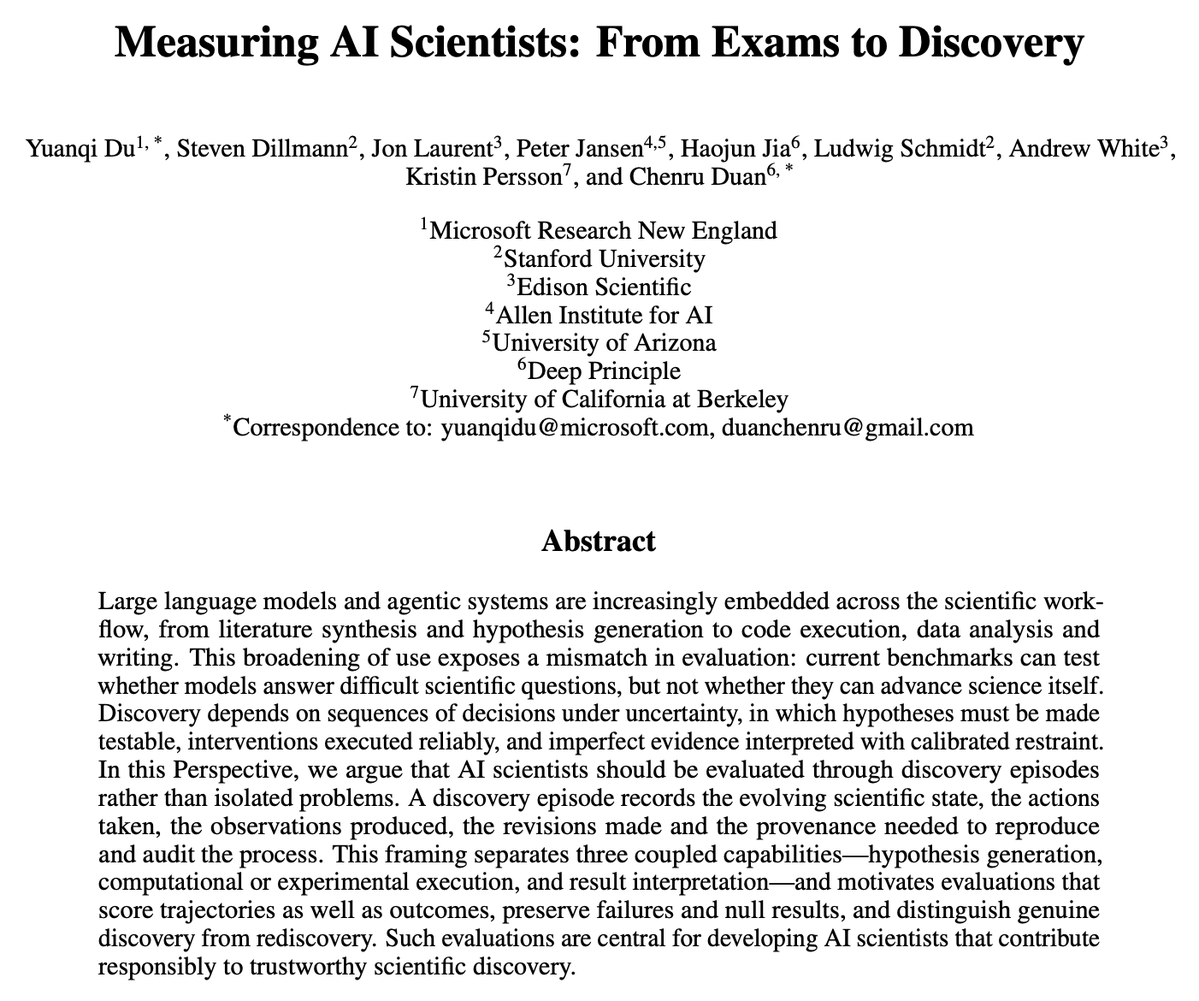
Unpopular opinion from our new paper: the benchmark leaderboard race is becoming a distraction in science. Every few months a harder exam. Every few months models saturate it. So, is AI making discoveries every week?
Answering hard questions ≠ doing science. Discovery is about reasoning and decisions under uncertainty: hypotheses that must survive verification with reality, experiments that fail, noisy data that demands calibrated restraint.
In our new Perspective, we argue AI scientists should be scored on full *discovery episodes*: state → action → observation → updated state, similar to a loop in RL. Score the trajectory, not the answer. Preserve the failures. And most importantly, separate genuine discovery from rediscovery of what's already in the training data.
Once we did that, science will be the best training environment for general intelligence. Long horizons, real tools, delayed feedback, difficult tasks, and ground truth you can't fake.
With an amazing team @YuanqiD@StevenDillmann@jonmlaurent@peterjansen_ai@HaojunJia1@lschmidt3@andrewwhite01@KPatBerkeley
More autonomy means less opportunity for a human to sanity-check every decision.
That makes trust in the models underneath these systems more important.
Physical AI will need to prove where it can and can’t be relied on.
🏢 Buildings are becoming more autonomous. #IndustrialAI is helping them anticipate change and act in real time.
But can they become more autonomous without becoming less human-centric?
What happens when you can hand a research agent a physics model it can trust without human oversight?
It can generate an idea, test it against reality, learn from the result, and try again.
Thousands of times.
There are really two different problems in Physics AI:
Discovery: Can we build a better model?
Verification: Should anyone rely on it?
We don't think the same process should answer both questions.
Better models need better ways to prove themselves.
@BioAI_NeuralNet Don’t forget Physics!
Neural operators are constrained, engineering-grade world models for a defined physics envelope. They can predict future states/reality of real physical systems.
A foundation of “World Model” wave of Physical AI.