🚨Publication Alert 🚨
My Research Article "Andaman and Nicobar Islands in India’s Strategic Vision" co-authored with @hashimkamal465 has been published in The Beacon Journal of @mce_pakistan , Pakistan Navy War College.
🔗: https://t.co/MSDYWKncAe
آج میں آپ سے دل کی بات کرنے لگی ہوں۔۔۔ انجان لوگوں کی ایک کمیونٹی سے ملنے جا رہی ہوں، یہاں فونز کی اجازت نہیں۔۔۔ لوگ صرف 'میل جول' کرتے لیکن دو گھنٹے انجان لوگوں کے ساتھ گزار کر کیسا لگتا ہے؟ یہاں کیا کچھ ہوتا ہے، آیے میرے ساتھ اس ولاگ میں دیکھیے۔
Wrote this fresh paper on Pakistan as a Middle Power as part of the @BelferCenter’s (Harvard University) project on Middle Powers that I helped conceive and am part of.
https://t.co/aFmVvarIoo
"Pakistan has agreed to purchase up to 40 Chinese J-35 fighter jets, becoming the first international buyer of China’s latest stealth aircraft."
https://t.co/5Xnqqfk3nP
André Barcaui, a researcher from the Universidade Federal Do Rio de Janeiro, recently conducted an experiment. Two groups of students of equal number were given the same work to do. One group was to use AI to assist their learning. The other was denied use of AI.
After completing the work the students were tested and those who had been denied use of AI significantly outperformed the AI group. In fact, students in the old school group were 66% more likely to do better on the test and tested 11% higher on average.
The reason is that when your mind encounters a problem it has to struggle to solve, that struggle produces lasting effects and improves your cognitive ability. Conversely, when a ready made answer is fed to you by AI you lose the real intellectual growth that comes with struggle.
This, incidentally, would also hold true for professors. If you read up for a lecture, make mental notes, and speak without slides and with demonstrable command of the subject, that will help you retain the knowledge you are communicating. If the prof is using slides made by AI and reading from them, students will know their instructor is lazy and prone to shortcuts. Teachers & students can thus get dafter together 😁.
A very thoughtful and engaging study that you can read for free ⬇️:
https://t.co/5pG1VHpW8o
Grateful to have this out in @IntSecHarvard. @jessicacweiss and I show how Cold War analogies obscure more than they reveal about US-China relations. 1/6
A.I. writing has its share of telltale signs: copious em dashes, tortured similes and metaphors, and conspicuous verbs. Yet more advanced models are falling into a new trap: emptiness. Even when asked to mimic the styles of great writers, Claude prefers to generate passages in which characters idly touch furniture in empty hallways and nothing at all seems to happen. Can A.I. produce writing we actually want to read? It’s not looking likely, Jay Caspian Kang writes. Read about his hope for the future of writing: https://t.co/oZf4qxUnRv
The accelerating movement toward multi-domain non-contact warfare capabilities without any strategic restraint erodes crisis stability in South Asia. https://t.co/KdgFH4ljvW
My latest article in the @GulfIntlForum
As the Gulf confronts overlapping crises, shifting alliances, and growing uncertainty, Pakistan finds itself navigating a delicate strategic space. The question is not simply whether Islamabad can mediate. The deeper question is whether it can balance competing relationships, maintain credibility across rival camps, and convert diplomatic access into sustainable influence.
In this article, I examine Pakistan’s evolving role amid a fractured regional landscape, the opportunities that come with diplomatic engagement, and the risks of overextension in an increasingly polarized Middle East.
Pakistan’s challenge today is not choosing sides. It is managing proximity to all sides without becoming captive to any of them.
The Lt Gen, who is the Commander of PA's 1 Strike Corps stationed in Mangla+ Commander of Pak's new Rocket force, gave a talk at Shangri-la 2026 . His points outline the emerging doctrine Pakistan seeks to operationalise with policy statements w.r.t new escalation dynamics.
Interesting points raised by Lt. Gen. Nauman Zakaria of Pakistan at the Shangri-La Dialogue. Much of what he said is certainly indicative of Pakistan’s military posture vis-à-vis India in the years to come. important to note that he commands Pakistan’s newly formed rocket forces and is widely regarded as one of the most swashbuckling and operationally competent generals in the Pakistan Army. His words offer bits and pieces of the doctrinal shift.
Happy to share my debut piece for @TheNatlInterest with @khansahar1 & @Haleema_Saadia.
We analyzed the May 2025 India-Pakistan crisis and Modern Warfare, & how it showcased a transition from platform-centric warfare to system-centric warfare.
https://t.co/Cml9fhTWKE
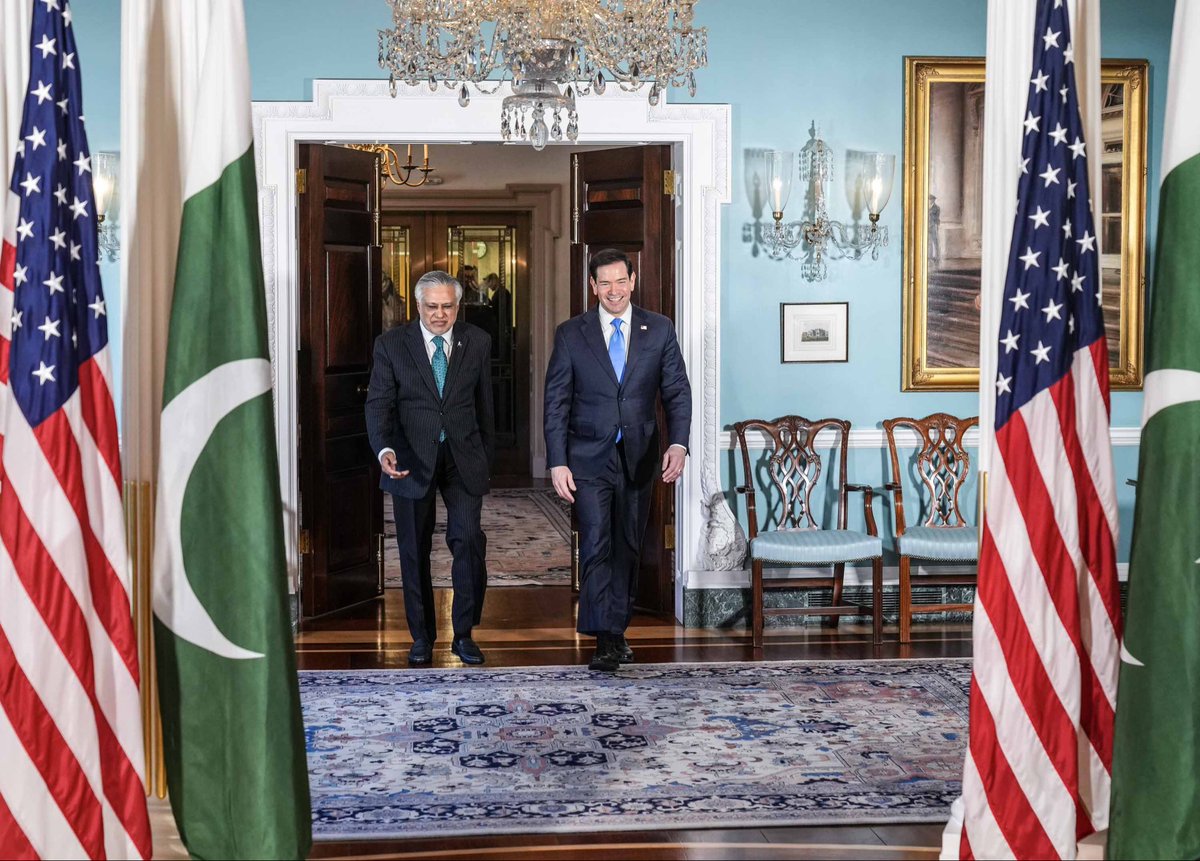
Met with Pakistani Deputy Prime Minister and Foreign Minister @MIshaqDar50 and thanked him for the role Pakistan continues to play in advancing peace in the Middle East. We agreed upon the importance of working together to further strengthen a meaningful partnership for better security and more prosperity for our two nations.
I am delighted to share that my Book, 'Balancing the Rising Tides: Japan's Indo-Pacific Trajectory' has been republished by Routledge. 😇 👇
@routledgebooks@tandfonline
The book is available on Amazon too.
https://t.co/F5JOs5kJLT
The emergence of Pakistan as a declared nuclear weapons state on May 28, 1998, was one of the major events of the late-20th century with far-reaching implications. The fact that Pakistan succeeded where many richer and better positioned states have failed or given up was the result of national resolve, the ability to exploit circumstances, and an urgency born of a deeply felt survival imperative.
Today, Pakistan’s nuclear arsenal encompasses 170+ nuclear warheads, accompanied by continuous progress in delivery systems, and advancement in aerospace capabilities.
Here are 4 books by Pakistani authors that tell this story from different perspectives. Be sure to get them because the story of Pakistan’s nuclear program is one of extraordinary success in spite of the gods.
As the world threatens to return to its historic normal of pure geopolitical competition shorn of legal pretensions there are many nations who can learn from Pakistan’s hard power focus.