Baobab, a prehistoric species which predates both mankind and splitting of continents over 200 million years ago. Baobabs (Adansonia) are distinctive trees with incredibly large trunks. They can store tremendous amounts of water, as their trunks noticeably swell during the rainy season.
Tree is native to African savannah, where climate is extremely dry and arid, it is a symbol of life and positivity in a landscape where little else can thrive. African baobab (A. digitata) has a vast range throughout the arid parts of Africa; six additional species are native to the Indian Ocean island of Madagascar, off south-east Africa; and an eighth species is native to north-west Australia. The largest known living baobab is the Sagole Big Tree, a specimen of A. digitata located in Masisi, Vhembe, South Africa, near the border with Zimbabwe. Based on its most recent measurements, Sagole has an extremely large base that covers 60.6m², a height of 19.8m and a total wood and bark volume of 414m³. Its aboveground dry mass is estimated to be 54 tonnes.
Baobab trees grow in 32 African countries. Tree known for its longevity and some specimens in Africa have been dated to between 1100-2500 years old and reach up to 30m high and up to an enormous 50m in circumference. Baobab trees can provide shelter, food and water for animals and humans, many savannah communities made their homes near Baobab trees. Baobab also looms among ancient mounds and remains scattered around them are invariably early medieval or Portuguese.
Until 2018, the largest living baobab was sacred Tsitakakoike Baobab, a specimen of the endangered species Adansonia grandidieri, which grew near Andombiro in the Ambiky Forest of south-west Madagascar. The incredibly stout and compact tree had a cylindrical trunk with a base that covered 59.6 m², a height of 14.6m and a total volume of 455 m³ - 380 m³ of which was trunk and 75 m³ of which was canopy. It partially broke and collapsed in February 2018 leaving about 40% of the tree still standing, but this was expected to also collapse soon after.
An even larger African baobab tree (A. digitata) alive during 21st Century was the Platland/Sunland Tree of Modjadjiskloof, South Africa, with a base of 67.9 m², height of 18.9m and a total wood and bark volume of 448 m³. Unfortunately, a large portion of the Platland Tree collapsed and died in 2016, leaving the Sagole Big Tree to claim the top spot.
Baobabs have among the lightest wood for any tree. Balsa wood is well known to model aeroplane makers as one of the lightest and softest woods, with a wood density that averages around 0.15 g/cm³, yet baobab wood is even lighter, averaging 0.13 g/cm³. As a result, the aboveground dry mass of the Platland baobab was estimated at only 58 tonnes and about 59 tonnes for Tsitakakoike. In terms of mass, giant gum trees (Eucalyptus) of Australia are the largest hardwood trees.
#archaeohistories
🌳 The African baobab — often called the “Tree of Life” — can live for over 1,500 years.
Native to South Africa and other parts of Africa, it stores water in its massive trunk and supports entire ecosystems with food, shelter, and nutrients.
One of the oldest and most remarkable living trees on Earth.
The image shows the Dumbbell Nebula, or M27. It is one of the brightest planetary nebulae in the sky.
The nebula was formed by the star shedding its outer layers, just as the Sun will do in approximately 6 billion years.
As you may know, March 8 is International Women’s Day 🌼, and March is also Women’s History Month in the U.S.
To mark the occasion—and ahead of our upcoming highlight ‘Women Artists in the Modern Era’ (from March 28 in our Permanent Collection galleries)—we are sharing five works by women artists from our collection.
In this second post, we introduce Victoria Dubourg (1836–1904) , a French painter known for portraits and still life.
This work depicts a vivid bouquet—chrysanthemums, dahlias, anemones, carnations, and marigolds—while tall gladioli rise on both sides, bringing energy to the composition 💐
It is a painting that speaks of the artist’s deep love for flowers.
-- #5WomenArtists --
🖼 Victoria Dubourg (Fantin-Latour), ‘Flowers,’ oil on canvas, 42.7 x 47.8 cm, Matsukata collection
--
📣 We’re currently closed for a display change, and will reopen on 28 March.
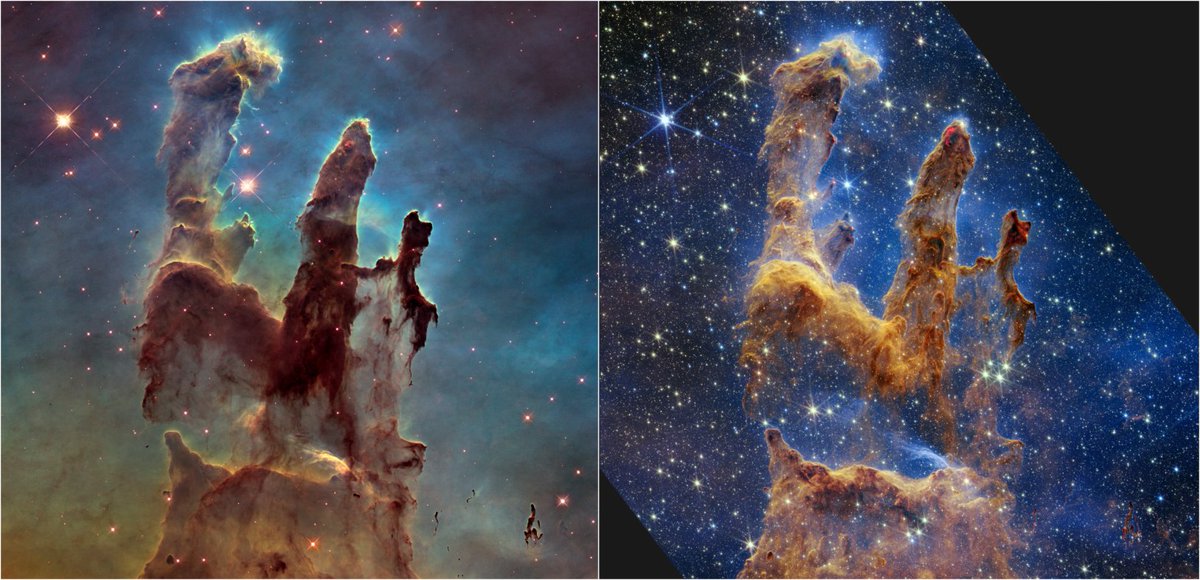
These pictures of the Pillars of Creation were taken 19 years apart by different telescopes, with each image capturing a unique perspective.
On the left, @NASAHubble shows more thick dust. On the right, @NASAWebb peers through the dust to show more stars. Which is your favorite?
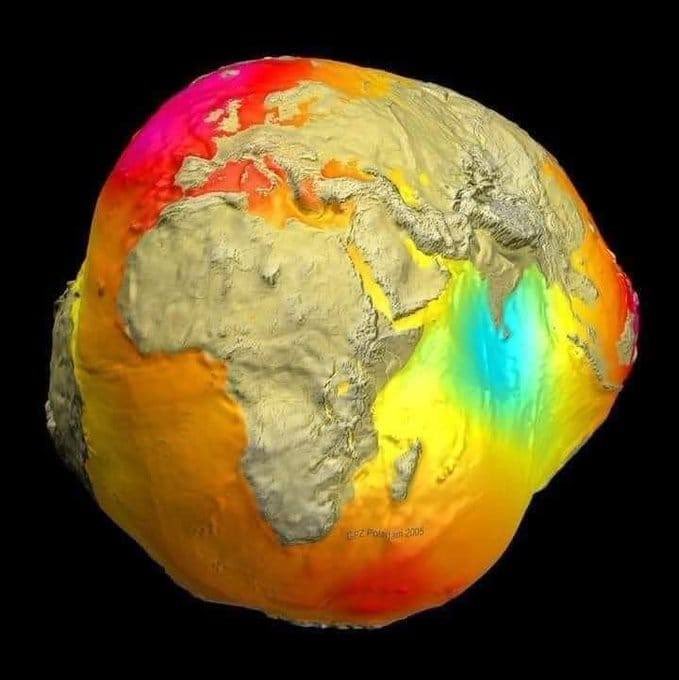
🚨: Gravitational map of the Earth. NASA's GRACE satellite has generated a geoid map of the earth based on the magnitude and shape of the globe and shows us an interesting image.
On this day in 2000, Joni debuted ‘Both Sides Now.’ Released as a concept album, the record centers on orchestral arrangements of classic jazz songs, and only includes two of her own songs: “Both Sides Now” and “A Case of You.”
Revisit the album and listen here: https://t.co/paGb3xnD0O
The Milky Way isn't your average spiral galaxy—it's a barred spiral, dominated by a massive, elongated bar of stars slashing through its heart like a cosmic backbone.This central bar isn't just structural flair; it's a powerful gravitational engine. Infrared and radio observations show it channeling enormous rivers of gas inward toward the galactic core, acting like a relentless conveyor https://t.co/fAKJfjAf9z this gas rushes in, it slams into dense clouds, triggering compression and igniting bursts of furious star formation near the center.This process is key to the galaxy's long-term story. The bar steadily funnels fresh fuel inward, sparking episodic starbirth frenzies in the core while gradually starving the outer disk of raw material. Over billions of years, this internal reshuffling sculpts the Milky Way's overall shape, builds sharp chemical gradients across its disk, and shapes distinct populations of stars.Far from being a static portrait, our galaxy's appearance today reflects these slow, persistent internal forces—perhaps even more than dramatic external collisions.Studying the Milky Way's bar also unlocks insights into countless other barred spirals scattered across the cosmos, revealing how these internal dynamos drive galactic evolution.
(Sources: ESA/Gaia mission data, ALMA observations, studies in Nature Astronomy and The Astrophysical Journal)
"Treating people with kindness and sincerity are the principles by which I engage in interpersonal relationships."
Mo Yan was awarded the 2012 #NobelPrize in Literature for his writings in which he merges hallucinatory realism with folk tales and contemporary social issues.
At a birthday party at John Lennon's New York apartment in 1984, Steve Jobs introduced the Macintosh to Andy Warhol, Keith Haring, and John Lennon's son, Sean.
More rare historical photos: https://t.co/W7jIvOHun5
At just 15 years old, Belgian prodigy Laurent Simons—nicknamed "Belgium's Little Einstein"—has shattered expectations by earning his PhD in quantum physics from the University of Antwerp, defending his thesis in late November 2025 and becoming one of the youngest doctorate holders in modern physics history.His rocket-fueled academic journey defies belief: primary school started at age 4 and wrapped up by 6; high school diploma by 8; a master's (or bachelor's in some reports) in quantum physics by 12, diving deep into the wild mathematics of bosons, black holes, quantum entanglement, and Bose-Einstein condensates. Now, as a teenager who could still be in early high school in most places, he's officially Dr. Simons, with an IQ of 145, photographic memory, and a mind that races through concepts that stump seasoned researchers.The spark? Deeply personal. At age 11, the devastating loss of his grandparents ignited an unrelenting drive: not fame, not accolades, but to crack the code of human longevity—to unlock ways to extend healthy life, perhaps even conquer aging itself. Parents wisely shielded him from lucrative offers by tech giants in the US and China, prioritizing balanced growth over burnout.His PhD thesis explored cutting-edge quantum phenomena, yet his gaze is already shifting. Fresh off the defense, he jetted to Munich to launch a second doctorate—this time in medical science, blending AI, biology, and regeneration research to chase breakthroughs in anti-aging, human enhancement, and what some call the quest for "super-humans."While not the absolute youngest PhD ever (records go back further), in contemporary physics and at this accelerated pace, Laurent's feat stands almost unmatched. The questions he tackles are colossal: from quantum mysteries that underpin reality to biological immortality that could redefine https://t.co/N4AlHUOPdn 15, most kids are navigating teenage life. Laurent Simons is rewriting the boundaries of human potential—one groundbreaking degree at a time. The universe just got a new genius on the scene, and his story is only beginning. Here are powerful images capturing this extraordinary young mind and his milestone:
Sources: University of Antwerp, VTM News, ScienceAlert, NDTV, and recent 2025-2026 coverage. The future just arrived early.
A black hole constitutes a region of spacetime where gravitational collapse has proceeded to such an extent that an event horizon forms—a null hypersurface marking the causal boundary beyond which the escape velocity equals or exceeds the speed of light in vacuum, c ≈ 2.99792458 × 10⁸ m s⁻¹. Within this boundary, all future-directed timelike and null geodesics terminate at a central singularity (in the idealized Schwarzschild or Kerr geometries), where spacetime curvature becomes infinite and classical general relativity breaks down.According to the no-hair theorem (supported by uniqueness results for stationary, axisymmetric, electrovacuum solutions of the Einstein field equations), astrophysical black holes are fully characterized by only three parameters in the Kerr–Newman family:Mass M
Specific angular momentum a = J/M (where J is angular momentum)
Electric charge Q (typically negligible in astrophysical contexts, Q ≈ 0)
Thus, observed black holes are effectively Kerr (rotating, uncharged) or Schwarzschild (non-rotating, uncharged) objects. Recent high-precision gravitational-wave observations of binary black hole mergers (e.g., events analyzed in 2025, including GW250114) have rigorously tested and confirmed the Kerr nature of post-merger remnants, along with Hawking's area theorem: the total horizon area A = 4π(r₊² + a²) cannot decrease over time, even during mergers, with the surface area increasing as predicted (ΔA ≥ 0).The event horizon itself remains causally disconnected from external observers due to infinite gravitational redshift; electromagnetic radiation emitted near or interior to r = r₊ (r₊ = M + √(M² - a²) in geometric units) is exponentially suppressed. Direct imaging is therefore impossible; instead, observations capture emission from matter in the immediate vicinity:Accretion disks — geometrically thin or thick flows of plasma spiraling inward, heated to ~10⁶–10⁹ K by viscous dissipation and magnetic reconnection, producing thermal and non-thermal radiation across X-ray to radio bands.
Photon ring — unstable photon orbits at ~1.5 r₊ (for Schwarzschild) create a bright, asymmetric ring via gravitational lensing of disk emission from the far side.
Relativistic jets — launched by Blandford–Znajek processes or magnetohydrodynamic extraction of rotational energy, often extending parsecs to megaparsecs.
The Event Horizon Telescope (EHT) has imaged the shadow and photon ring of M87* (2019, refined in subsequent campaigns) and Sgr A* (2022, with ongoing polarization and variability studies through 2025–2026), providing direct tests of strong-field gravity, frame-dragging (Lense–Thirring effect), and magnetic field topology near the horizon.Recent advances (2025–2026) include:Confirmation of Hawking's area increase in merger ringdowns.
XRISM spectroscopy revealing warped, reflection-dominated iron lines indicative of near-maximal spin (a ≈ 0.998) in rapidly rotating systems.
JWST discoveries of overmassive supermassive black holes (SMBHs) at z > 8 (e.g., in "little red dots" and early quasars), with masses ≳ 10⁸ M_⊙ within ~500 Myr after the Big Bang, challenging standard Eddington-limited growth and favoring heavy/direct-collapse seeds or super-Eddington/hyper-accretion phases.
Stellar-mass black holes (∼3–100 M_⊙) form primarily from core collapse in massive stars (M ≳ 20–30 M_⊙), while intermediate-mass (10²–10⁵ M_⊙) and supermassive (10⁶–10¹⁰ M_⊙) variants likely arise via hierarchical mergers, gas accretion, and seed mechanisms in the early universe.
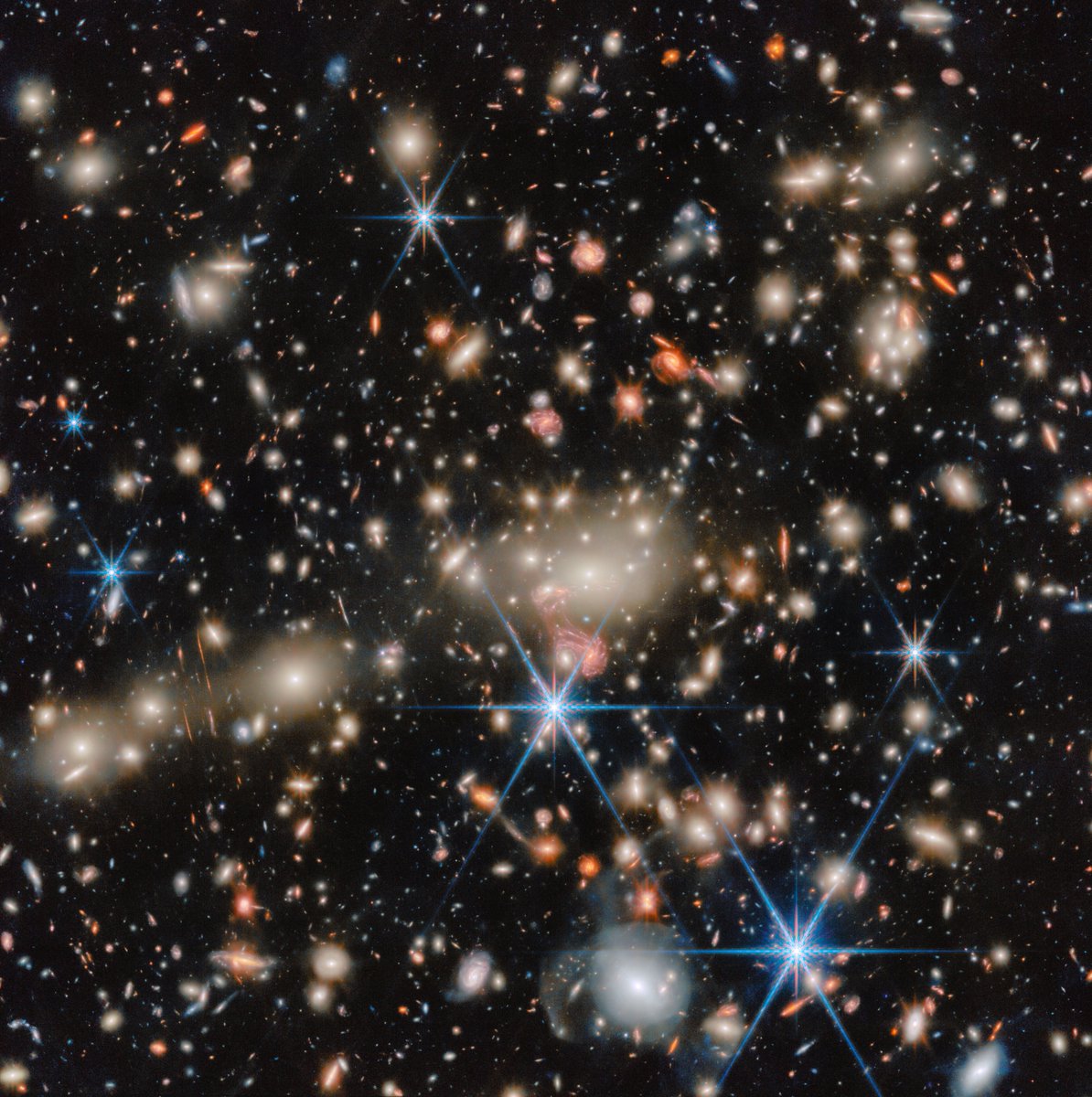
🆕 This NASA/ESA/CSA James Webb Space Telescope image brings us a scene from the distant Universe.
It shows the galaxy cluster MACS J1149, which is located about 5 billion light-years away from us.
🔗https://t.co/hZcT1c4XOk
@esascience@ESA_Webb@NASAWebb@csa_asc@stsci
Bowl with Face. Culture: Mississippian. Place of origin: Missouri, United States. Date: 11th–14th century AD. Medium: Ceramic. Collection: The Metropolitan Museum of Art, New York.
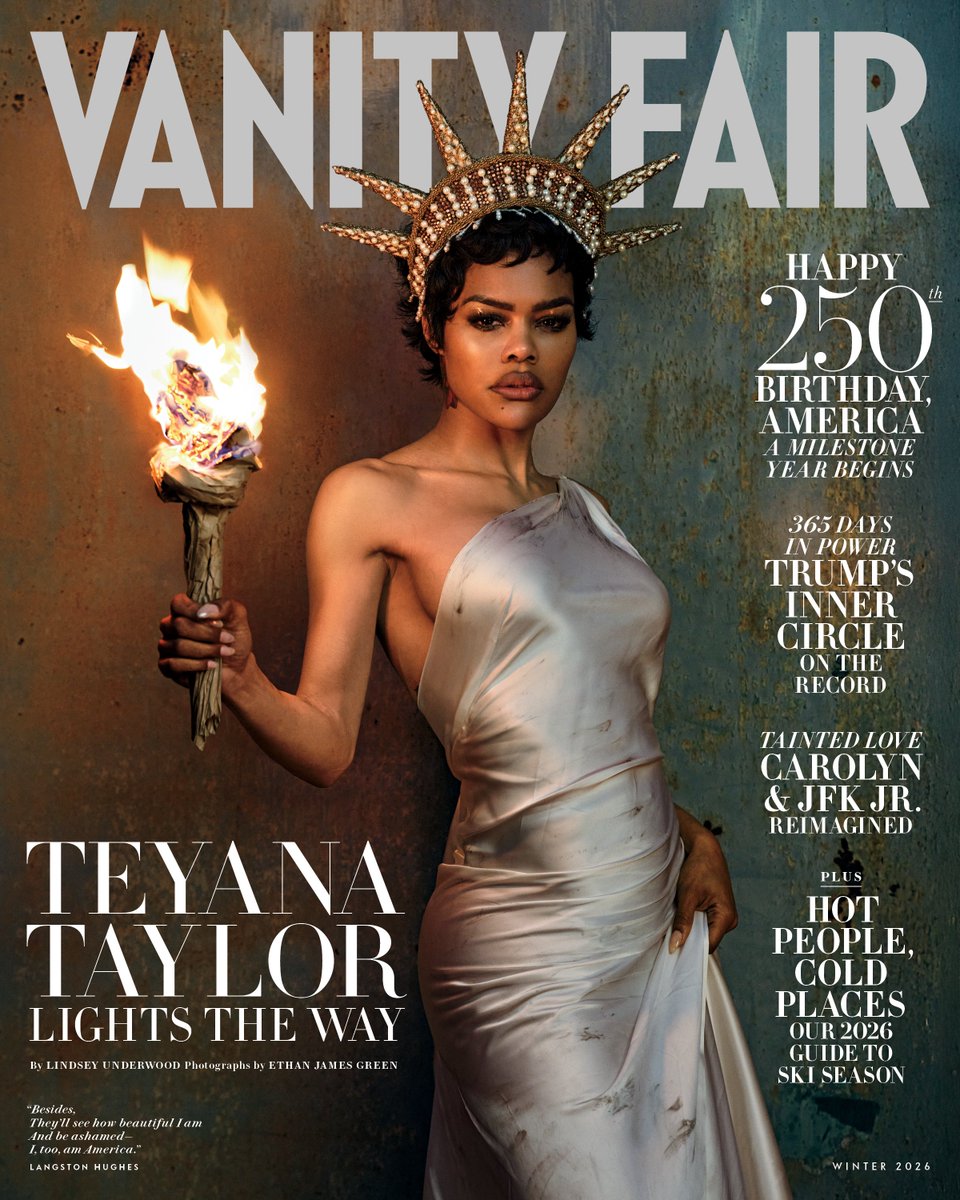
Two decades of hard work in and out of the spotlight prepared Teyana Taylor for her electric, Golden Globe-winning role in the newest Paul Thomas Anderson film, ‘One Battle After Another.’ Playing Perfidia Beverly Hills was an exercise in resilience and vulnerability—and the result is a lot of Oscar buzz.
Head to https://t.co/JgGnbykZGz to read our story on Vanity Fair’s Winter Issue cover star.
https://t.co/Jzaq4l1wYA