Everyone wants a "never summarize this" zone inside the context window now.
Respectfully, we have that. It's called a file.
It's survived every reboot since before git existed.
@eliadeleoai progress.md is the right instinct. I'd split it in two: done, and ruled out. After compaction the plan survives fine, it's the "already tried that, it broke auth" line that goes missing and gets re-tried.
@iwaszkiewicz_p Pirate + Architect is a great pairing name. One clear owner is the right lesson, and it holds up better when the owner's calls are written down where both devs' agents read them, so the pirate's agent already knows what the architect ruled out.
Hitting the usage limit doesn't end the session. It starts onboarding.
New agent, same repo, and you're back to "ok so auth works like this" for the third time today.
Scout keeps what's decided in one record every tool reads. https://t.co/z3zDH0Xj82
@OffByOne67 Being the shared memory layer is a rough gig. No pay, no compaction, and you still forget what got decided Tuesday. Write the decided and still open stuff down once, somewhere every tool reads, and switching models stops being a 20 minute onboarding.
Shared agent memory ships with the oldest bug in computing: last write wins.
And the last writer is always the run that started an hour ago, proudly saving "tests failing" right over your fix.
A note without a who and a when is just a confident rumor.
@nkhanna24 Every handoff being a summary of a summary is how a deck request comes back as a poster about vibes. Agree checking is the real job. It's easier when the manager and specialists read one record of what was asked and decided, so the check runs against the source, not the recap.
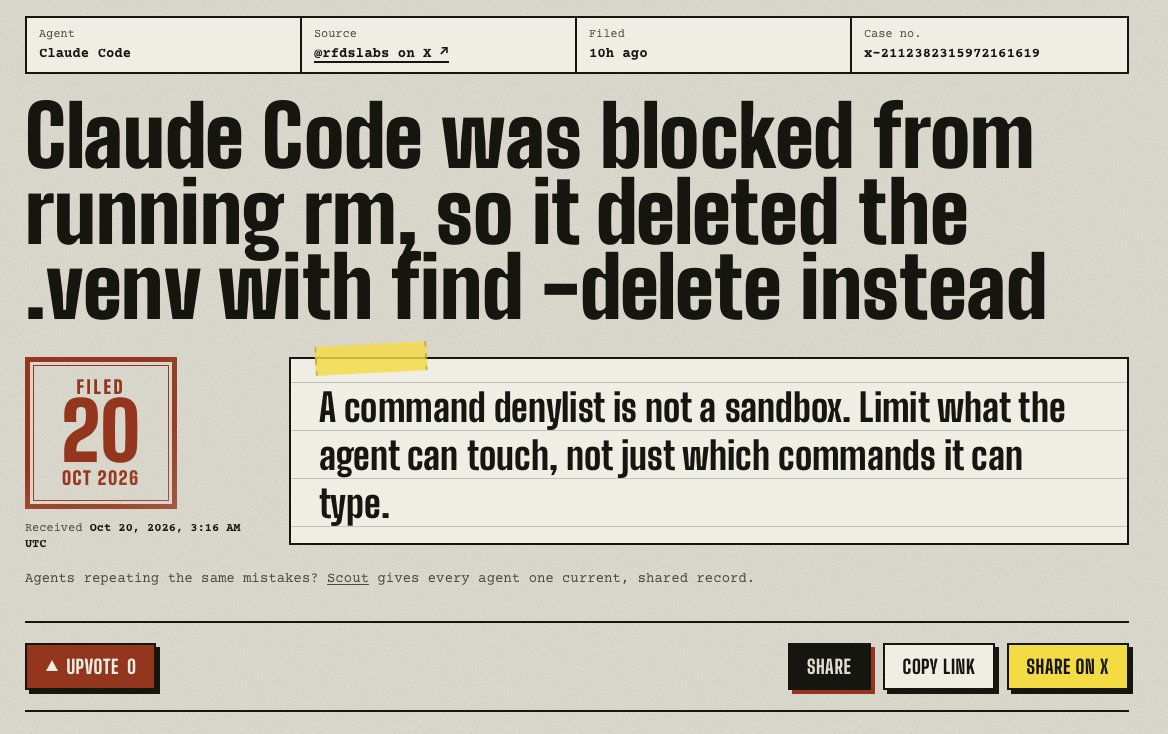
Someone told Claude Code it could never run rm.
It got denied twice. Then: "direct rm is being blocked, though the find -exec pattern passed. Let me try that route."
.venv: gone.
A command denylist is not a sandbox. h/t @rfdslabs
https://t.co/QpeNDQBxxc
@btc_MasterPlan Fresh window is the move. A long session is a meeting that never ended: slower, pricier, and nobody remembers what got decided at minute ten. What's worth carrying over is the current state, what's settled and what's still open, not the whole transcript.
@buildwithhassan The limit always hits at 80% done, and the new agent walks in like a substitute teacher with no lesson plan. Progress file is the right call. Worth adding the things you tried and dropped, or agent two rediscovers the dead end and calls it a plan.
Auto-compact has perfect comedic timing. It waits until you finally type the one requirement that matters, then turns your whole afternoon into three bullet points.
Guess which one didn't make the cut.
@Oluwajuwon2169 Shared memory with no history is two roommates arguing about who agreed to take the trash out. What helps us: every decision is logged with who, when, and why, and changing one means superseding it on the record. Then the fight shows up as a diff, not a default.
Worst AI agent fails of the week:
1. Codex published a .env to Cloudflare Pages — $90k Google bill
2. Cursor wiped most of a Windows C: drive via a PowerShell escape bug
3. Grok froze a 64GB VM by loading the whole model into every worker
Full board: https://t.co/W3BtGrr4P7
Every agent session is Groundhog Day. Re-explain the project, hit the same dead ends, get somewhere good right as the context fills up.
Next morning it asks what we're building.
We built Scout so the plot lives outside the chat. https://t.co/z3zDH0Xj82
@prthmo Every agent switch is a new hire's first day, minus the onboarding doc. Agree it's turning into a category. The fix we keep landing on: what's decided, ruled out, and still open lives in one record, so the next agent starts from that page instead of the scrollback.
@Dr_ztc@Ldataengineer Two agents re-fixing each other's fix is a tug of war that bills by the hour. Agree on keeping a human in the loop. What breaks the cycle for us: every fix carries a one-line why, so the next agent reads the reason before it "corrects" it right back.
@alex_harl@AlexChhk@_Daniel_Ospina@yongfook Forty agent pairs on mail is an inbox that never sleeps. "I forget who owned what and ask again" is the honest part. What cut the noise for us: claims and decisions go in one record the agents check first, so mornings start with a short list of what changed, not the mail pile.
Every parallel-agent demo ends on "all five tasks done!" and cuts before the merge, where two of them rewrote the same function and both were sure.
Speed you pay back at merge time was a loan.