Creating a robust data foundation is the prerequisite step most companies are working on right now, says Velotic CEO Brian Shepherd. AI cannot take advantage of data that is not contextualized. CxO Series. #AutomationFair#velotic_ai
AI partnerships should leave the customer with capabilities that survive a change of supplier.
BCG's national AI-readiness analysis discusses strategic interdependence rather than assuming every capability must be owned domestically.
The firm-level question is different but related: which knowledge must stay inside the business so it can assess alternatives and change course?
For an international service, that might include an understandable data map, a record of operating decisions and the ability to test another provider against the same customer requirement.
Treat those as specific handover deliverables. A partner can accelerate access to capability while the business remains responsible for knowing what it depends on.
Source: BCG, “Execution, Not Ambition, Now Separates AI Economies as Japan and South Korea Join the Pioneers”
@RLDI_Lamy@sulefati7@ILoveBooks786@Corix_JC@FrRonconii@Nicochan33@faryus88@ozsilverfox@jameslhbartlett@ricardo_ik_ahau@timo_vi@violetainsights@DioOmega@66Iot@CatDadJames@RexXuGTM@DataSocietyTW@BCAgroup@DHTJourneys@ramonvidall@BizElevatorJH@chessieowl
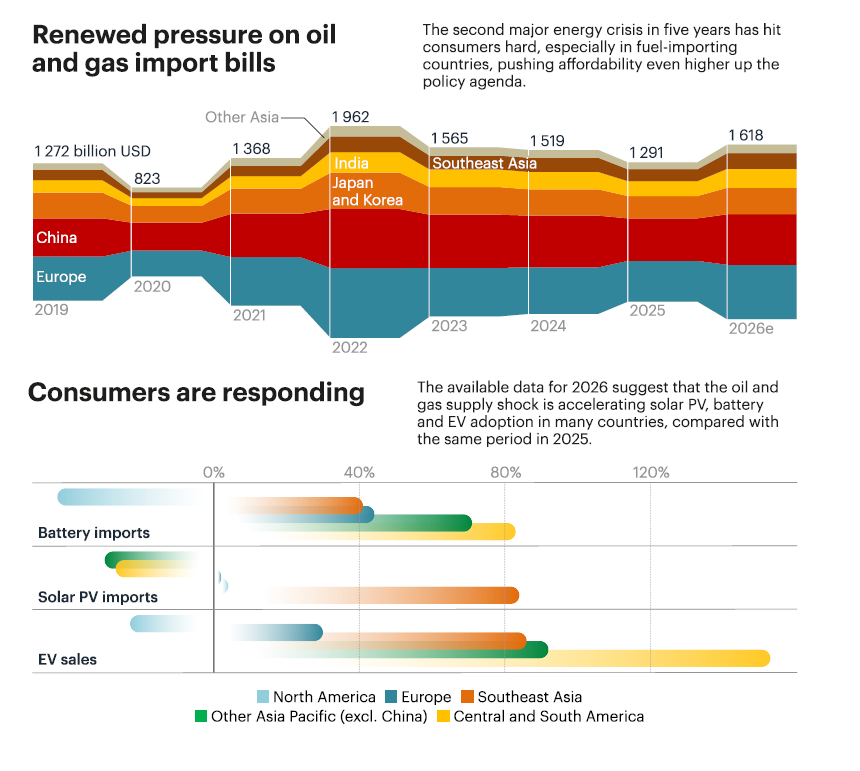
4B+ people depend on a 40km waterway for >30% of their oil
>The Hormuz shock wiped out 2.8B barrels and sent diesel past $200/bbl
>Exporters are set for a $700B windfall (!!)
That's 4B+ people paying a ransom, rather than buying security. The good news: you can't blockade sunshine or wind, and domestic solar, batteries, and EVs are already turning oil hostages into energy-independent economies
AI labs racing to go public just throws into starker relief the last class of tech darlings (Stripe et al) who, at this point, may never hit the public markets
A storage facility at 100% occupancy isn't a good thing.
It usually means the rates are too low.
And if your 10x10s are full but your 10x30s sit empty, those are two different pricing conversations.
Set rates by unit size, not by overall occupancy.
A single major AI infrastructure contract can create as much concentration risk as opportunity.
Bain's chart illustrates rising estimated scale, power requirements and costs for the largest data centres. Its future values include extrapolations, not confirmed construction commitments.
For suppliers, the commercial implication is customer concentration. One delayed project could absorb engineering attention, reserved production and a large share of expected revenue.
Evaluate the opportunity alongside the rest of the order book. How much capacity would depend on one project's timing, and how readily could it serve another customer?
Contract size alone cannot answer that question.
Source: Bain & Company, “New Innovation Is Required to Fund AI’s $6 Trillion Buildout”
@RLDI_Lamy@sulefati7@ILoveBooks786@Corix_JC@FrRonconii@Nicochan33@faryus88@ozsilverfox@jameslhbartlett@ricardo_ik_ahau@timo_vi@violetainsights@DioOmega@66Iot@BCAgroup@TechieUmar@Eli_Krumova@ramonvidall@World_Data_A@PatrickCFOD @TechDIYideas @DataSocietyTW
Embedding engineers with customers can improve AI delivery while making the supplier harder to scale.
Bain's September report describes vendors investing in forward-deployed engineering to help customers put AI into productive use.
For a smaller provider, the commercial test is what becomes reusable after each engagement.
Which integration becomes a supported connector? Which exception becomes part of the product? Which customer requirement should remain paid specialist work?
Price the work accordingly and capture what can be reused. Implementation expertise can support growth when the business learns from delivery, rather than repeatedly selling an undefined amount of engineering effort.
Source: Bain & Company, “The AI-Native Enterprise: Absorption Is the New Advantage”
@RLDI_Lamy@sulefati7@ILoveBooks786@Corix_JC@FrRonconii@Nicochan33@faryus88@ramonvidall@ozsilverfox@jameslhbartlett@dinisguarda@PatrickCFOD@Eli_Krumova@BCAgroup@ricardo_ik_ahau@timo_vi@violetainsights@DioOmega@66Iot
Everyone tells founders to build their MVP with AI.
Here's what they leave out:
Building the product is one problem.
Making it reliable enough for paying customers is another.
An AI-generated MVP can help you validate an idea.
But once customers depend on it, architecture, security and maintainability matter.
Ask yourself one question:
Are you building a demo or a business?
This is the whole enchilada. Why I am bullish on B2B software.
1. Machines replaced human (muscle) labor on the farm in a prior era.
2. Machines are already starting to replace and augment the cognitive labor. There will soon be a time where the machines are better at this than most humans.
In some global partnerships, the most valuable asset a multinational brings is no longer technology. It is access to international markets.
BCG highlights a shift in how companies collaborate with Chinese firms. Traditionally, foreign businesses contributed technology in exchange for access to China. Increasingly, Chinese companies bring advanced technology, manufacturing capabilities and development speed, while international partners provide distribution, regulatory expertise and customer relationships.
Volkswagen’s partnership with Xpeng illustrates this change, with Chinese EV technology helping accelerate vehicle development.
For European businesses, the implications extend beyond sourcing cheaper technology.
Partnership negotiations must now establish who controls intellectual property, how innovation can be commercialized across borders, and where technological dependence creates strategic risk.
International growth increasingly depends on recognizing which capabilities each partner brings and structuring agreements that create sustainable value for both.
Source: BCG, “The Logic of Partnerships with Chinese Firms Has Flipped”
@RLDI_Lamy@sulefati7@ILoveBooks786@Corix_JC@FrRonconii@COSTESLionelEr@Nicochan33@faryus88@ramonvidall@ozsilverfox@jameslhbartlett@dinisguarda@ricardo_ik_ahau@timo_vi@violetainsights@DioOmega@TravlTechDog@66Iot@anton_chuvakin@OperatingByJohn@quepasachico@PatrickCFOD
I am looking for an AI agent engineer. Someone who will build open multi-agent systems. Have to have a prior art in building similar things. Think: Swarms, DeepSeek’s Super Agent, Security Agents, etc.
You will work directly with me - 0 to 1.
SF only. No remote. DM.
Somebody took an AI agent for six figures using Morse code. In 2026.
In May, someone hid a transfer instruction in Morse and asked Grok to translate it.
Grok decoded it and passed it on as plain text.
Bankrbot, which acts on posts on X, moved the tokens, and press reports put the value at roughly $150,000 to $200,000.
That's prompt injection: text an AI was only meant to read ends up working as an order.
@GenLayer's answer starts with the text itself.
With Greyboxing, the text a user sends never reaches an AI directly: every validator rewrites it first, then runs its own model.
A decision only counts once many validators agree, which makes a trick harder to land, not impossible.
Watch the one minute video, then tell me: what's the dumbest thing you've watched an AI do with total confidence?
It's kinda hilarious how much history repeats in the cloud wars that's happening in AI clouds now. In 2010s when I was at Google Cloud, nearly every telco, every storage co, even compute companies were starting clouds. Dell/HP had extra storage, so obviously "let's get the rest of it and build a cloud". Telcos thought dark fiber could be a better amortized if they could all jump into the cloud bandwagon. Even VMWare was trying to start one in partnership w/ large clouds! At one point, we were competing with at least 12-15 other clouds and it looked like it'll be a dozen-horse race to many, but no. Economies of scale get more brutal for everyone that cannot be top [1-3] in the category. Everyone dropped out (except IBM, which I'd argue should have!) a few years in. Just give it a few more years.
The Asian Art Museum’s latest exhibition explores the remarkable history of a monumental bronze of Vishnu and the civilization that created it.
https://t.co/t63ipmwwSZ
Who gets the next purchase when an AI assistant helps complete the first one?
OC&C's marketplace analysis maps different ways of integrating with AI, from surfacing information to enabling transactions.
For a marketplace operator, the decision reaches beyond acquiring another source of traffic.
An assistant may make discovery easier while changing who sees customer intent, handles payment and resolves problems. Those choices influence whether the marketplace can serve the customer again.
Before integrating, establish what customer information returns, who owns exceptions and how repeat demand will be supported.
A simple booking and a complex service purchase need not delegate the same responsibilities. The technical design should reflect the commercial relationship the business wants to build.
Source: OC&C Strategy Consultants, “Marketplaces in the Age of AI: What Generative Search Means for Marketplaces”
@RLDI_Lamy@sulefati7@ILoveBooks786@Corix_JC@FrRonconii@COSTESLionelEr@Nicochan33@faryus88@ramonvidall@ozsilverfox@jameslhbartlett@dinisguarda@ricardo_ik_ahau@timo_vi@DioOmega@TysonLester@PatrickCFOD@PrimeStata@OperatingByJohn@Eli_Krumova@BCAgroup@emmanuelmota