Does the news reflect what we die from?
More than 80% of people — including surveyed Americans, Brits, Germans, and Italians — say they follow the news because they “want to know what is going on in the world around them.”
It’s not just that people expect the news to inform them about what’s going on in the world. Most think that it does. When asked what emotions the news generates, “informed” was the most common response.
This is what media outlets themselves promise to do. Here are several quotes from the New York Times’s mission statement:
“We seek the truth and help people understand the world. [...]
We help a global audience understand a vast and diverse world.”
However, as we discuss in a new article, the media focuses on a particular sliver of our world, leaving much of the “vast and diverse world” largely out of their reporting. We investigate this through the lens of health, looking at causes of death and reporting in the United States.
Our point is not that we should want or expect the media’s coverage to perfectly match the real distribution of deaths, although we’d argue that it would be better if it were less skewed.
We wrote this article so that you, the reader, are aware of a significant disconnect between what we often hear and what actually happens.
It’s easy to conflate what we see in the news with the reality of our world, and keeping this mismatch in mind can help you avoid falling into this trap.
Descabido é continuar a utilizar a esperança média de vida como métrica. "Healthy years" seria uma métrica muito mais justa. Em Portugal as mulheres podem esperar viver 58 anos em boa saúde. Os homens 61 anos.
@VitorCa51158613 Se a esperança média de vida passar dos 80 para os 85 ou os 90, é normal que a idade de reforma aumente. Ligar a idade de reforma a esperança média de vida é assim tão descabido?
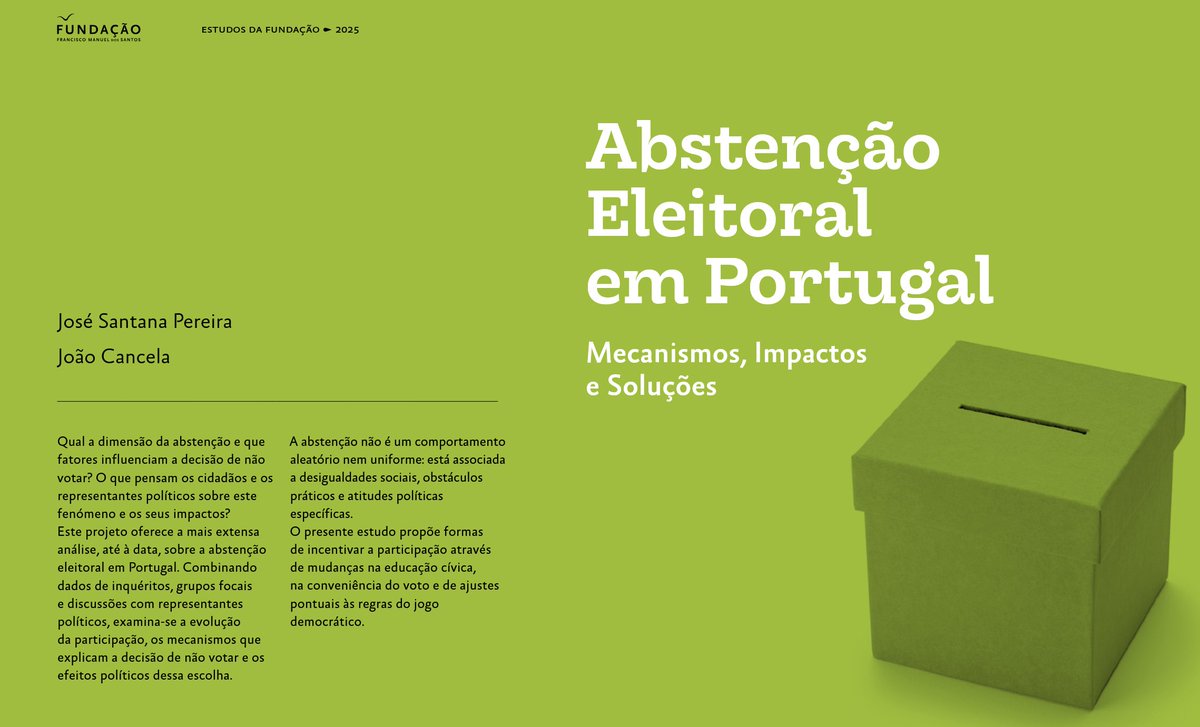
O José Santana Pereira e eu passámos os últimos anos a estudar a abstenção eleitoral em Portugal. Fizemos um inquérito nacional, conversámos com abstencionistas e com representantes políticos.
O resultado está hoje disponível no site da @ffms_pordata (mini-fio, link abaixo)




![OurWorldInData's tweet photo. Does the news reflect what we die from?
More than 80% of people — including surveyed Americans, Brits, Germans, and Italians — say they follow the news because they “want to know what is going on in the world around them.”
It’s not just that people expect the news to inform them about what’s going on in the world. Most think that it does. When asked what emotions the news generates, “informed” was the most common response.
This is what media outlets themselves promise to do. Here are several quotes from the New York Times’s mission statement:
“We seek the truth and help people understand the world. [...]
We help a global audience understand a vast and diverse world.”
However, as we discuss in a new article, the media focuses on a particular sliver of our world, leaving much of the “vast and diverse world” largely out of their reporting. We investigate this through the lens of health, looking at causes of death and reporting in the United States.
Our point is not that we should want or expect the media’s coverage to perfectly match the real distribution of deaths, although we’d argue that it would be better if it were less skewed.
We wrote this article so that you, the reader, are aware of a significant disconnect between what we often hear and what actually happens.
It’s easy to conflate what we see in the news with the reality of our world, and keeping this mismatch in mind can help you avoid falling into this trap.](https://pbs.twimg.com/media/G2q-UNAXIAAz3xz.jpg)