Interested in the #TME? Well, these data published in #JExBio in July 2022 demonstrate that the enzyme QSOX1 may have more influence on the tumour microenvironment than generally appreciated. 👉 https://t.co/2bzZA0ecyC #OneYearinJExBio@CatInScience, @lab_slater, @GleghornLab
Today while walking through a frosty, swampy area in the woods, I came across this strange looking plant. It smelled like garlic and it was impossible to uproot.
Turns out it's skunk garlic, a thermogenic plant that can generate heat and melt surrounding ice. Pretty dang cool!
I didn't know powdered sugar came 10x concentrated from the grocery store. Does this mean I have to dilute by a tenth to get a 1x working concentration for my dessert? 🧑🍳
My second paper from my PhD with @GleghornLab is out as a preprint! A big thanks to my advisor + my lab for supporting me as I tried to figure out what really regulates QSOX1 in pancreatic tumor cells. 🧦My favorite little disulfide bond generating catalyst. 🧦
@MicrobiomDigest Now, perhaps if they didn't label any of their samples and used different versions of their data (instead of one report), they could end up grabbing the wrong plot by mistake. As someone who has run hundreds, if not thousands of samples, I can't really imagine doing that.
@MicrobiomDigest From my experience (w/NovoExpress) you can easily duplicate plots and export them. This looks like the same run with the gating shifted slightly to the left. How easy it is to make this mistake by accident: not easy at all. You'd have to have pretty bad with data management...
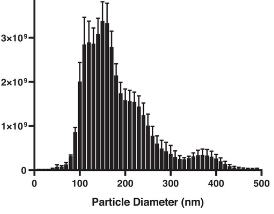
@Joadwe @aquicarattino You're correct, it's NTA. I think NTA is "precise" (at least in its engineering), but it is absolutely not accurate. Event then - if a filter truly removed most EVs > 0.22 um, then I doubt we'd see a peak specifically around 370 nm. But I'm only speculating.
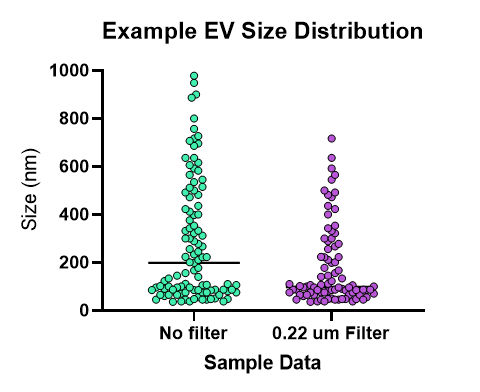
I have a random question for the #extracellularvesicles community that I've been mulling over for a while: why do people use 0.22 um filters instead of, let's say, 0.45 um filters to clarify conditioned media prior to EV isolation/purification?
@aquicarattino I wouldn't say they are working poorly, necessarily. Lipid-based particles behave differently than other types of nanoparticles. They can deform and squeeze through the pores more easily. They are also more fragile. But bottle top filters do a good job of removing cell debris.
@aquicarattino No, this is not real data. In hindsight, I probably should have put a watermark across the plot to make it more obvious. I made the plot based on data that I've seen in numerous papers as well as my own observations. Here is a real plot showing >30% of the particles are >200 nm
@fadi_abz That's a good point - the material (PES, PP, PTFE) will certainly change how EVs pass through and using a syringe filter can create a lot of back pressure. I think both EV yield and quality may be adversely affected. Curious if anyone has set up experiments to test this already.
I think performing a filtration step is necessary for non-adherent cell culture, but is it needed for adherent cells? Has the community looked into alternate clarification steps? @IsevComms
I'm in my third month of being jobless after graduating with my PhD. I'm financially broke although my extended family is taking care of me. Is this normal? Everyone is saying the job market is hot right now but I can't find any interested employer. I'm at a loss for what to do.