New report just out, examining startup support organisations (accelerators, incubators & more) in Romania. Many thanks to colleagues Natasha Kapil, Lukasz Marc, Oana Craioveanu, Madalina Neagu & all the others who supported the work!
https://t.co/KLAgbbPvFb
@SamJRushworth Sam, will that mature conversation include immigration? The Centre for Social Justice has just published their estimate that, since 2020, 27 non-EU migrants were hired for every young Briton: https://t.co/bDCak36JMd
@newstart_2024 I previously worked in a UK charity which proposed a DEI policy of 'not less than 50% female'. The CEO and board saw no problem with it being 60-70% female but shamefully wanted to mandate that it should never be 60% male.
It's absurd that entrepreneurs visas were significantly tightened for innovators and startups, with endorsing bodies slashed from 50+ to just 4 for 'quality control', whilst the 'skilled worker' visa route is being flagrantly abused by low-value-adding firms like vape shops.
ANNOUNCEMENT: WE’RE SAVING SCIENCE!
We’re often told that science is “self-correcting.”
But that’s not really true.
Science doesn’t correct itself like a thermostat adjusting the temperature in your house. Science is a human institution run by human beings. And human beings are vulnerable to career incentives, groupthink, moral fads, political pressure, and fear.
And when those forces capture academic journals, peer review stops being a filter for bad ideas and starts becoming more of a credentialing system for fashionable nonsense.
This isn’t exactly new.
In 1996, the physicist Alan Sokal managed to publish a totally gibberish article in the journal Social Text full of trendy postmodern jargon. His point was simple: if you flatter the ideological commitments of certain academic editors, nonsense can pass as real scholarship.
Two decades later, @ConceptualJames, @HPluckrose , and @peterboghossian pulled off the “grievance studies” hoax, placing over a half dozen absurd papers in peer-reviewed journals. One paper used dog parks to analyze rape culture and queer performativity. Another rewrote parts of Mein Kampf in the language of feminist theory.
The problem wasn’t just that fake papers got published. It was that they were completely indistinguishable from the real thing.
And today, the problem is even worse.
We now have serious SCIENCE journals publishing papers about feminist lesbians marrying brine shrimp. We have disturbing papers that aim to “queer” and sexualize infants. We have scholarship on “lesbian-queer-trans-canine relationalities” and “trans-dog intimacies.”
But while Clown World papers are concerning because it makes a complete mockery of academia, the same broken, ideologically captured system is also publishing research in legitimate science and medical journals that pushes sex and gender pseudoscience, relies on deeply flawed data, and influences policies on the medical transition of children and young adults.
That’s not funny. That affects real people. It affects medicine. It affects law. It affects children.
And when critics try to respond, they often discover there’s no serious mechanism for correction. Submitted Letters to the Editor often go completely ignored. Contrary evidence is rejected without comment. As a result, the best critiques are often relegated to personal blog posts, social media threads, or newspaper op-eds, while the original paper remains in the literature wearing the armor of “peer review.”
That is untenable.
So Kevin McCaffree, editor-in-chief of Theory and Society (@Theory_Society), and I decided to do something about it.
Today, in the Wall Street Journal, we announced a first-of-its-kind article type called “Peer Review.”
The idea is simple: publication should be the beginning of academic scrutiny, not the end of it.
A Peer Review article can critique a paper from any scholarly journal. It can address problems with methods, evidence, logic, definitions, theory, or interpretation. But it has to focus on the claims and arguments, not personal attacks.
Submissions are capped at 2,500 words and go through a straightforward merit review instead of endless gatekeeping and ideological screening. We ask just one basic question: Is this critique coherent, serious, reasonable, or even popular enough to deserve scholarly attention?
If yes, it gets published.
And the authors of the original paper get a built-in right of reply, so readers can see the critique and the response in a legitimate academic venue.
That’s how science is supposed to work.
Science becomes self-correcting only when real people build the mechanisms that allow correction to happen.
That’s what we’ve done.
Now it’s time for academics to use it.
Read our announcement on the @WSJ below.
🔗https://t.co/gqkDE7aaDC
@DannielleB_jc@LegalYookay I had an American head of department who was exactly like this. His view was simply that university HR was biased against him, and he couldn't take the risk of a false accusation.
@lucky2103@RadioGenoa@grok Apparently it's a tradition to avoid undue influence from church sermons on Sundays and drunkenness from end-of-week paydays!
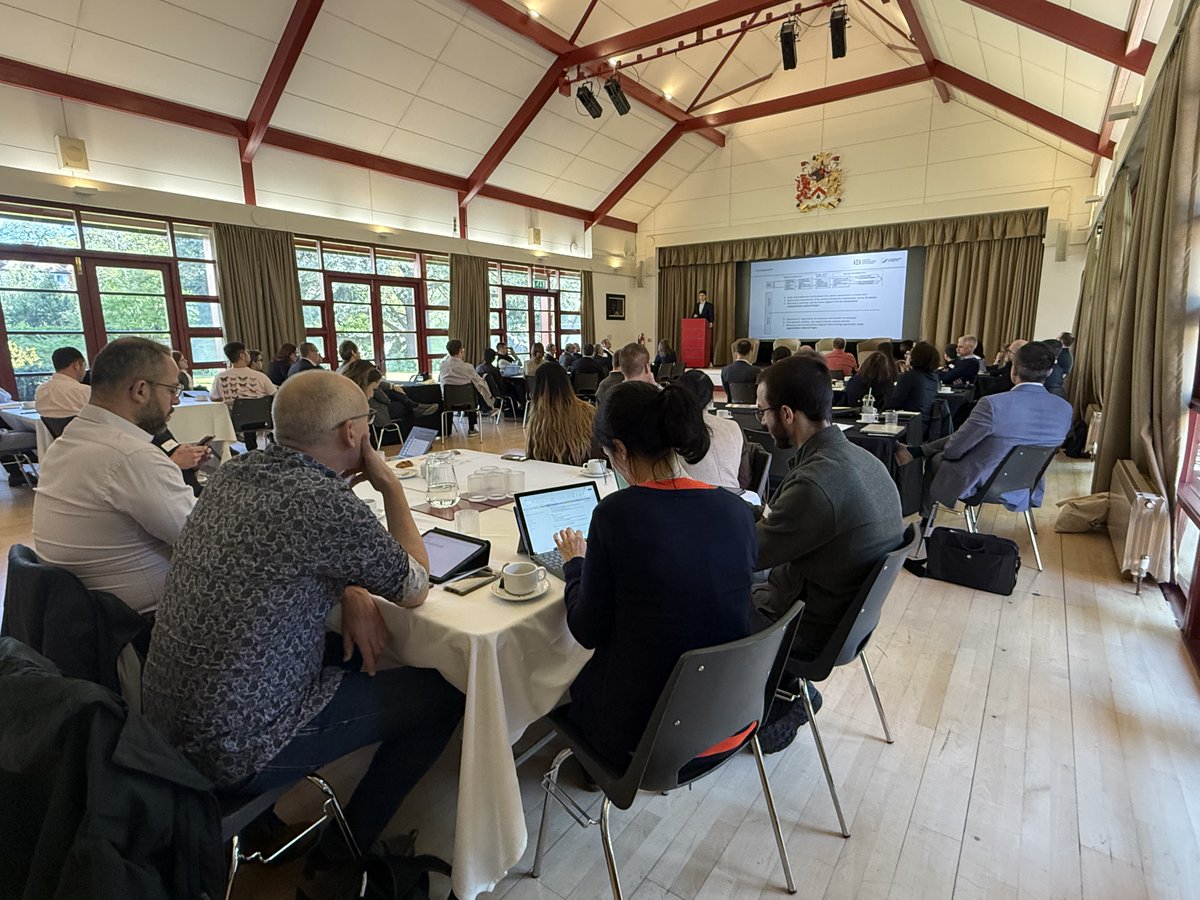
Delighted to see our CEO, Tim Barnes, alongside our research lead @cdh1001 and researcher Jenny Shehaj presenting some working findings of our upcoming report on #startup#incubators and #accelerators in the #uk at @WolfsonCam
Thanks to @innovateuk for their support!
On April 20th this year, the UK Biobank charity, which holds the genetic and medical records of approximately 500,000 British volunteers — people who donated their DNA, their health data, and their family histories on the explicit understanding that the material would be used for medical research — informed the British government that its data had been advertised for sale on Chinese e-commerce platforms. Three separate listings appeared on Alibaba. At least one of them, on the available evidence, contained data from all 500,000 participants.
The government's response, to its credit, was to ask Biobank to pause public access to the database while a "technical solution" is developed. The vendor was contacted; the listings came down before any sales appear to have completed. The story was reported once or twice and then dropped from the news cycle inside 48 hours.
What happened, in short, is that one of the most valuable medical research assets the British state possesses - a population-scale genetic and longitudinal health database, decades in the assembling, irreplaceable - was found being offered on a Chinese e-commerce site. The 500,000 British citizens who donated to it in good faith did so on the explicit promise that their material would be used for research purposes, by accredited investigators, under controlled conditions, within a system designed to protect them. The system, on the available evidence, did not.
There is a pattern here, and it is the pattern of every single tweet I have written in this series for the last month. The British state can no longer secure the things you give it on trust.
It cannot secure your borders, your public finances, your court records, your passport processing system, your prisons, or now your largest medical research database. The only consistent throughline of the last two decades of British government has been a quiet and continuous reduction in the basic competence of the state to do anything that requires sustained operational attention.
@Daves1412@s8mb The finding is akin to saying "electric cars are vastly cheaper than ones with internal combustion engines (if we ignore the costs of the batteries)." That's not serious scholarship.
@SirNotAppearing@s8mb Read the study. It explicitly excludes the cost of intermittency - the fact that renewables don't have consistent output. Given that free, grid-scale storage is currently impossible, that makes the report nonsense.
@s8mb Yep, and it also ignores the costs associated with replacing every remaining boiler with heat pumps, too. It's activism rather than serious scholarship.
@UniofOxford This is an embarrassingly bad paper. To entirely ignore the costs of transitioning all boilers in the UK to heat pumps, and then to further ignore the huge costs of intermittency, comes across as activism rather than serious inquiry.
@dorfman_p It's an embarrassingly bad paper. It assumes cost savings "once the system transition is achieved" (i.e. every boiler in the country is somehow replaced with heat pumps for free), and then explicitly ignores the cost of intermittency. It's nonsense.
With @timothy_barnes @CfEntrepreneurs at Incubator & Accelerator Network conference, previewing our IAN2026 survey results. If you've not yet completed it, please do! https://t.co/vaX3qS3CiM
Prohibiting self-custody of stablecoins, as the BoE proposes, is authoritarian, less secure, hugely difficult to enforce, and will kill many innovative blockchain firms in the UK.
Innovate Finance has sharply criticised proposed stablecoin regulations from the Bank of England, arguing that the framework risks undermining the development of a competitive sterling-based stablecoin market https://t.co/kCgJDcgALH
Also, as others have noted, this is exactly the use-case for Zero Knowledge Proofs - which several cool startups have been working on. Why is there no engagement with that topic?
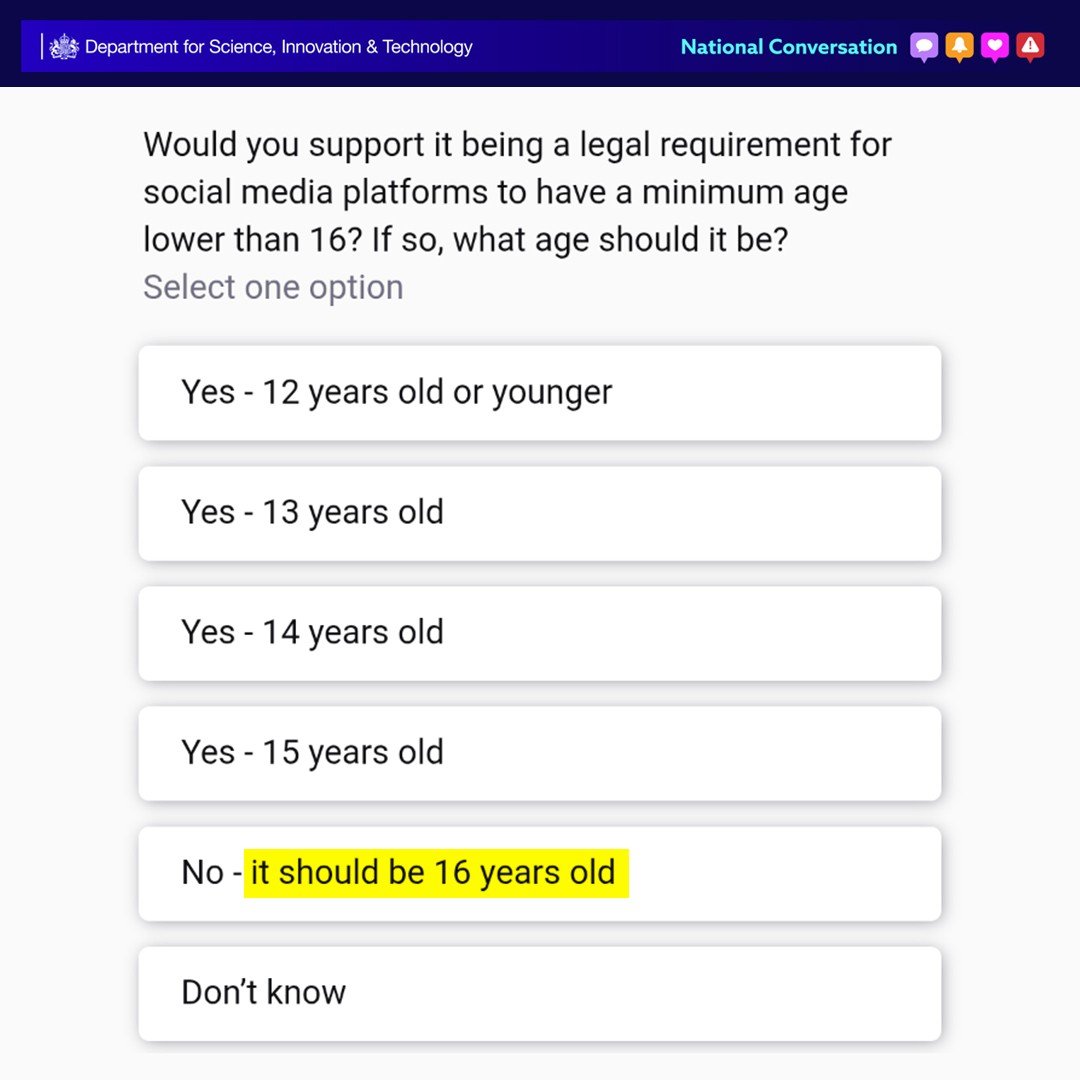
I've checked and this is true - the DSIT 'National Conversation' about social media literally has no option for parents to say that they don't believe in a legal requirement for age-gating it!
🆔Government to public: Do you want digital ID checks to be used to enforce a social media ban for under-16s
☐ Yes
☐ Definitely yes
☐ Strongly yes
☐ Yes 100%
The “consultation” doesn’t appear to have a box for disagreeing.