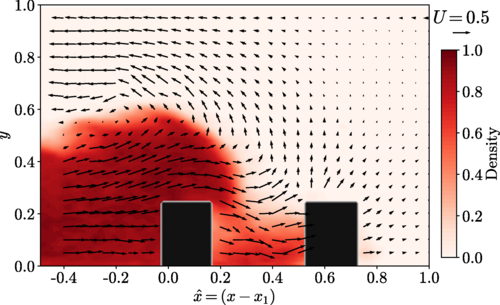
@PhysRevFluids With a several year delay, but the final paper from Alex's thesis is now available @PhysRevFluids. This paper focusses on dense obstacle arrays so that the current flows on top of the obstacles.
https://t.co/5xtG4Umib1
Congratulations Dr. Alex Meredith on your graduation. Nice for me to wear PhD regalia for the first time as well...
If people are interested in gravity currents interacting with current scale roughness fields then check out the following (with more to come...)
The next paper from Alex's PhD is published in @PhysRevFluids.
We look at gravity currents moving through sparse obstacle arrays (think a sea breeze moving through buildings in a city) and show how the density structure and speed of the current changes.
https://t.co/J5shFd36pu
Great opportunity of an iceberg stuck in a Taylor column to remind the world about this work in @JFluidMech looking at how Taylor columns can affect the melt rate of icebergs in the lab:
https://t.co/XgifpTC80u
If you're at all interested in any part of the Southern Ocean, check out this mammoth review paper that was just published:
https://t.co/kktb2jTvHx
Huge shout out to @LukeBennettsUoA, Callum Shakespeare, and Cat Vreugdenhil for coordinating all 38 authors!
Applications for summer graduate fellowships in Geophysical Fluid Dynamics are being accepted until Feb. 5th. This year's topic is Multiscale GFD.
More information and applications: https://t.co/bP3yB8t3vl
#fluiddynamics#geophysics#appliedmath
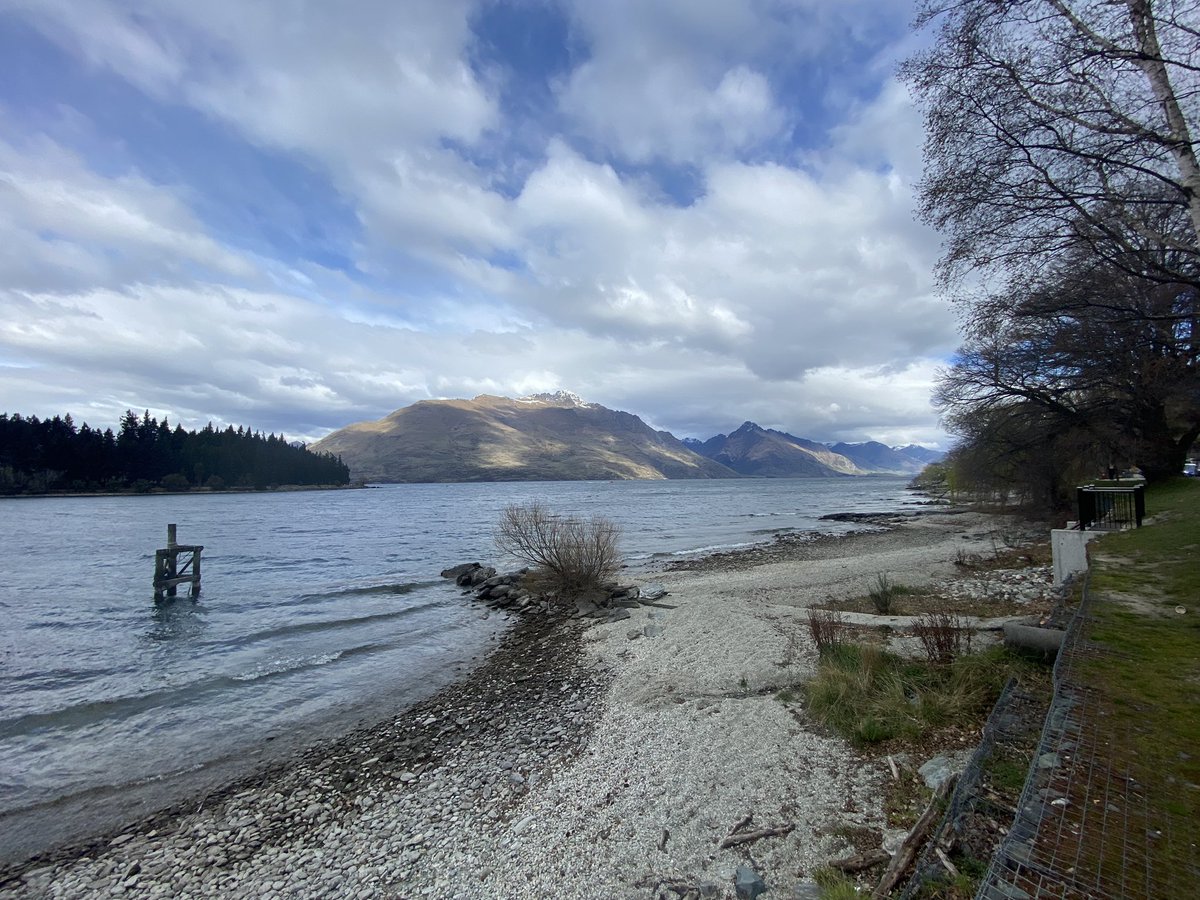
Since @brsutherland and @alexisonfluids showed off their wonderful Cape Cod working locations, I feel obliged to show that NZ also has lovely places to work…
If anyone knows an aspiring PhD candidate (or is one), the Civil and Natural Resources Engineering department @UCEngineering has a general scholarship round open now.
Feel free to contact me for info, particularly about fluid mechanics!
Details are here: https://t.co/tS3TfLyHJV
Congratulations Dr @CookStMonster on a great PhD defence!
Anyone who's interested in observations of stratified turbulence in highly energetic and/or coastal environments should definitely stay on the lookout for the upcoming publications (or read the thesis).
Can anyone explain to me why putting raw experimental data (a small table) in a 3rd party repository is better than in the actual paper?
Surely the paper itself is the most accessible place for the data...
@navid_ocean Fair.
In this case it was as simple as melt rate = (final mass-initial mass)/time so I'm not sure a script would be that helpful for anyone but maybe I should write a well documented script to store with the data.
Or maybe I should stop doing 1970's technology level science...
I had a lot of fun writing this short piece about a pair of recent papers based on exciting observations from under Thwaites glacier ice shelf.
Obviously I like it when people read what I write but really you should read the actual papers that it’s based on!
Varied patterns of melting and morphology have been uncovered beneath a West Antarctic glacier. Find out what these patterns reveal about the potential for collapse in this great N&V by @cdmcconnochie https://t.co/BtdUUKyvxl
@maaahge What a crazy innings though!
I'm assuming you saw this by following the game closely rather than happening to see it based on the wonderful metaphor in the commentary...
It's also humbling to think about how these globally important, large scale processes "depend on how the thickness of the mm-thin laminar sublayer at the ice-ocean interface is controlled, a question that cannot be conclusively answered at this time."
I'd definitely recommend this to anyone interested in ice-ocean parameterizations! It's great to see a step toward a comprehensive parameterization that accounts for different melting regimes and small scale physics.