🧠 Can we recover the equations governing a system directly from noisy, high-dimensional observations?
#DYSCO, by Paolo Muratore, is a first step: it learns latent spaces that capture the underlying dynamics & enables recovery of governing equations
📄https://t.co/gFCj7JCxMX
Ready to start with #CEBRA for your behavioral clustering, neural data, or joint-modeling? Check out our new demo notebook to help you learn the best practices and how to develop models! https://t.co/cAYqSSVYg7
🌈🦓 #ML4Science
Ready to start with #CEBRA for your behavioral clustering, neural data, or joint-modeling? Check out our new demo notebook to help you learn the best practices and how to develop models! https://t.co/cAYqSSVYg7
🌈🦓 #ML4Science
We have a new release up! Check out 0.5.0rc1!! 🔥
Important maintenance updates to keep up with dependencies, some nee features, and preparing for much more coming in the next weeks 👀…
https://t.co/TzGKiqnWvZ
#cebra @mwmathislab
In fact, this is what this very cool preprint does, cross subject decoding using CEBRA!
Mind blowing decoding across even held out cohorts of patients 🤯
Population dynamics and deep-learning analyses (@cebraAI@TrackingActions) of anterior insula single-unit recordings uncover distinct coding patterns of anxiety-provoking and safe environments, as well as tastants of positive and negative valence.
#SfN24 update: sadly, we are not there in person, but we love to see a lot of #DeepLabCut powered science is 🥳 and we are happy to retweet it! 💕 (tag us!)
👀 But, here is what we would present 🥰🔥 DeepLabCut 3.0 release candidate is up!🔥
pip install deeplabcut==3.0.0rc5
I have been reviewing the CEBRA paper in depth. What really strikes me is the multi-sessions/animal embedding. I feel like this paper is only scratching the surface of what could be done there. For starter, we could embed across species or even between models and experiments.
🚨Excitingly, this new paper in @NatureComms shows #CEBRA for behavioral analysis! Using SuperAnimal model for pose, we use 🦓 to do behavioral analysis — check us out if you are considering animal behavioral clustering 🚀🐭 (we are not only for neural data! 🥳)
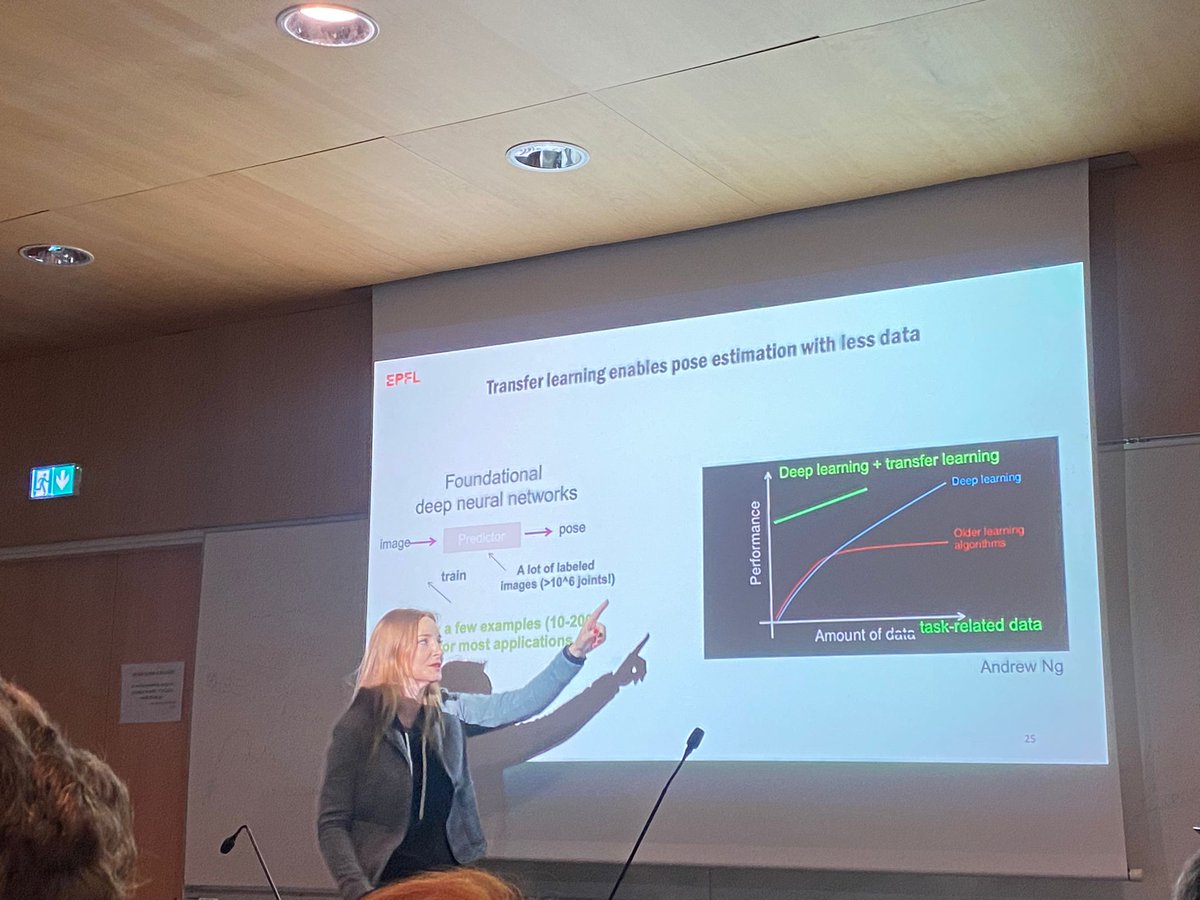
🔥 SuperAnimal: Foundation pose models for animals, trained on over 80K images, our model(s) can be used in the lab or the wild 🐭🐆🐄
💜models are available within @DeepLabCut & @huggingface w/extensive model/datacards
📰https://t.co/alReOIrpw0
📄https://t.co/N7UJj8szm4
1/2 Happy to present our new findings this Thurs 16:20 at the Mathematics of Neuroscience & AI conv. https://t.co/h5cMtFvk8b. We use @TrackingActions’ lab @cebraAI to probe stimulus-induced cortical embeddings by layer, cell type, in a biophysical model of cortical microcircuit.
Delighted to play a small part in this tour de force from @Simon_CEChang et al !
Beautiful merger of many behavioral tasks, neural recordings, @cebraAI, opto & scRNA-seq across tasks to find flexibility (and some neg. valence stability) of neural ensembles in the amygdala 💪🔥
@AheadOfTheNerve@WeissShahaf I wouldn’t recommend different iterations and temperatures if you want to head-to-head compare model infoNCE loss values; consistency would be okay though, as if you want to be sure they are each trained to be across-run consistent, then fine across animals/models
🖤🦓🥳😱 A humbling milestone: we just hit *100* citations and >17K downloads of the software since #CEBRA was published in @Nature (May 2023)!
Thank you to all the users and authors out there! 🖤🦓
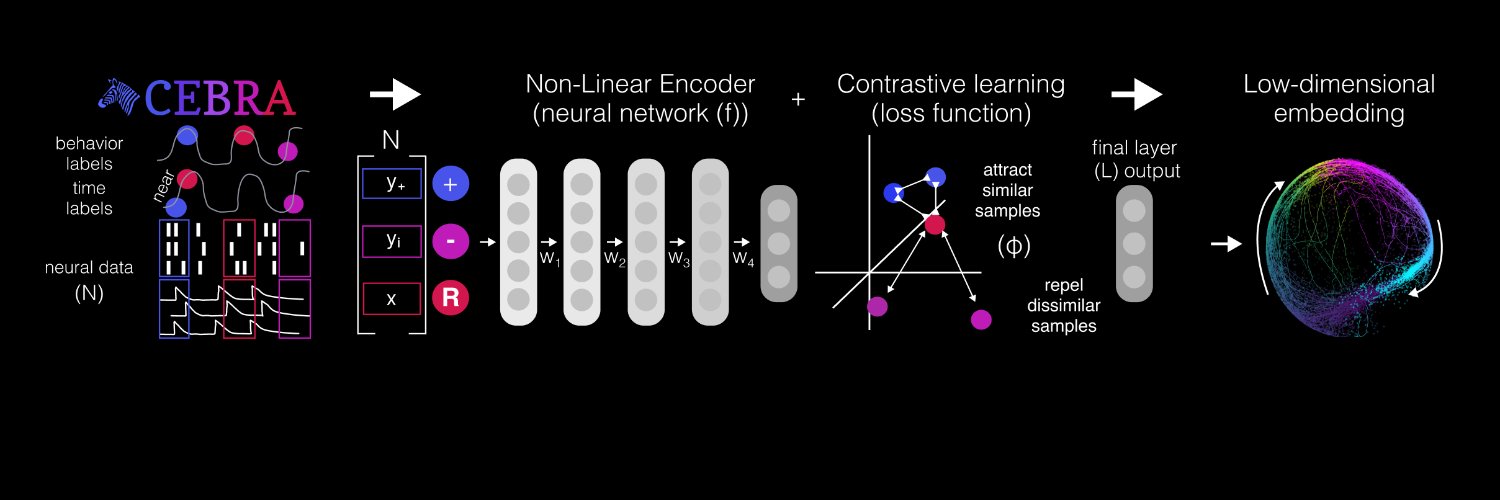
🦓 Self-supervised multimodal ML is promising the next AI breakthrough - in our new work published in @Nature, we debut @CEBRAai: for self-supervised hypothesis- and discovery-driven science.
📝 https://t.co/VmrRfy5V9B
💻https://t.co/RsnRWqkbGs
🦓 https://t.co/zgxSGtOpav
🧵⬇️
#CEBRA🦓can be used to build a unified neural encoding model using data from many animals, and that can then be deployed on new animals for BMI-style decoding 🦾
🔥what was super exciting is the pre-trained encoder can be used to rapidly adapt to a new dataset, which doesn’t have the same # of neurons, etc, and by rapid, in this case less than 1 sec of new data!
(And this is with a super simple MLP NN and kNN decoder!)