In this episode of the In/organic Podcast, @cehassold and Ayelet Shipley discuss what this deal reveals about podcast valuations and the future value of creator relationships.
65% growth. 100% founder-owned. Sold at 10x earnings.
Why sell now?
The answer may say more about how the market values podcast assets today, and why Acast could be making a smart bet before everyone else catches up.
Spotify: https://t.co/0HrhYVL3cn
Apple Podcasts: https://t.co/ccPA1RgMYQ
YouTube: https://t.co/tXHYT7W6Oi
Interested in sponsoring the show? Contact https://t.co/upnOvJauBb
Scale, capability, and measurable results used to command a premium. Now? They’re table stakes.
In this episode of the In/organic Podcast, Ayelet Shipley and @cehassold discuss the “star quality” thesis and why the real differentiator is distinctive work, cultural relevance, audience, IP, distribution, trusted relationships, and a reputation that’s nearly impossible to reproduce.
It’s the difference between “We need a business like this” and “We need this specific business.”
Spotify: https://t.co/loyFnIzIOt
Apple Podcasts: https://t.co/60fGM5uDjK
YouTube: https://t.co/291JqKsacd
Interested in sponsoring the show? Contact https://t.co/upnOvJauBb
I get a lot of questions from #PE#investors on where to place bets in the #commerce enablement landscape in the AI era. For example, what happens to CX > DX > MDM > PIM > DAM > DSA, etc? Do they converge? It's hard to see a complete convergence at this state because the problems from the starting point of the enterprise data problem to the glass pane where buyers engage its a pretty messy journey. AI can make a lot of improvements, but I don't see how it make stitching those things together for >1,000 SKU businesses.
What I said to one investor this week: work backwards from the buyer journey (B2B or B2C) and where its headed. If live commerce, as an example, finally on the rise in the U.S., thats a whole new set of data problems someone needs to solve. Imagine brands and retailers running live commerce 24/7 at scale with AI generated variations. What is required to adapt the current stack to that reality? If you have a thesis, that could be a bet worth placing with @Whatnot raising a $20bn Series G.
https://t.co/HSADMHXQOP
@ttunguz have you experimented with any semantic routing that works well? Part of the problem is knowing when to use local vs. frontier from task to task (esp for unstructured requests as your define in your newsletter). A Red Hat developer built one for OpenClaw: https://t.co/rarMNOw5Zd
Liberal arts concentrators are about to have a career renaissance in the #AI era.
Their edge is unsexy: trained to read books and papers end-to-end and engage critically with the material. AI outputs sound confident — often better than expected — and as @samwoods says, the untrained eye ships them as-is.
Related — I've been testing the llm-council skill for @claude. Having 5 advisors powered by each of Claude, GPT, and Gemini pressure-test each other genuinely sharpens ones own thinking. But it doesn't solve the deeper problem: the council only knows what you feed it. Missing context and hallucinations still slip through.
Define "leading"? They @united was ranked #6 by @WSJ. Scott Kirby seems to have not learned much from having to clean up after the mess Jeff Smisek left following his forced departure. Merging two great brands / identities in service of 'scale' is not "bold" its a distraction. Kirby's idea of a great customer experiece? Try finding a customer service agent at ORD, their hub - GONE! 100% virtual.
I asked @RyanHarwood27 to break down the launch of his venture, @tamaragroup, with @vayner_x at #possible2026
Ryan put it this way: "We're not being paid to think. We're not being paid to appease. We're being paid to create."
Organic content creation at scale is the most misunderstood and most important part of modern marketing, and that traditional agency staffing (roughly 80% strategy / 20% production) has it backwards. Tamara Group flips the ratio.
What is a “Buy Box” in an M&A context? This was a topic of discussion on the The @cpgguys podcast I joined recently and it's got nothing to do with Amazon! 😄
It's a term I picked up at the first DealCon M&A Summit I attended a couple years back. Its a pretty simple concept, but one would be surprised how many buyers contemplating hashtag#acquisitions get stuck filling in all the boxes with super clear definitions
The goal of a Buy Box is to push a buyer (leadership and investors) to clearly define and communicate the attributes of an ideal acquisition target. Doing so, makes is easier to focus on this opportunities that matter and to pass on the ones that are not a fit.
Example 'Buy Box' Filters (adapted for a #strategic #acquirer context):
✔️ Revenue Range (minimum & maximum)
✔️ EBITDA Range (minimum & maximum)
✔️ ICP (customer types and vertical markets)
✔️ ACV (ideal annual revenue value per customer)
✔️ Capability (tech or human capabilities to be gained)
✔️ Special Sauce*
* If the desire is to drive a transformational outcome through M&A, buyers should have a special sauce 🍝 in mind.
Examples include:
🍝 Best in Class Product / Tech (delivers 4+ quarters worth of product build & customers in one deal)
🍝 World Class Customer Community (takes years to build a credible one, I gave the example of the The Digital Shelf Institute which is prominent in commerce)
🍝 Highly Impactful Leadership (thought leadership, credible awards you can't buy, that come with high NPS and eNPS that often drive growth and customer retention)
Thats a build on the several things we talked about on the show. BIG thank you to @paparajsri and @PVSBond for having me on to talk all things M&A in commerce & media!
https://t.co/zzmyTi9V3M
PSA: Anyone thinking about using @polsia with Oauth or user account management system, think twice.
Per an email to me from the support email system:
"I don't have a timeline on when we'll publish formal security controls or offer a hardened auth standard for customer apps. I'll make sure your feedback gets logged — enterprise-grade auth with defined security controls" is exactly the kind of thing we need to hear from users building for high-trust audiences.
In the meantime, my honest advice: don't launch auth to your customers until you're comfortable with what's underneath it."
I discovered this issue after the agent flagged by hapstance that the API's it built we exposed "anyone can enumerate user IDs (1, 2, 3…) and pull full PII: emails, names, companies, roles, subscription status." It then asked me if it wanted me to fix it (and charge me credits to in essence fix the flawed code it wrote.
Any agentic platform built for millions of customers that thinks protecting user information is optional for the roadmap cannot be a serious business and I dont understand how people I trust are giving it airtime with such a serious gap.
@Digiday Depends on whether you count debt market conditions at "not yet". Sub 3.5x leverage is current state. Agree, the pressure is on larger deals, but there is a trickle down effect, prob down to $20M EV deals.
im in the process of doing that with a specific use case. In the cases I was referencing, I was dropping in code snippet to get feedback on how to handle specific errors, it did not always know CLI commands that were widely published. In another, I asked for help with a specific part of my resume; it suggested content that the recruiter universe considers AI "red flags"
@freeCodeCamp Claude doesn't know Claude Code itself as much as you might think, and there were so many times things did not work as expected and I was using my old school ways to pull us through it to the end.
The human still knows best.
@chamath made a similar point on @theallinpod last week but this is an interesting stat from @coderabbitai; AI code "creates 70% more problems...". Meaning, AI code is not "production ready."
In truth the point is really that humans are still learning to balance when to keep hands on or take them off the wheel.
Example: Asked #Codex to build @SlackHQ comms for my agent. Done in 2 mins.
Except it didn't support channels, threads, or emoji responses — just DMs.
Maybe intentional for security. But Codex never asked. It assumed.
The model executes fast. It doesn't yet ask the obvious follow-ups a good engineer would.
https://t.co/CmaOqJcCqN
We are terribly good at innovating faster than we can build. Interference and GPU capacity constraints are the modern version of internet speed being constrained by lack of fiber and last mile network maturity.
This analogy holds true with one BUT...
1. The "Bandwidth" vs. "Compute" Parallel
The Internet Era: In the late 90s/early 2000s, we had the code for streaming video and complex websites, but copper wires (dial-up) couldn't carry the data. The "pipe" was too small.
The AI Era: We have the algorithms (Transformers) to do incredible things, but silicon (GPUs) can't process the math fast enough. The "engine" isn't powerful enough.
2. Physical vs. Logical Constraints
Fiber/Routing: To fix the internet, we had to physically dig trenches and lay fiber optic cables. It was a labor and hardware problem.
GPU/Energy: To fix AI, we have to build massive data centers and upgrade the electrical grid. It’s no longer just about better code; it’s about physical power plants and cooling systems.
3. The "Last Mile" Problem
Internet: You could have a massive backbone, but if the house didn't have fiber, the speed was slow.
AI (Inference): You can have a massive model in the cloud, but if the inference hardware at the edge (or the cost per token) is too high, the "user experience" fails.
BUT... The AI constraint is actually more complex than the internet one for two reasons:
Energy Consumption: Doubling internet speed didn't require doubling the world's power production. AI scaling does have a massive, linear relationship with electricity.
Scarcity: Fiber is made of glass (sand); it's cheap once laid. GPUs are made of incredibly rare high-end components (HBM memory, 3nm wafers) that only 1 or 2 companies in the world can actually make.
"We've been growing a lot and are out of GPUs."
Sam Altman, OpenAI CEO
Mar 2025
"We are still waving off customers or scheduling them out into the future. This is a situation that we have not seen in our history."
Safra Catz, Oracle CEO
Oct 2025
"You may actually have a bunch of chips sitting in inventory that I can't plug in. I don't have warm shells to plug into."
Satya Nadella, Microsoft CEO
Feb 2026
"What keeps us up at night… The top question is definitely around capacity. All constraints — be it power, land, supply chain constraints — how do you ramp up to meet this extraordinary demand?"
Sundar Pichai, Alphabet CEO
Feb 2026
"There's no relief as far as I know. No relief until 2028."
Lip-Bu Tan, Intel CEO
What happens when your AI doesn’t answer?
Everything is in short supply. It’s no longer just GPUs. It’s power. Data centers. Memory. CPUs.
If there’s no relief for six more quarters, perhaps it’s time to plan for a world where inference isn’t freely available on-demand.
Inference prices, which have been static, will rise. Subsidies will be harder to justify.
Enterprises will need to rationalize workloads, deciding which teams receive state-of-the-art models & which don’t. Not every CRM update requires a trillion-parameter frontier model.
Inference rationing normalizes. Marketing receives this much, sales receives that much, software engineers probably receive a lot more.
Constraint will be the mother of invention. Companies will optimize what they have, adopt open source where they can, and likely move to smaller models for many workloads.
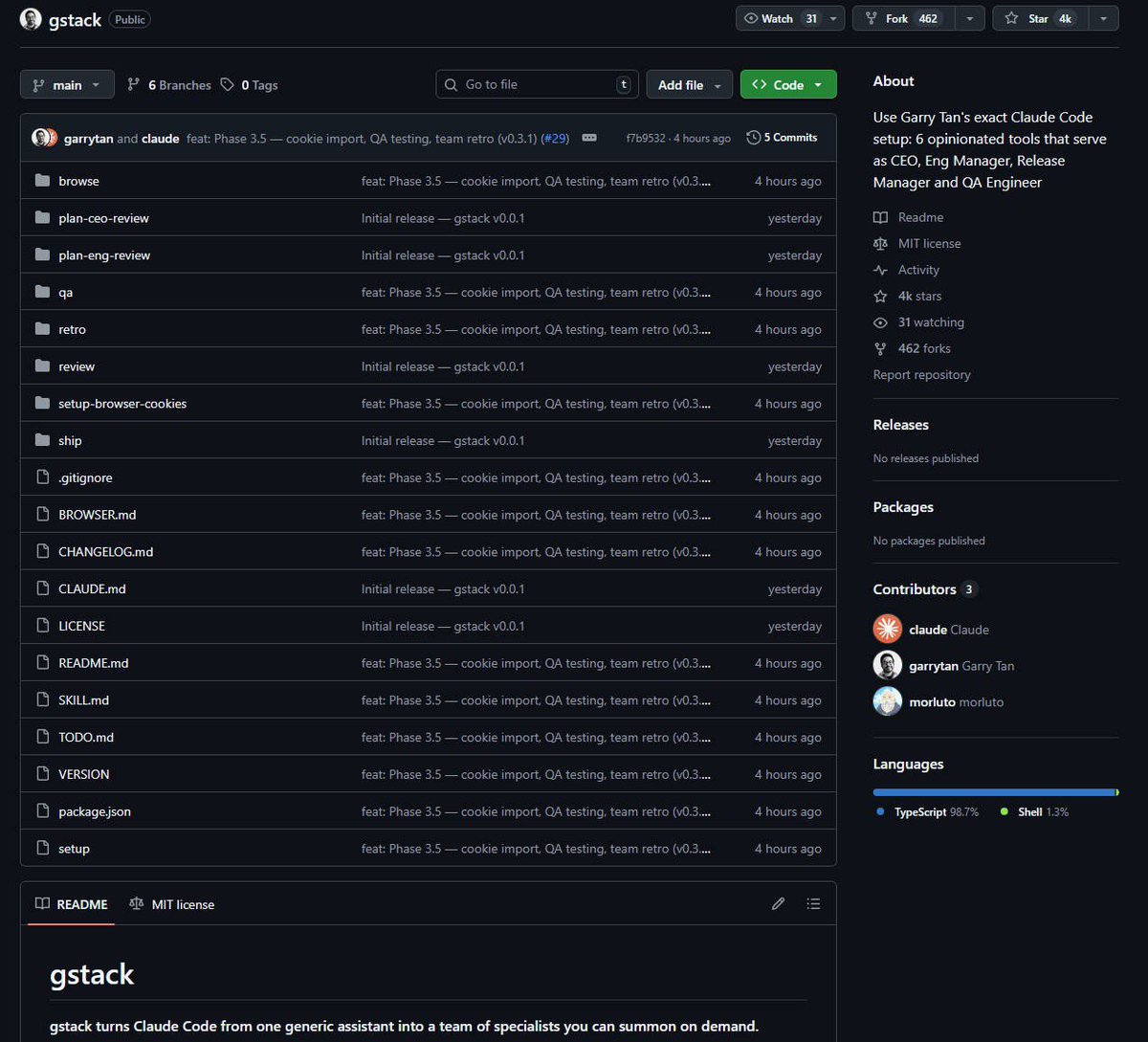
🚨 BREAKING: The CEO of Y Combinator, Garry Tan, just open-sourced his personal AI setup.
It’s called gstack.
It turns Claude Code into a full virtual tech company:
→ CEO agent
→ Engineering Manager
→ QA tester
A conductor agent forces strategic thinking before any code is written.
Ship software like YC.