Yesterday, I lectured on Alexander Hamilton’s economic program for the U.S. I always look forward to this lecture, both for the content and because Hamilton is my favorite founding father. I was never a Jefferson man.
Hamilton understood that “libertarianism in one country” is not feasible. Assume, just for this paragraph, that libertarian economic policy is right: that a minimal state is the best recipe for growth. A country that adopts it will grow much richer than its neighbors. But then its neighbors will want to invade it to seize its wealth or, at least, use the threat of violence to turn it into a tributary state and extract rents. And a libertarian state cannot defend itself (no, Switzerland was never a libertarian state; it always spent heavily on defense, for example in the service it required from its citizens). The more you believe in libertarian economic policy, the more you should fear your country adopting it (unless, by some miracle, the whole world adopts it at once).
Hamilton instead foresaw that the U.S. would live in a world of competing empires, where constant war requires professional armies, not militias. The Revolutionary War was not won by militias, however much the myth of the well-regulated militia survives among some Americans, but by the professional armed forces of the U.S., France, and Spain. No “la Royale” under the Comte de Grasse, no victory at Yorktown.
Hamilton therefore anticipated that the U.S. would need a powerful fiscal-military state and a prosperous economy to ensure the survival of freedom and the republic. Economic and military strength go hand in hand: like the god Janus, they are two faces of the same phenomenon.
For some decades, the U.S. fiscal-military state could stay small: two oceans and luck with neighbors (a quasi-balance with the British Empire to the north after the War of 1812, where neither side had much incentive to deviate, and a quasi-failed state to the south). But by the early twentieth century, reality kicked in: Germany, Japan, the Soviet Union, China. This is an important and often underappreciated mechanism behind the creation of the Federal Reserve System in 1913 and its survival thereafter, as shown by the way it floated the Liberty Loans of 1917 (no, the U.S. could not have fought in France on tax revenue alone; no great power ever has).
This was not the first case. Central banks were not born from monetary theory but from war. The Bank of England was created in 1694 to finance William III’s war against France. Hamilton’s First Bank of the United States was established to consolidate Revolutionary War debt. The logic is simple: the state that borrows cheaply and at scale outlasts its rivals on the battlefield, and a credible central bank is what makes such borrowing possible.
This is why central banks survive even in republics deeply suspicious of concentrated financial power. Presidents could campaign as Jeffersonians as much as they wanted; the first serious war turned them into Hamiltonians. Hamilton understood how the world works; Jefferson did not. And the causality also runs in the other direction: by lowering the cost of mobilizing resources, central banks made war on a modern scale possible.
To paraphrase Charles Tilly: war made the central bank, and the central bank made war.
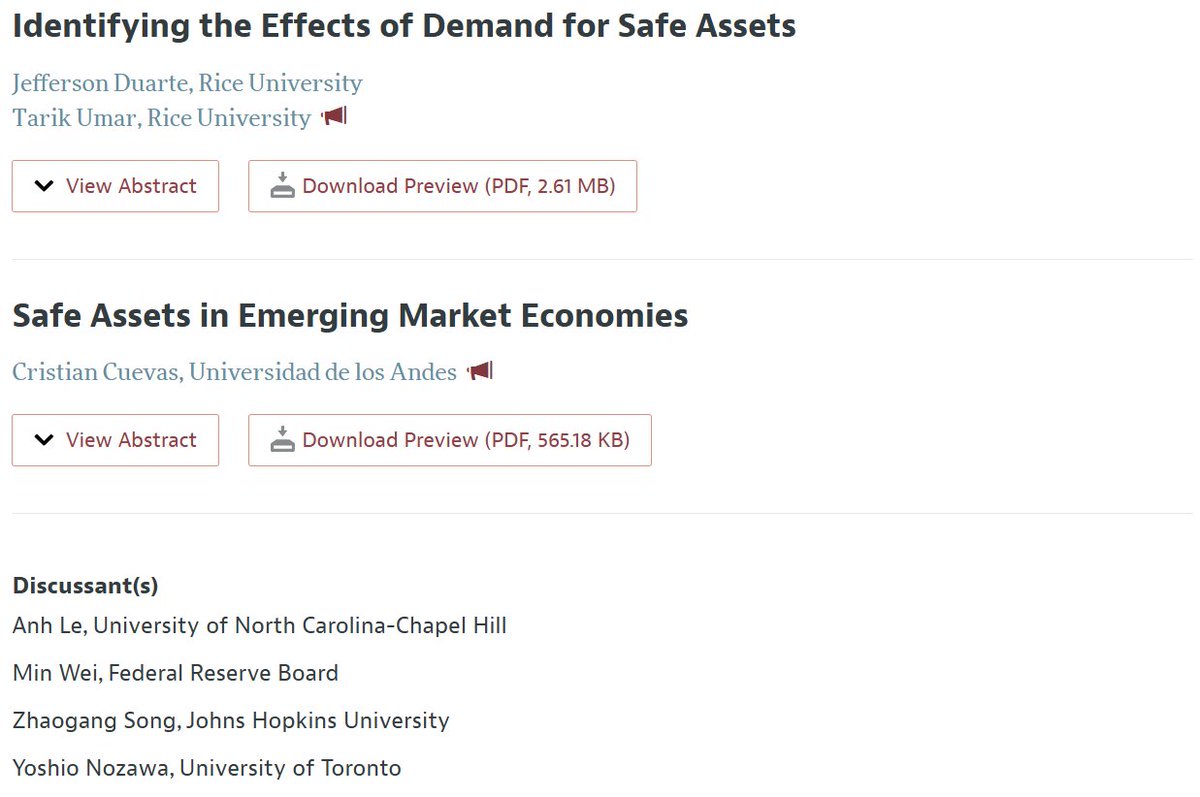
The LACEA 2025 Annual Meeting Program is now live!
You can browse the full schedule—including keynote lectures, contributed papers, invited sessions, and institutional events—at the link below.
👉 https://t.co/cHUzQ77pz3
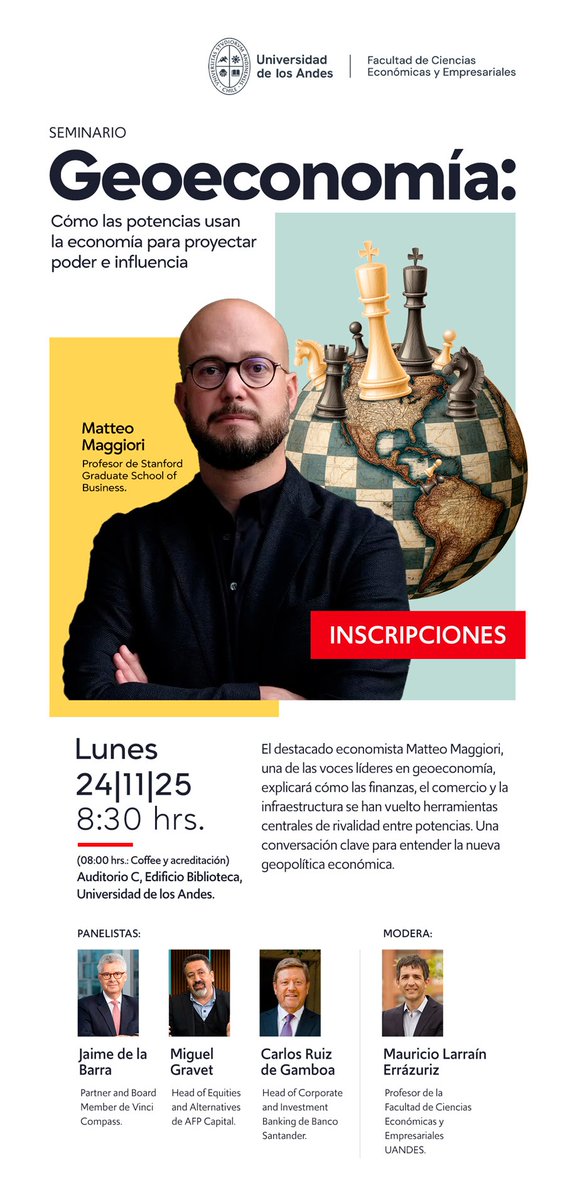
On Nov 24, @uandes hosts @m_maggiori for a keynote on Geoeconomics and a panel with Jaime de la Barra (Vinci Compass), Miguel Gravet (AFP Capital), Carlos Ruiz de Gamboa (Banco Santander), and Mauricio Larraín Errázuriz (UANDES).
Learn more and register: https://t.co/sKQsr0crt4
This article on Fed independence manages to be a lively "page turner", of historical significance, and of immense relevance to current debates. It has my highest recommendation for both beach and office reading.
https://t.co/rOG0WfEnNn
We can't wait! All roads this morning lead to Reading! After careful preparation since November 2024, we are excited to open the 56th @MMF_research annual conference in about an hour here, with an excellent programme & some 150 delegates. More details: https://t.co/HYcgSbQ2bS
How to make sense of Donald Trump’s tariffs https://t.co/lduF73ZuLy via @financialtimes // Finally someone realizes Trump works under a different economic framework than the mainstream that underlies Smith/Keynes/Friedman: "geoeconomics" @m_maggiori
Chile puede convertirse en el primer país del mundo fuera del Este de Asia en tener una tasa de fecundidad por debajo de 1,0.
Un fenómeno demográfico sin precedentes históricos fuera de Corea, Japón o algunas regiones de China.
Y apenas estamos empezando a hablar del tema.
Hoy sale una entrevista de Ivan Luzardo y mia en El Mercurio de Chile:
https://t.co/70NpFvcYQQ
sobre el invierno demografico que se avecina en toda Iberoamerica. El colapso de la natalidad en Chile de 2014 a 2024 es casi imposible de creer.
In the detailed program you will find information on all sessions of the LACEA-LAMES annual meeting in Montevideo. https://t.co/MO1SXBhOw2
...
En el programa detallado encontrarás la información de todas las sesiones de la reunión anual de LACEA-LAMES en Montevideo. https://t.co/MO1SXBhOw2
@voxlacea@econometricsoc@FCEA_UdelaR@fcsudelar
Summer Forum 2024 begins next week! From June 5-26, hundreds of economists will connect in Barcelona and online to debate the latest research across dozens of topics in #Economics and related fields.
We look forward to welcoming you all! #bseforum
https://t.co/ixttNO7Vay
The XXVI workshop on intl econ & finance will be held in Chile on Sep 26-27. Tom Sargent and Hugo Hopenhayn will be the keynote speakers. Please send us a paper on macro/development/intl macro, broadly defined, by June 23rd.
All the info at https://t.co/BInp2r5X72