Are secret recordings admissible in evidence?
Secret audio and video recordings are admissible in evidence in Kenya, provided they satisfy statutory requirements for electronic records and survive constitutional scrutiny regarding privacy and fairness. The legal framework governs admissibility across three main thresholds: statutory electronic evidence rules, constitutional limitations, and the emerging judicial balancing test.
Under the Evidence Act (Cap 80), secret recordings constitute electronic records, and their admissibility turns primarily on Section 106B. When an electronic record—such as an audio file, tape, or video capture—is tendered using secondary media rather than the original recording device itself, it must be accompanied by a formal Section 106B certificate. This certificate must be executed by a person holding a responsible position regarding the operation of the device or the management of the relevant activity, whether that is the individual who captured the footage, the system administrator who retrieved it, or a forensic analyst. The party adducing the evidence must demonstrate that the recording device was operating properly, that the file has remained free from tampering, selective editing, or splicing, and that an unbroken chain of custody has been maintained from the moment of capture to its presentation in court.
Beyond technical statutory compliance, secret recordings must overcome a rigorous constitutional hurdle anchored in Article 31 and Article 50(4) of the Constitution of Kenya. Because covert surveillance inherently infringes upon the right to privacy, the court must apply the exclusionary rule under Article 50(4), which mandates the exclusion of evidence obtained through a violation of the Bill of Rights if admitting it would render the trial unfair or otherwise be detrimental to the administration of justice. However, privacy is not an absolute right.
Under the limitation principles of Article 24, Kenyan courts routinely weigh individual privacy expectations against overriding public interests, such as exposing corruption, unraveling financial crimes, or preventing grave criminal conduct. Where an individual uses private quarters to orchestrate unlawful acts, courts have consistently held that the expectation of privacy cannot serve as a constitutional shield for wrongdoing.
This balancing approach is reflected across Kenyan jurisprudence. In criminal proceedings, as seen in Republic v. Philip Kilonzo & Another and various anti-corruption trap operations prosecuted by the Ethics and Anti-Corruption Commission, judges retain discretion to admit secretly obtained recordings where their probative value significantly outweighs any procedural prejudice and serves the broader interests of justice. In civil and commercial litigation, courts continue to draw upon the foundational principle that relevance dictates admissibility, subject to the court’s overriding discretion to exclude unfair material and the strict fulfillment of electronic certification rules.
Ultimately, the successful admission of a secret recording requires establishing five interconnected elements: logical relevance to a fact in issue, strict technical compliance through a Section 106B certificate, positive identification of the voices or faces captured, forensic proof of authenticity and custody, and satisfaction of the constitutional proportionality test ensuring that the admission does not undermine the integrity of the judicial process.
The Chief Justice is right in stating that sexual offences should and will not be handled in AJS. This a necessary affirmation of the dignity, safety and rights of survivors. Rape, defilement, sodomy and domestic violence are not disputes but crimes. You do not negotiate trauma. You prosecute it.
AJS has its place in our justice system, for commercial disputes, neighbourhood conflicts, restorative processes where parties bargain from relatively equal power. But in sexual and gender‑based violence, the power imbalance is structural and brutal. The law cannot tell a survivor to sit across the table from their abuser and bargain away accountability.
We have seen the damage when sexual offences are pushed into informal settlements. Silence, intimidation, family agreements that erase the survivor and entrench impunity. Communities are pressured to protect the perpetrator’s name, not the survivor’s future. When the court abdicates to such processes, it abandons its constitutional duty to protect the vulnerable.
Saying no AJS for sexual offences is, therefore, a line in the sand. Some harms are so grave that the State must speak, investigate, and prosecute loudly and clearly. Article 27 on equality, Article 28 on human dignity, Article 29 on freedom and security of the person all demand more than compromise, they demand justice. Survivors deserve a courtroom that believes them, not a backroom that bargains them away.
#HakiNaImani
Dear Colleagues
Do you know that ;
1. Section 4A of LSK Act was introduced in 2023 and now requires LSK to inspect law firms, investigate advocates, issues penalties such as fines etc?
2. Do you know that if you suspect your client engages in money laundering - you are required to secretely fill a form and report to LSK?
3. Do you know that LSK is now required forward the confidential forms to the government?
4. Do you know all law firms are required to designate a anti- money laundering compliance officer for purposes of reporting to LSK. In small, and medium law firms- this will be the managing partner.
Well, allow me to explain the history of all these.
1. In 2022- the government introduced an amendment to the POCAMLA that required lawyers to report to the Financial Reporting Center- all suspicous money laundering transactions.
2. Failure to report was a criminal offense punishable by two years imprisonment. Mwaura Wakabata through Omwanza Ombata filed a Petition to challenge the constitutionality of the Act. High Court was hesitant to grant interim orders to suspect the amendment .
3. Later LSK hired my law firm to represent it in the case. I suspended all assigments, and concentrated on this case- preparing a 54 paragraph affidavit [ attached] that raised 10 major fundamental policy and regulatory concerns about making lawyers as snitches for the government.
4. When the application for conservatory orders was listed for hearing- I intensely pushed Justice Makau on behalf of LSK to suspend the amendment. We had to employ all tricks in the litigation handbook to get the interim orders. Justice Makau was convinced especially after reading our affidavit on behalf of LSK.
5. All hell-broke loose after we got the interim orders. The IMF, FTFT, and World Bank put a lot of pressure on the government to win the case. They threatened to cut funding to Kenya if lawyers did not become reporting agents of government.
6. On behalf of LSK I attended more than 7 meetings where I put my foot down and intensely pushed back, reporting to LSK President all my moves. In Jan 2023- senior advisors of the President invited all parties to a meeting at State House to settle the case. They deliberately declined to invite me because of my hardline position- when I got wind of the meeting I threatened to scuttle any outcome in court. They changed their minds. A state house operative called me, apologised and got me into the meeting.
7. In the State House meeting- Mr Onderi advocate appeared for Mwaura Wakabata, Hellen Namisi [ now judge appeared for LSK Nairobi Branch]. I was for LSK. I briefed the LSK President and he agreed with my strategy. During the meeting the senior advisors of the President tried to intimidate me but that morning I had taken spiced tea. I stood firm. Strategically appearing dominating, annoyed, and angry [ this is a strategy in negotiation]. I declined to sign a draft consent they had prepared until we got our way.
8. After lots of behind the scenes negotiations between GoK and my clienf [ LSK] -a consensus was reached. Mwaura Wakabata through his lawyers- signed it. I was asked by LSK President to sign it. What was the final consensus ? First, lawyers should NOT report to the government but should report to LSK. LSK should be the regulating agency but accountable to the Financial Reporting Center.
9. At the moment, LSK has got support from the UN to train lawyers on compliance issues- how to report on clients. It is a real issue. We must address it. Especiallly the teething reporting concerns that I raised in my 54 page affidavit. Lawyers are also raising these issues. Already advocates are getting arrested and charged in court under the Act.
10. In my view, we must consider amending section 4A of the Act to further strengthen protections to the advocate by limiting reporting obligations and sanctions. We also need an intense regulatory regime that requires approval from a High Court judge.
Breaking Down the Computer Misuse and Cybercrimes (Amendment) Act, 2025🧵:
The law now covers access “through a programme or device” -meaning AI tools, bots, or malware are expressly included.
“Assets” now include virtual and crypto property even outside Kenya.
“Identity
President Ruto has signed 8 Bills into law, including key ones that affect digital safety, crypto trade, air travel, and government operations.
Here’s a breakdown of the signed Bills.
Thread below:
Dear Law Students, please read this Court of Appeal judgment on matrimonial property. As I was going through it, I came across this closing paragraph: “Following the untimely death of Hon. Mr. Justice Fred Ochieng prior to the delivery of this judgment, and there being concurrence by the remaining members of the bench, this judgment is delivered under Rule 34(4) of the Court of Appeal Rules.”
Rest in peace, Judge.
Link: https://t.co/AqNBAoOBUz
Apellate Advocacy at the CoA is one very PARTICULAR PRACTICE: the court will ask, what rules/law allows you to move us, what law/rules give us power to issue the reliefs you want & more importantly what aspect if a judgement do you appeal on, & at times I've seen Ngugi JA question grounds that are not MATTERS OF LAW in cases of second appeals. Because first appeals are retrials hence the factual issues can be retried.
I wish to report to the House that my office has received a petition from Mr. Allen Waiyaki Gichuhi, EBS, SC of @WamaeAllen, calling for the House to consider amending the Consumer Protection Act (Cap. 501) to codify the in duplum rule.
The petitioner avers that the purpose of the rule is to protect borrowers from exploitation, prevent the endless accumulation of interest, and encourage fair lending practices. Section 44A of the Banking Act codifies the in duplum rule, which provides that interest on a loan ceases to accrue once it equals the outstanding principal amount when the loan becomes non-performing. ~ @HonWetangula #BungeLiveNA,
Join us in solidarity for the Purple Ribbon March against the brutal killing of Advocate Kyalo Mbobu. Let's stand together, demand justice, and ensure accountability. Your presence matters.
Date: Friday, 12th September 2025
Time: From 9 AM
Route: Milimani Law Courts through Kenyatta Avenue to Vigilance House
#JusticeForKyaloMbobu #PurpleRibbonMarch #AdvocatesForJustice #StandWithUs
Okay, documentary twitter, today I gift you 20 documentaries and their links. Most are very deep and long. If you like them , you can watch them.
A thread.
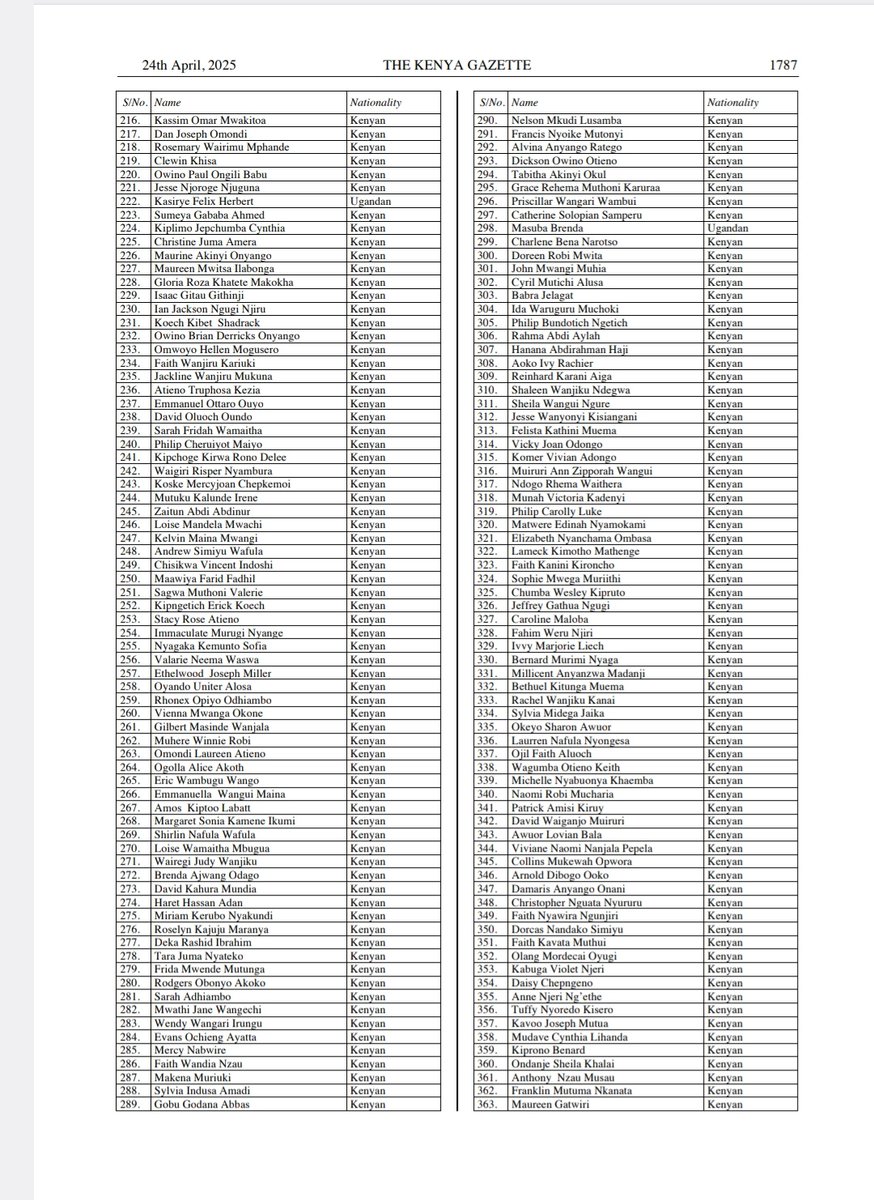
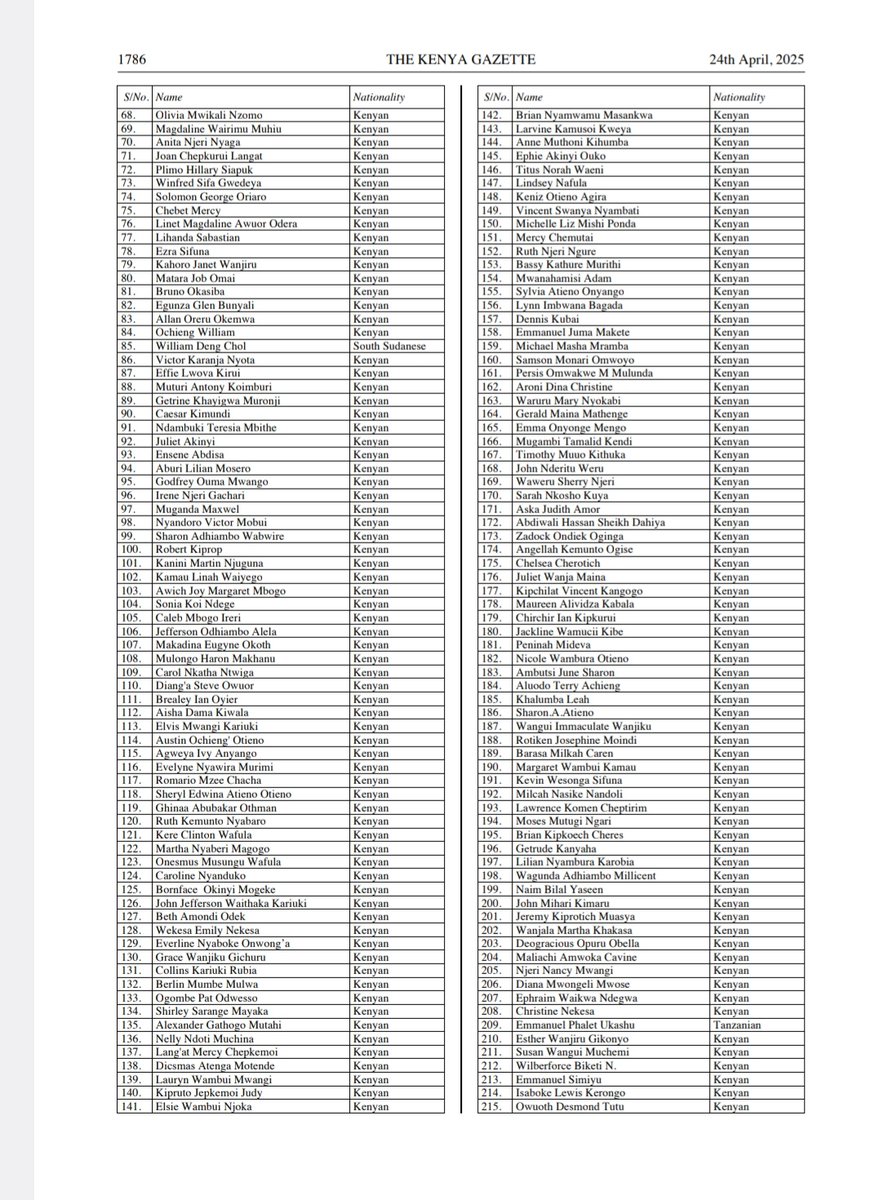
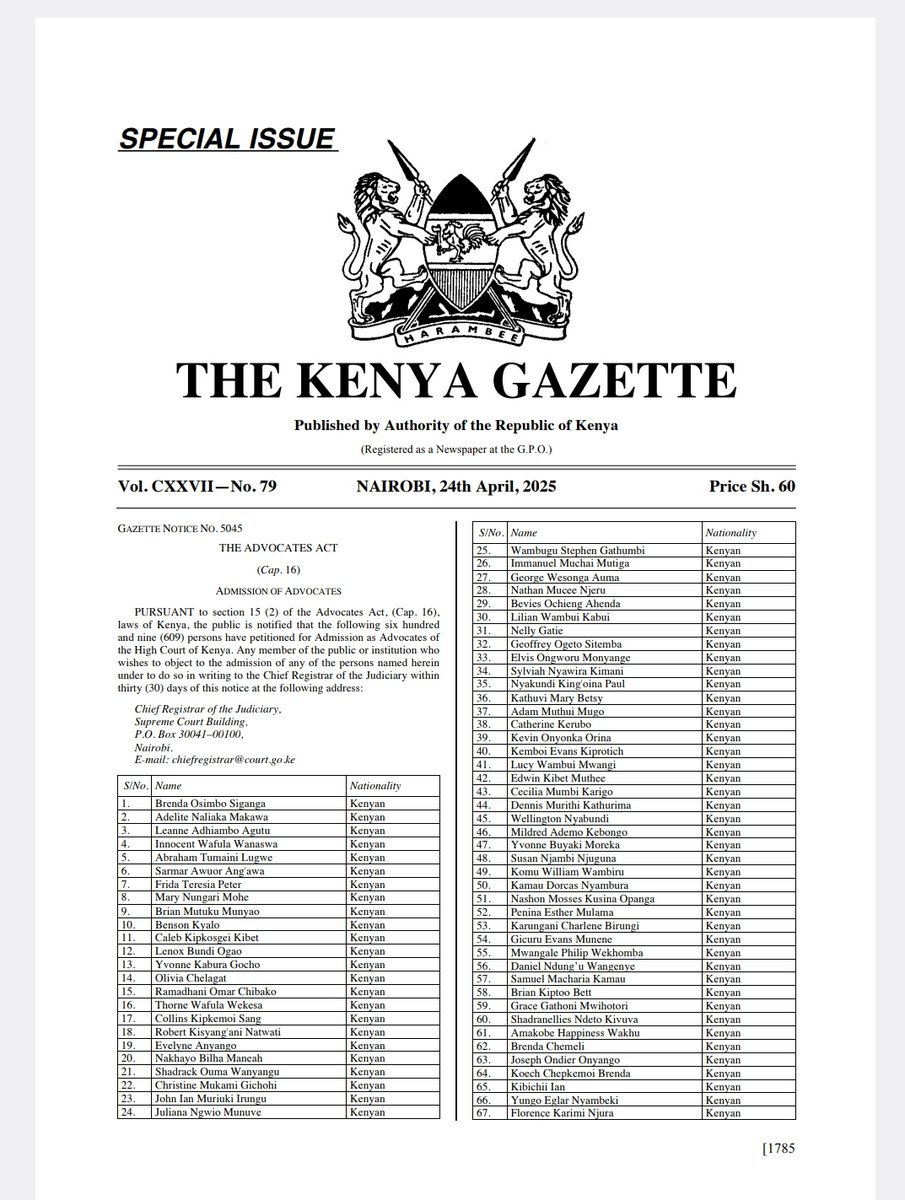
WELCOME TO THE BAR new advocates being sworn in today! Congratulations to you, your parents, guardians and teachers. Go forth and serve with excellence. Identify your relative/friend and give them a shout out here and help us celebrate them!
Dear Esteemed Law Lecturers,
The latest Court of Appeal (Civil) Judgments and Rulings delivered on 28th March are here. Put your students to the test with real-world legal reasoning and critical analysis. https://t.co/Ko0CzS8tBP
Dear single Lawyers, please find (Civil & Criminal) Judgments and Rulings delivered today by the Court of Appeal. If you are married, kindly wait until next week, focus on your matrimonial jurisdiction first.😂
https://t.co/4PScWmHqQf