NFT Fractionalization Has Failed
People have been enamored with NFT fractionalization for years. It's not a new thing.
The idea is simple: One CryptoPunk NFT is worth $150,000 today. Very few people can afford to buy a single Punk.
What if you could acquire a 1/00th of that same Punk for just $1,500? Suddenly, the opportunity becomes far more accessible. And if the value of the Punk triples during the next NFT bull market, that $1,500 investment could balloon to $4,500+.
BUT, previous attempts at fractionalization have always struggled to gain traction:
➡️ NFTX tried to do this with fractional vaults for years (deposit Punk NFTs and get PUNK fungible tokens) but has no significant adoption even today.
➡️ Flooring Lab launched a couple of months ago with a similar idea: deposit an Azuki NFT and get 1,000,000 uAzuki tokens that can be traded like meme coins. It’s doing alright, partly because it’s using a new token FLC to incentivize liquidity and bootstrap the protocol.
In my humble opinion, despite the best of intentions, these types of protocols will continue to struggle.
To even start using these fractionalization protocols, a user needs to approve multiple transactions. Every transaction incurs fees. This adds up quickly, in terms of money spent and the mental effort required to grasp each step. There's a constant concern that mistakes could lead to the loss of valuable NFTs. NFT perpetuals (@nftperp or Tribe3) are probably a more efficient way for most people to capture the upside from NFTs.
HOWEVER: By making every NFT fractional by default yet seamlessly combinable as a whole, 404 tokens (conceptualized and launched by @Pandora_ERC404) address the UX issues associated with fractionalization.
Yes, it’s the old adage in tech: Fewer steps = More conversions.
I considered two complementary angles for the potential use cases of 404:
1⃣ Can NFTs benefit from greater fungibility?
2️⃣Can fungible tokens benefit from being NFTs?
1. Can NFTs benefit from more fungibility?
Liquidity reigns supreme in crypto.
Fractionalization can greatly enhance liquidity, by allowing investors to buy and sell affordable fractions of an NFT and expanding the market of potential participants.
Fractionalization makes price discovery happen more quickly. In 2023, the sluggish downward trend experienced by many NFTs stemmed from their inherent illiquidity, prolonging the time needed for fundamentals to align with prices.
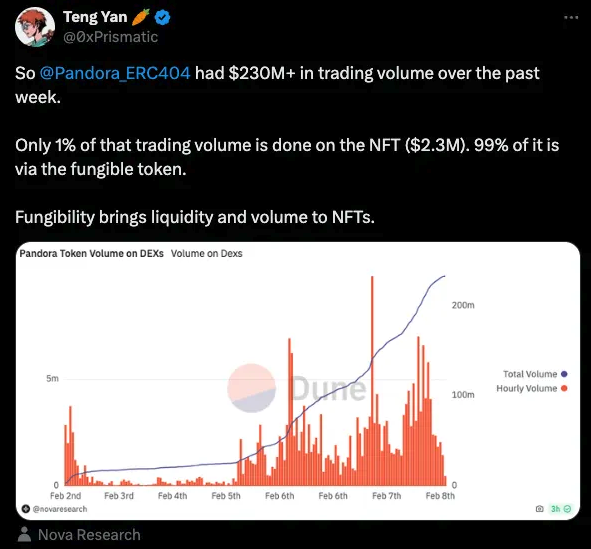
To illustrate how fungibility increases liquidity: just look at what happened with PANDORA. 99% of the trading volume was done via the fungible token rather than the NFT.
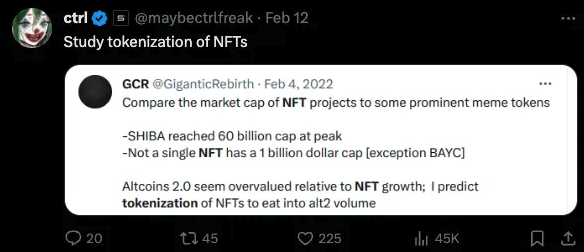
@maybectrlfreak believes that by making NFTs fungible, the valuation of NFT collections (~$1B at the top tier) can get closer to that of the top memecoins ($60B+), because of increased capital flows.
This creates some potentially interesting use cases for 404 tokens in the future:
High value Art and Collectibles: Typically these are highly scarce and valuable. Tessera tried to do this with its fractional platform but had to shut down last year due to limited adoption. One hurdle here is effectively reconstituting NFTs after fractionalization for resale—a process often mired in complex DAO governance. 404 tokens mitigate this issue.
@palettebycfw is one example: a collection that introduces native fractionalization to generative art using 404, with a “re-roll” feature for artworks in its collection. It makes collecting art more interesting with a new layer of interactivity.
Real Estate: Real estate is being tokenized on the blockchain, riding on the RWA trend. Various startups have explored different approaches, from using NFTs to directly represent properties (@Roofstock ) to leveraging fungible tokens for ICO-like fundraising to acquire properties (@citadao_io). 404 has the potential to amalgamate these approaches.
Hyperfinancialisation & Gambling: The native "re-roll" aspect of 404 creates dopamine hits and can be used to hyper-financialise ANY asset by introducing lootbox-type mechanics. Good.. or bad? Already seeing experiments, like @aevoxyz using this for its airdrop farming campaign
2. Can fungible tokens benefit from being NFTs?
While much of the 404 spotlight has been around the greater fungibility of NFTs, there's another side to the coin: Fungible tokens can also benefit from transitioning into NFTs.
Various types of fungible tokens can receive a significant upgrade with 404:
Governance tokens grant holders voting rights in DAOs. By enabling these tokens to also become NFTs with varying reputation states (in the metadata) based on holders' contributions, a new dimension of governance can emerge. Imagine a governance NFT that confers different levels of access to exclusive features based on the holder's historical engagement within the community. This incentivizes active involvement and fosters a more meritocratic governance model.
Utility tokens can incorporate unique traits to offer personalized experiences to users. For instance, a gaming platform’s token could be tied to an NFT with distinct in-game assets or abilities based on traits and rarities.
Memecoins (think WIF, DOGE, PEPE) can use NFT mechanisms to better engage and grow their communities. By introducing rarity traits and loot box mechanics, they can gamify user interactions. The 2021 NFT bull cycle showed how much we love “altcoins with pictures”. The fusion of memes and NFTs not only amplifies the fun factor but also cultivates a stronger sense of belonging.
Overall, it's still early days for 404. The "re-roll" aspect can be a nuisance for building out some of these use cases. Being able to persist NFTs and their metadata in some way after transfers/sales could come later in an improved version.
But... very interesting.