Delegation Decisions Are Near.
Execution Data Is Already Speaking.
As the @celestia ecosystem moves closer to the next delegation cohort update, we took a closer look at validator performance from a purely operational angle.
Recent proposer execution activity, participation dynamics and short-term consistency signals reveal an interesting picture of how the validator set has actually been behaving in real network conditions.
We’ve compiled a structured on-chain performance overview based on real execution data — no assumptions, no narratives.
Want to see who is really delivering blocks — and who just talks about it?👀
👉 Check the latest performance breakdown on the Celestia forum: https://t.co/Hl9Oy7nqQo
v0.16.1 HardFork Complete!
MIP8 is now live on Mainnet!
Thank you to all the node operators for great coordination.
100% of operators were upgraded prior to the fork.
Mainnet now moves to having a full 200 active validators!
The following operators have been allocated their VDP delegation and are up for active set selection!
Welcome to Mainnet!
JustANode
BitCtrl
Nodeify
Decentra
blocash
BlockPro
LI FI
Metatarz
Paradise Nodes
SpeedyNodes
POSTHUMAN
MSC industries
Phase Stake
Unity Nodes
Inotel
Validexis
Cosmic Validator
Obelisk
Unity farms
LootGO
TServices
Cointelegraph Decentralization Guardians
Point Group
Kiln
CHAIN DIGITAL
Etherfuse
Astrosynx
GlobalStake
AiNodes
Data Nexus
Lunar Strategy
InfraSingularity
LuckyResearch Labs
Delegation Decisions Are Near.
Execution Data Is Already Speaking.
As the @celestia ecosystem moves closer to the next delegation cohort update, we took a closer look at validator performance from a purely operational angle.
Recent proposer execution activity, participation dynamics and short-term consistency signals reveal an interesting picture of how the validator set has actually been behaving in real network conditions.
We’ve compiled a structured on-chain performance overview based on real execution data — no assumptions, no narratives.
Want to see who is really delivering blocks — and who just talks about it?👀
👉 Check the latest performance breakdown on the Celestia forum: https://t.co/Hl9Oy7nqQo
☕️🧠 SATURDAY MORNING SYSTEMS BRIEF | Execution Determinism Scan
P-OPS TEAM — Validator Operations
🧘 Quiet networks expose execution behaviour.
When transaction pressure falls away, the validator stack stops reacting and starts revealing its baseline.
Not speed.
Not throughput.
Consistency.
🪟 Today’s observation window: replica execution alignment across validator nodes.
Across supported networks this morning:
🪙 Block cadence stable
📡 Gossip propagation normal
🔁 Vote aggregation predictable
⚙��� Execution traces matching expected compute envelope
Nothing unusual surfaced.
Which is exactly what low-noise windows should reveal.
🎛️ Signal Focus — Deterministic Execution
Consensus assumes something subtle:
Every validator executing the same block must produce the same result.
Every time.
Minor divergence in execution timing or state transitions can introduce:
• inconsistent mempool ordering
• delayed vote emission
• replica lag during high-density blocks
• state commitment variance across peers
Under heavy traffic this hides inside throughput.
On quiet mornings it becomes measurable.
🔍 What We Observed
🧠 Replica execution timing clustering tightly across nodes
📊 State transition duration holding inside expected variance bands
🔄 No abnormal recheck or replay behaviour
⚙️ Disk and memory access patterns stable across validator workloads
Execution behaviour appears aligned.
Which indicates the stack is operating inside its deterministic envelope.
🧪 Live Checks (Execution Path Pass)
𝚝𝚘𝚙
𝚒𝚘𝚜𝚝𝚊𝚝 -𝚡 1
𝚟𝚖𝚜𝚝𝚊𝚝 1
𝚓𝚘𝚞𝚛𝚗𝚊𝚕𝚌𝚝𝚕 -𝚞 𝚗𝚘𝚍𝚎 –since “15 min ago”
Watch for:
• abnormal CPU wait states
• sudden disk queue expansion
• memory paging events
• repeated execution retry logs
Execution should remain smooth and repeatable.
Not oscillating.
🧩 Validator Context
Execution determinism affects more than local performance.
It directly influences:
• vote emission timing
• proposal validation speed
• state root convergence across replicas
• finality stability under heavy blocks
Nodes with unstable execution paths often appear healthy until transaction density increases.
Saturday diagnostics reveal that early.
🛠️ Operator Adjustment
⚙️ Confirm database I/O latency remains low
🧠 Verify memory headroom during execution cycles
📡 Ensure sentry routing isn’t introducing validation delay
📊 Monitor block execution duration distribution
Re-check:
𝚒𝚘𝚜𝚝𝚊𝚝 -𝚡 1
𝚟𝚖𝚜𝚝𝚊𝚝 1
Execution variance should remain narrow.
Wide variance often precedes performance degradation during peak load.
🧠 Why This Matters
Consensus doesn’t require validators to be fast.
It requires them to be predictable.
Deterministic execution improves:
• block validation reliability
• vote timing consistency
• network convergence speed
• long-term reward stability
Saturday windows make this visible.
When traffic quiets down, determinism becomes measurable.
☎️ P-OPS Team | Validator Operations
🌍 https://t.co/z2tDlQjtwr
🌿 https://t.co/6vFEuq6fSe
🐦 https://t.co/3IMrLugwGq
📡 https://t.co/vBgSvPB5TM
👾 https://t.co/OjziFm4JOe
#SaturdayMorningSystemsBrief #ValidatorOps #ConsensusSystems #Linux #NodeOperations #POPSTeam
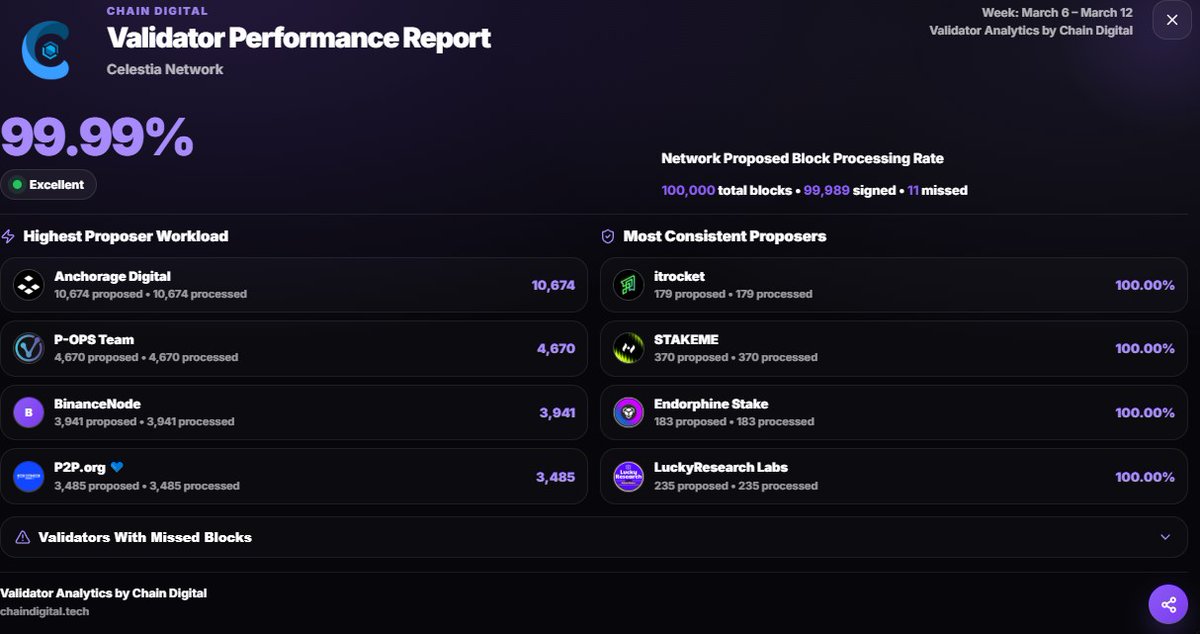
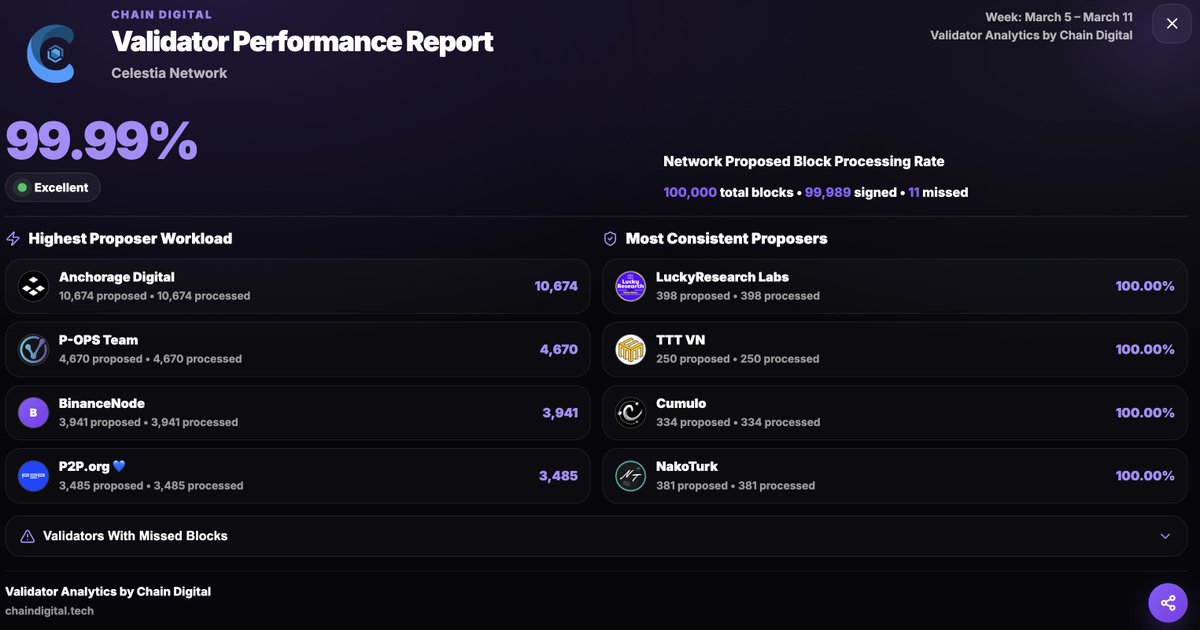
Over the past week we analyzed proposer performance across the @celestia validator set.
Around 100k proposer slots were observed during the study period.
Large stake operators naturally handled the highest proposer workload, including
@binance@Anchorage@POpsTeam1@P2Pvalidator
At the same time, several validators demonstrated very consistent slot execution:
@LuckyResearchVN@ttt_lab@kimiko_cumulo@NakoTurk
We continue tracking validator reliability and proposer discipline across the network.
The full weekly performance report will be published publicly very soon — stay tuned 👀
And validators… let’s try to stay out of the “missed blocks” list next week 🙂
#Celestia #TIA