Common misconception. Historically, pure math concepts like analysis are actually obnoxious pedantic distillations of intuitive applied math concepts, not the other way around. The application almost always comes before the formalization
The World Cup is not really about crowning a champion.
It is about keeping hope alive because we are addicted to optionality.
Hope is not about guaranteed results, but about keeping an option open. An option that was open for Mexico when they entered the pitch yesterday. An option that Cape Verde kept alive for as long as they could. An option that Paraguay held onto, in its own way, as long as they could.
Because what a loss in the knockout rounds does is kill an option. It is a global tournament designed to start full of hope, with hope collapsing at each stage. And if that is not a metaphor for life, I don’t know what is.
For many, the most exciting part of the World Cup is not the final. A match between two teams most people do not identify with. But the preservation of hope of the earlier runs. As long as your team is holding on, you can still dream of being a champion.
That hope is what keeps us addicted and invites us to try again.
Exactly. I've been disseminating a similar message for years.
The concentration of power in AI and the desire for control is by far the biggest danger of AI. It could lead to a few private companies and/or countries being in control of access to information, access to knowledge, and access to the tools of economic expansion.
It's a kind of medieval obscurantism akin to the Ottoman empire banning the use of the printing press for 200 years, in part to keep control of the dogma, but also to protect the corporation of the calligraphers and scribes.
Relevant historical bits about the Internet:
1. It took a deliberate decision by Al Gore and Bill Clinton to open up access of what was then ARPAnet to commercial entities and to the public, against the desires of the entrenched telecom industry. During a public roundtable about the "information superhighway" in 1993, the CEO of AT&T told Gore and Clinton "leave it to us". Gore said no.
2. In the late 1980s, setting up an Internet presence required buying proprietary hardware with proprietary OS and software stack from Sun Microsystems, HP, IBM, or Dell. By the 2000s, all of this was wiped out by commodity hardware, Linux, Apache, and an entirely free/open software stack. This migration to open platforms was the result of market forces.
Infrastructure wants to be open.
Foundation models are becoming an infrastructure and will inevitably become commoditized.
Long term, the money is in the application layer, which is what I, Arthur Mensch, Alex Karp, and others have been saying.
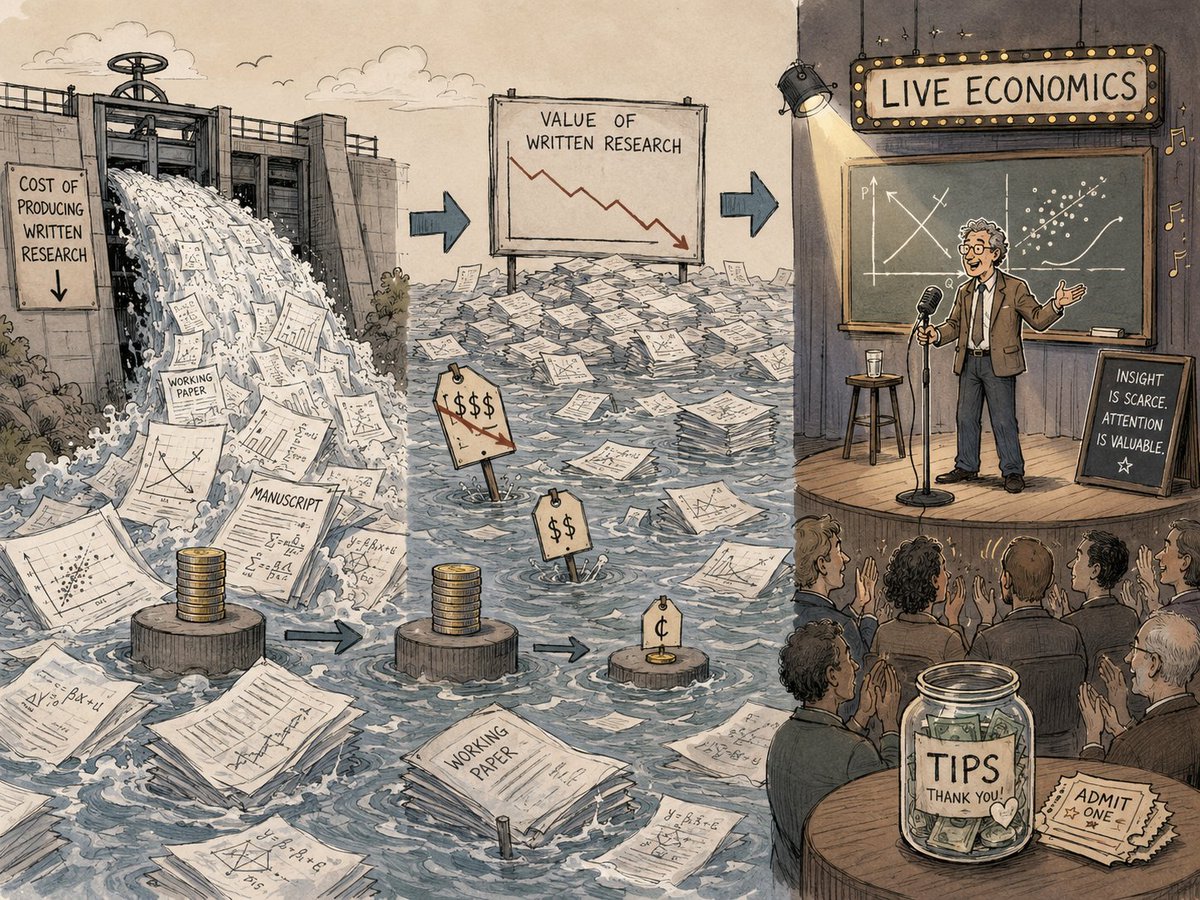
Dear Fellow Econ Profs:
1) Fable is back; floodgates of written, quality econ research are open.
2) In general equilibrium cost determines value.
3) The value of your written research will be debased.
🎇 Will we, like musicians, will be paid for our live performances of our research, not the research?
Great news!
The Global Macro Database has been updated
"The 2026_06 update adds 39 new historical and country-level sources, bringing the database to 160 sources, extends automated error monitoring, resolves dozens of data-quality issues, and improves the Stata, R, and Python packages."
https://t.co/xBMXCjgnUW
https://t.co/a43Xr3X64c
Archive of macroeconomic models based on a common computational platform that provides various tools for model comparison. It contains over 160 published DSGE and other structural macroeconomic models drawn from academic papers and central bank research.
Why do workers dislike inflation? Because wages catching up to prices means costly conflict: tough pay talks, job search, bargaining. Survey + model show conflict more than doubles inflation costs. @jptguerreiro@JADHazell@ChenLian92 & Christina Patterson https://t.co/AObZHTOANN
What a time to be an economist! AI is creating new datasets—and new questions—about productivity, labor markets, firms, and economic growth.
Want to help answer them? We’re hiring a PhD economist to join the growing Economic Research team at OpenAI.
https://t.co/rPMSnJdyzq
Some news about @RevEconStudies.
New journal: Restud Insights. Accepting submissions Sept 2026.
2 types of articles: "Insights" (similar to AER Insights) and "Communications" (2k words + 2 exhibits).
It will be an “up-or-out” editorial process.
More info soon.
Governments steer contracts, loans, and regulatory breaks to favored firms. Everyone knows it happens. But how much is it worth? When Malaysia's 1998 crisis cut off the flow, connected firms lost ~$5.4B in market value. Political favoritism is a priced asset.
It's surprisingly plausible that we got GLP-1 drugs because of Danish tax law.
For tax reasons, Novo Nordisk is actually controlled by a non-profit foundation.
There are many downsides of this. But one possible upside is that it's helped the company avoid institutional drift.
The founding goals of the company were written into the non-profit's constitution, so now every new generation of leaders has to abide by them.
In particular, the company is legally mandated to reinvest significant sums in R&D, regardless of the effect on shareholder value.
That R&D gave us one of the major drug breakthroughs of this century so far.
In 2008, my PhD advisor told me that in 100 years, all human problems would be solved, economic models wouldn't work anymore, and growth would be beside the point.
I'm still very skeptical, but that looks less crazy in 2026 than it looked in 2008.
En el curso de macroeconomía 2 (maestría) de @FLACSOec vamos revisando diversos macro con dinámicas complejas. Todo en Python (Google Colab). Espero pronto consolidar este material y difundirlo, pues quizá pueden abrir nuevas discusiones "heterodoxas" e incluso "ortodoxas".
I posted a brief guide about syncing Overleaf with VS Code, through either Dropbox or Github. This way, you can get the benefit of Claude Code and Codex with the nice collaborative tools offered by Overleaf.
Overleaf guide is here: https://t.co/k5CMEDCHGI
Collaborating with non-LaTeX users just got a whole lot easier! 🤝 You can now import .docx (Word) files directly into Overleaf (we'll automatically convert them to LaTeX for you!), and export your work back to Word when you're done.