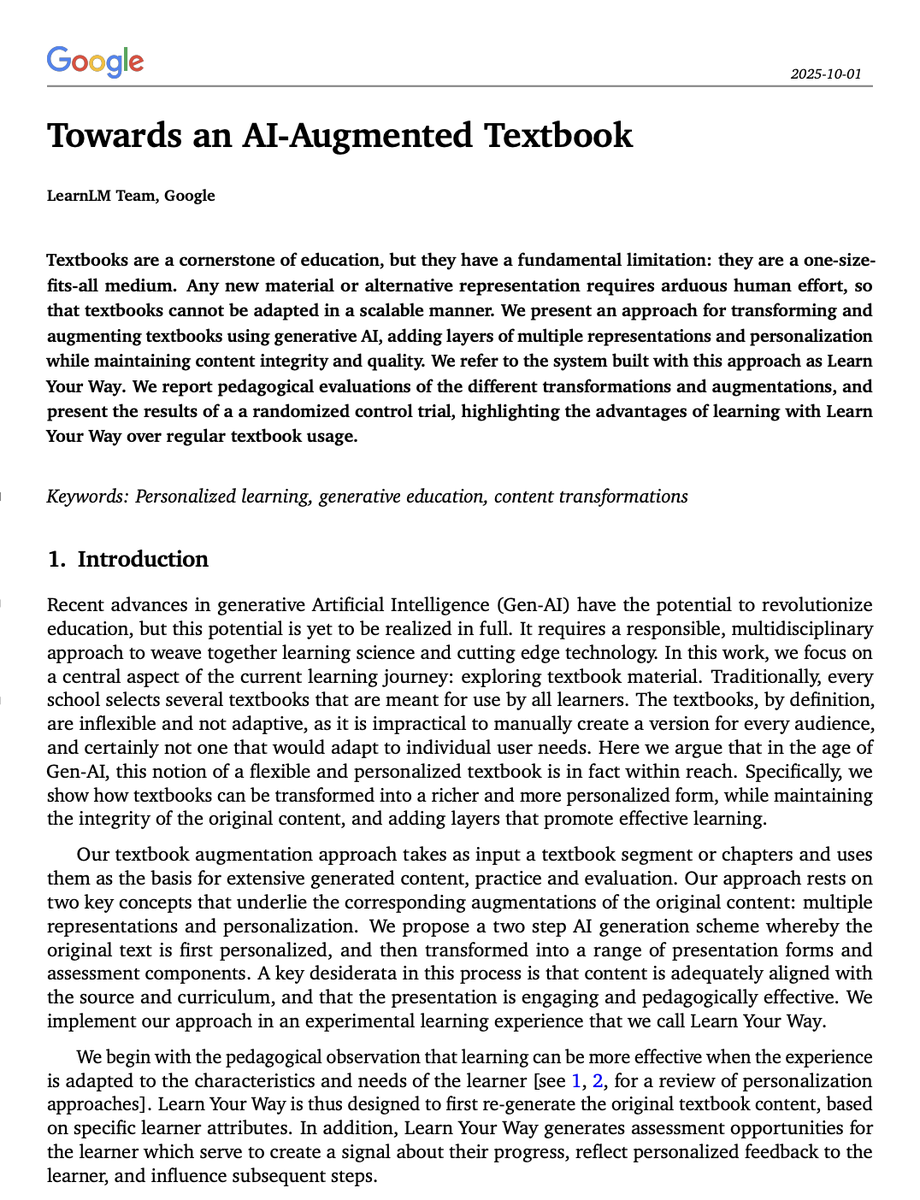
Google solved one of the oldest problems in education.
They killed the traditional textbook.
They built a system powered by LearnLM and Gemini that takes any static textbook PDF and dynamically rebuilds it around the student.
Here is how the pipeline works:
First, it asks for your grade level and what you actually care about (sports, music, food).
It re-levels the entire textbook to match your comprehension without cutting the core material, then rewrites the generic examples around your personal interests.
Then it applies "Dual Coding Theory", the cognitive science principle that your brain builds stronger mental models when it engages with the same concept across multiple formats.
Using specialized AI agents and a fine-tuned educational illustration model, it automatically turns one boring PDF into five interactive experiences:
• Immersive text broken into digestible chunks with custom visuals
• Narrated slides with interactive fill-in-the-blanks
• Zoomable mind maps that jump from the big picture to fine details
• Section-level quizzes that catch your exact knowledge gaps in real time
• Audio lessons featuring a simulated teacher and student
To see if it actually worked, Google ran a randomized controlled study with 60 high school students in Chicago.
Both groups got 40 minutes to learn about adolescent brain development.
Half got a standard digital textbook PDF. Half got Learn Your Way.
The results aren't even close:
• Students using Learn Your Way scored 9% higher on the immediate test
• 3 to 5 days later, they scored 11 percentage points higher on long-term retention (78% vs. 67%)
• 100% of them felt more comfortable taking the exam (compared to 70% with the PDF)
• 93% said they wanted to use it for future learning
And when human subject-matter experts graded the AI-transformed textbooks across subjects from history to physics, they rated them 0.85+ across accuracy and learning science principles.
Static textbooks were never the best way to learn.
They were just the only way we could scale printing.
For 500 years, students had to adapt their brains to fit the book.
Now, the book adapts to fit the student.
i'm admittedly pretty harsh on the google guys, mostly cuz i know the co super well.
but holy hell, i'm having an incredible time with neon so far.
product issues aside, this is a very different experience, almost like a strange new feeling. the way it talks, the way it responds, everything feels pretty damn fresh if that makes any sense. it's very creative. & unusually great at proposing ideas. i can't even say it's about intelligence or better answers in general. i am normally okay with words, but this is very difficult for me to articulate well.
anyway, it's fairly clear that google absolutely cooked here.
i have never doubted google's technical capabilities. those were & are totally obvious. i mean it is literally the birth place of ai. it was always a question of whether google could turn an extraordinary technology into newer experiences that ppl love using, which sort of requires shedding every success of the past.
these newer generation of models, particularly neon clearly gives them extraordinary new legs to stand on. it doesn't feel like "gemini" at all.
congratulations to everyone at google, i will continue to play around with more. there are obviously some product frustrations & confusing elements but i'm setting those aside for now.