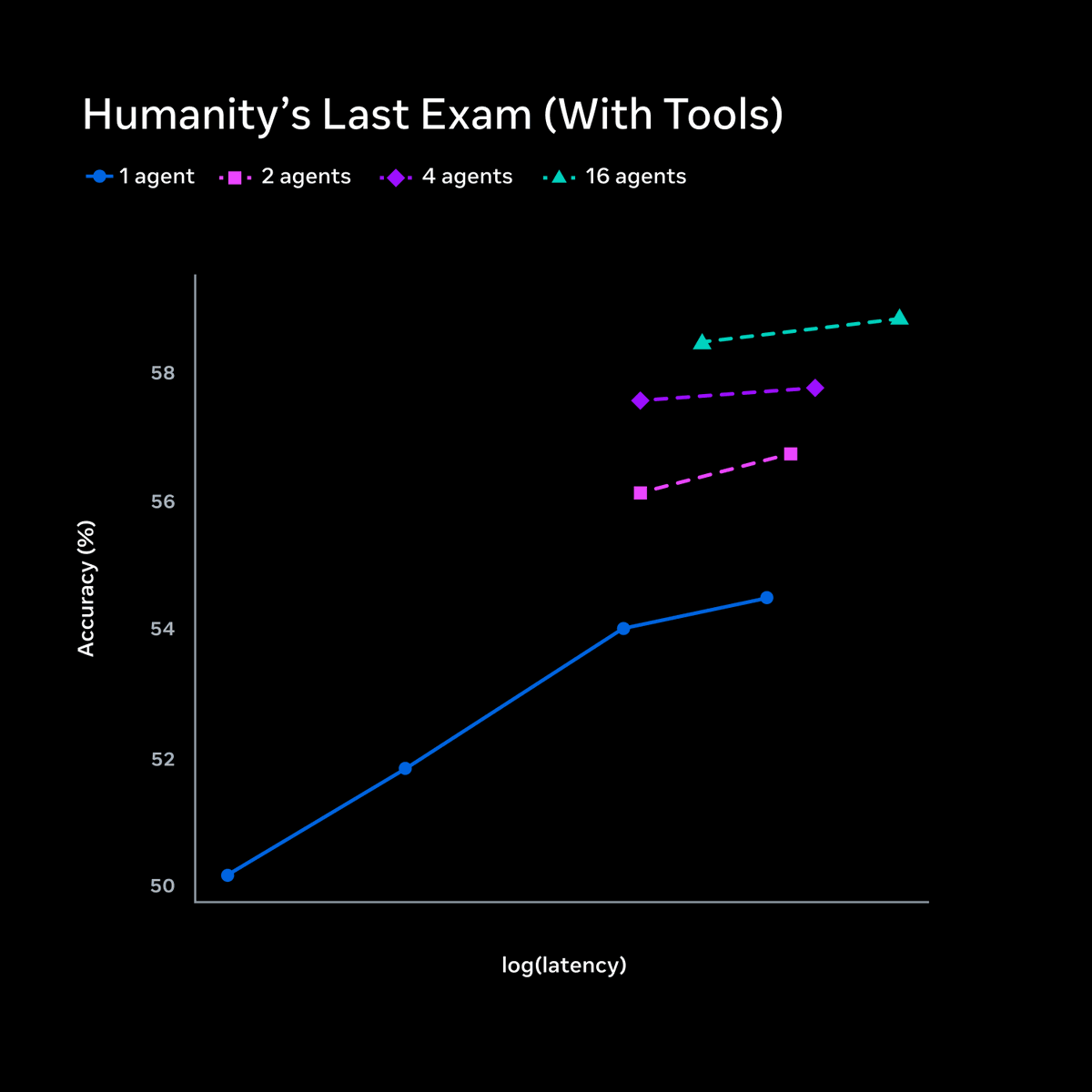
Releasing Muse Code in beta today. It's a terminal coding agent that takes on complete software engineering tasks across large repos: planning changes, writing code, validating the results. Powered by Muse Spark 1.2, a coding-focused model update.
Day 1 at #ACL2026 in San Diego. Sharing some posters below that caught my attention at first glance!
1. Why Does Reinforcement Learning Generalize? A Feature-Level Mechanistic Study of Post-Training in Large Language Models
arXiv: https://t.co/hRvUxMobvV
The paper trains RL and SFT from the same base model on identical data, and shows at the feature level that SFT overwrites the base model's representations while RL preserves and slowly refines them.
2. Scaling LLM Multi-turn RL with End-to-end Summarization-based Context Management
arXiv: https://t.co/lam7lue4Ah
Probably my favorite poster of the day. The paper shows summarization can be a learnable part of the policy with a gradient that decomposes into ordinary sub-trajectory gradients, which stretches a 32K context window to 320K effective context while using standard GRPO infra.
3. Memory-R1: Enhancing LLM Agents to Manage and Utilize Memories via Reinforcement Learning
arXiv: https://t.co/uMlH13uI9V
Both the Memory Manager (ADD/UPDATE/DELETE/NOOP) and the Answer Agent are trained with outcome-only RL, and 152 QA pairs are enough to beat the strongest LoCoMo baseline by 28.5% F1 with zero-shot transfer to MSC and LongMemEval across 3B–14B backbones.
4. InfiniteWeb: Scalable Web Environment Synthesis for GUI Agent Training
arXiv: https://t.co/rjkUfMVO9F
Fully functional, resettable websites with programmatic evaluators synthesized for $1.93 a site. Training with these 600 generated tasks improved UI-TARS-1.5-7B from 24.5 to 31.4 on OSWorld, outperforming Claude-4-Sonnet.
5. Graph-Based Alternatives to LLMs for Human Simulation
arXiv: https://t.co/OG4dIPIUBj
Instead of prompting an LLM to role-play each person, they represent people and answer options as nodes in a graph and train a GNN to predict which option each person picks. This matches the strongest LLM-based methods on surveys, test-taking, and voting with roughly a thousand times fewer parameters — a good reminder that not every problem needs a language model.
6. SpecAgent: A Speculative Retrieval and Forecasting Agent for Code Completion
arXiv: https://t.co/zmvZUvdwu4
Doing the expensive repository reasoning at indexing time (before inference) and caching speculative context improves pass@1 by 9–11 points with zero added latency during inference.
7. How Memory Management Impacts LLM Agents: An Empirical Study of Experience-Following Behavior
arXiv: https://t.co/QdVxCJZEh0
A careful empirical study showing agents imitate whatever they retrieve, so bad memories keep propagating. Strict addition plus utility-based deletion beats naive memory growth by about 10% across four different agents.
8. RecMem: Recurrence-based Memory Consolidation for Efficient and Effective Long-Running LLM Agents
arXiv: https://t.co/uK0UJJV1yU
Instead of invoking an LLM on every interaction the way Mem0 or others do, consolidation waits in RecMem until a topic recurs, cutting memory construction cost by up to 87% with no accuracy loss.
9. Learning on the Job: An Experience-Driven Self-Evolving Agent for Long-Horizon Tasks
arXiv: https://t.co/PoBUQRNbch
The plan → execute → reflect → memorize loop is nothing too novel, but somehow they still achieve SOTA on TheAgentCompany with just Gemini-2.5 Flash and no finetuning.
10. Dynamic Infilling Anchors for Format-Constrained Generation in Diffusion Large Language Models
arXiv: https://t.co/Zf7Eh7Wugu
A training-free trick for diffusion LLMs — fixed anchor positions force rigid generation spans that either truncate reasoning or pad it with filler, so DIA estimates where the end anchors should land before infilling, bringing large zero-shot gains in valid JSON rate and GSM8K.
11. Vulnerability of LLMs' Stated Beliefs?
arXiv: https://t.co/JtXjTyEh30
A systematic multi-turn persuasion study showing confidence decay precedes belief flips and that asking models to verbalize confidence makes them easier to persuade, though methodology-wise it may be incremental to Xu et al.'s "The Earth is Flat because…".
12. A Study of LLMs' Preferences for Libraries and Programming Languages
arXiv: https://t.co/h3ok5LhLin
The first empirical audit of which languages and libraries LLMs pick when the user doesn't specify. Across eight models, Python appears in 90–97% of benchmark solutions and remains the top choice in 58% of high-performance projects where it is suboptimal (Rust is never chosen once), and NumPy is imported unnecessarily in up to 48% of cases.
More tomorrow.
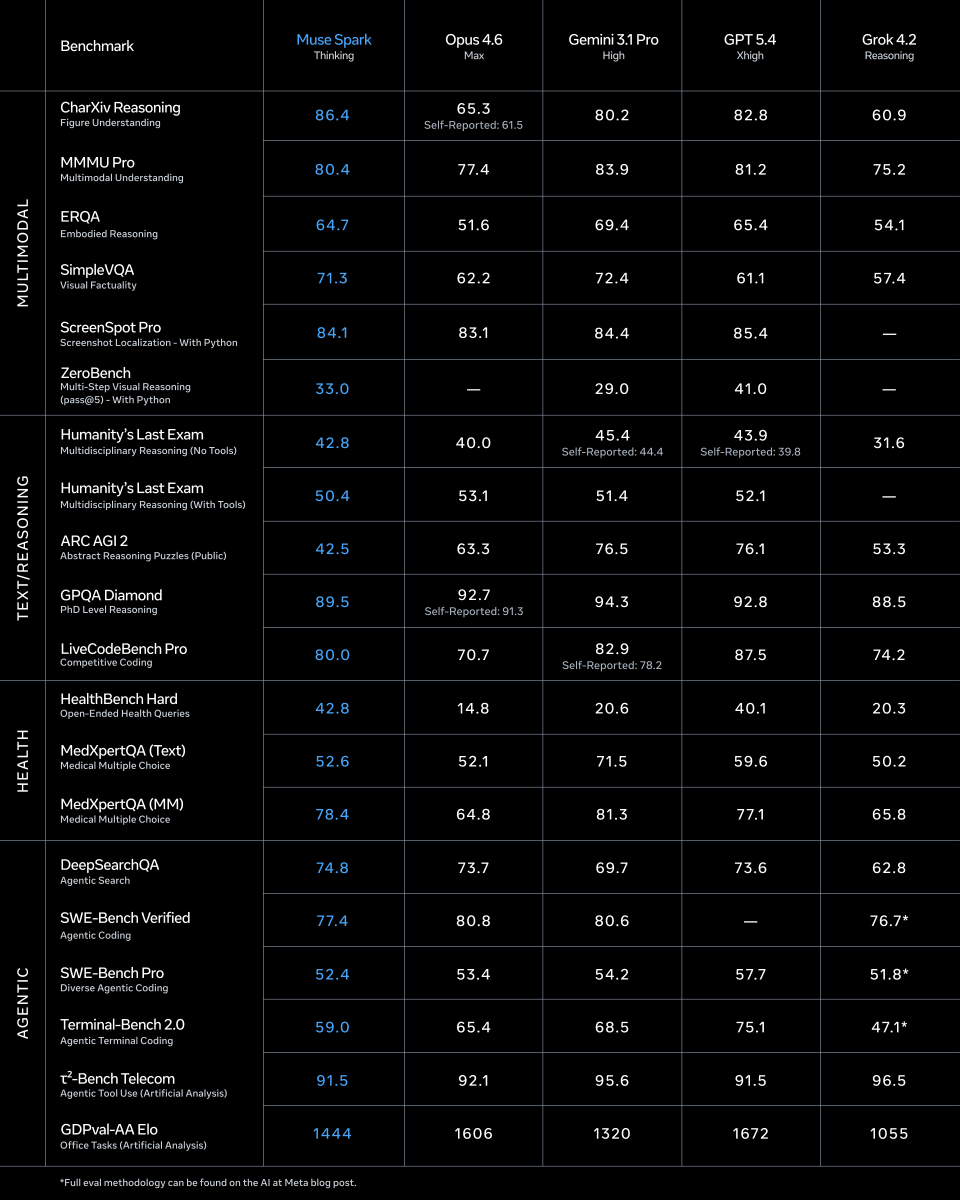
We are releasing our new model muse spark today - our first step towards personal super-intelligence after 9 month great team effort! Please try it out and tell us what you think!
Excited to share Muse Spark, the first model from whole team’s work in MSL! 🚀
It’s natively multimodal and agentic. I’ve been using it for my daily coding and research tasks. Still plenty of room to improve in agentic domains, but we’re moving with great velocity.
It’s a seriously good model! Check out the full breakdown and try it out in https://t.co/Fka0wdAswy
Check out Muse Spark, our first milestone in the quest for personal superintelligence! Scaling this with the team has been a total blast. Give it a spin and let us know what you think! 🥑
Grok CLI >>> Cursor and Claude Code
We wanted an IDE for @xai's @grok so we did something meta: we prompted the newly released Grok 4 to create... Grok CLI itself!
Grok CLI can:
1. Modify local files and use the shell
2. Go through huge codebases and fix them
3. Persist for longer and solve really complex math and physics problems
Instant setup on @Replit
Bonus: Can create and run ai agents with @langchain@composio
it's completely open source!!
link to the code: https://t.co/3Bw3Aoa4SG
link to the repl: https://t.co/Axi47SFpyZ
We implemented our ODIN, a two-head RM, one correlating with lengths(ignored in RL) and another uncorrelated with lengths (final reward in RL), into RLHFlow, which is an easy-to-use Repo. It could be a great baseline for reward hacking research! Try our code if you are doing RM/hacking research!🧐
Meta GenAI is looking for 2025 research interns across language, and multimodal. In particular, my team is looking for interns on RLHF algos, agents, and post-training more broadly. https://t.co/gAlMz81oIH
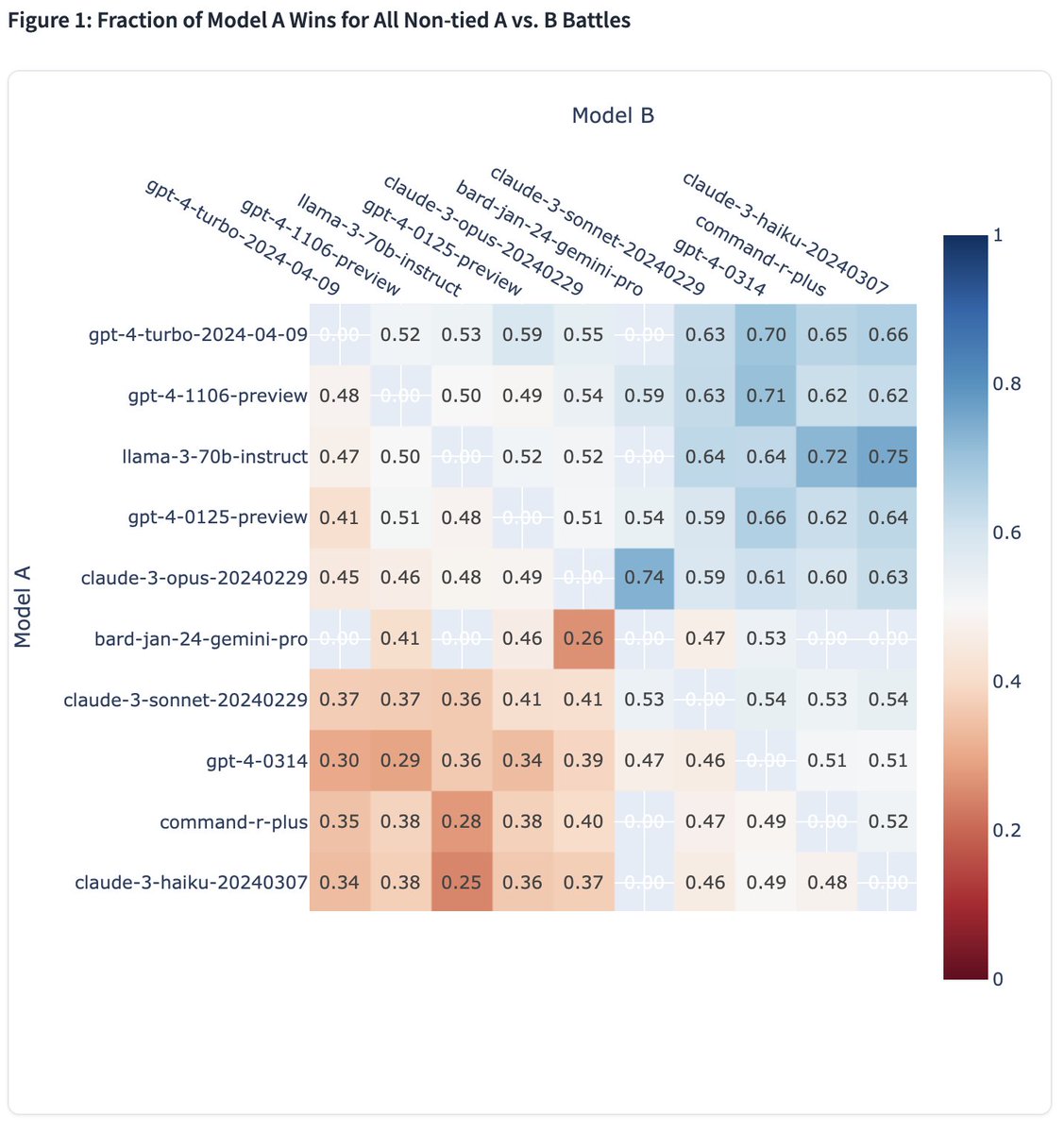
Moreover, we observe even stronger performance in English category, where Llama 3 ranking jumps to ~1st place with GPT-4-Turbo!
It consistently performs strong against top models (see win-rate matrix) by human preference. It's been optimized for dialogue scenario with large amount of instruction data in post-training.
More analysis still ongoing with topic distribution and agreement study. We also look forward to details in Llama-3's technical report.