CEO & Co-founder @Zorotechnology — Leading the ZK Machine Learning Network for AI Robotics. Ex Head of Product Pagoda (Ex Near Inc) @NearProtocol. Ex @Microsoft
Zoro Launchpad is live
🔗 https://t.co/l5eiiwgcfm
Meet the new product in the ZORO ecosystem, a place where everyone can take part in early-stage AI and Web3 project launches through our on-chain infrastructure.
Projects can launch in two formats:
• Standard Launch — open to everyone, backed by Zoro protocol tools
• Genesis Launch — curated by Zoro Venture Studio with full strategic support
The first AI projects on the launchpad will be announced this week.
Be early in the next AI launch.
Post-TGE, back to building the Web3 AI infrastructure on BSC (Open to build on other chains too 😉 )
Since launch, we’ve moved fast. So much went live at once, and tbh the response has been incredible.
We sold out on IDOs, listed $ZORO, dropped to over 200,000 holders, and launched a new narrative in crypto: AI-on-Chain.
In our view, AI-on-Chain is the start of a fully on-chain infrastructure where real-world data (movement, biometrics, environmental signals) becomes fuel for AI agents.
And we’re not stopping there. We're already moving toward the next frontier: Physical AI.
Our goal here is to create an ecosystem where wearables, smart devices, and on-chain models connect in real time.
What a week for Zoro 😮💨
1. We closed four IDOs. The whole team is genuinely grateful to the launchpads we partnered with. The collaboration clicked from day one, and their communities showed up strong. It’s clear we made the right choice, and the results speak for themselves.
2. We also listed $ZORO. Great volumes, strong momentum, and a few solid co-marketing campaigns with our CEX partners helped amplify the buzz.
3. On top of that, we delivered the promised drop, and our holder count just crossed 200,000. Some joined through activities at https://t.co/LFdrjllhiR, some through IDOs, and others picked up $ZORO on the open market after listing.
4. And what we're especially proud of — we launched AI-on-Chain, our unique infrastructure for streaming real-world data (like movement, signals, and biometrics) directly to the blockchain.
The foundation is set. And we’re already building what’s next.
Let’s Go.
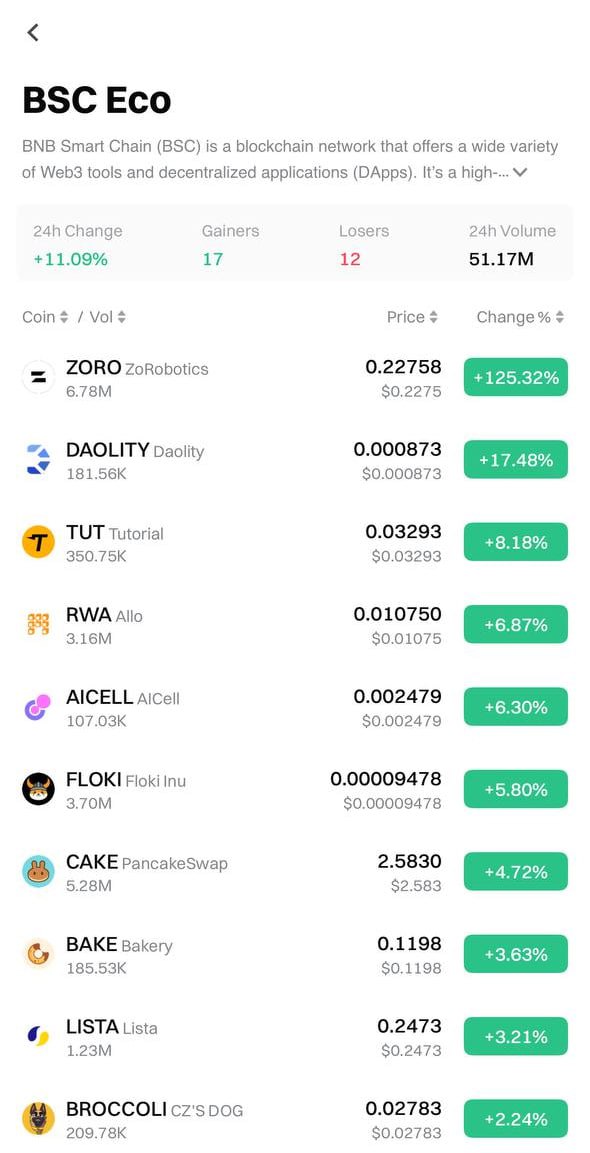
Just opened https://t.co/yghLeTiM8j to see how everything’s moving in the BSC Eco section and saw $ZORO sitting right at the top. First day live and already the biggest gainer.
Kind of wild, honestly 🤯
Plenty more ahead.
Last week, we shared an overview of how Zoro stacks up against other leading AI x Web3 platforms. It sparked some thoughtful conversations, but one comment in particular stayed with me:
💬"So this is basically the Mechanical Turk of Web3, but with real rewards and real accountability?"
I love this comparison. It captures something core to what we’ve been building at Zoro.
Amazon Mechanical Turk pioneered task-based crowdsourcing at scale, but it lacked transparency, sustainable incentives, and quality tracking. It was built for throughput, not fairness or trust.
Zoro flips that model on its head. It is a new kind of decentralized labor infrastructure for AI.
It’s one of the many reasons I still read the comments, follow chat threads, and keep my DMs open. The Zoro community continues to ask the kinds of questions that help us build better.
Thank you for pushing the conversation forward!
Unlike tons of other AI-based projects, Zoro is built DIFFERENT
Most Web3 AI projects solve one part of the AI stack:
• @bittensor_ rewards model validators
• @oceanprotocol tokenizes datasets
• @rendernetwork offers GPU compute
• @Fetch_ai builds autonomous agents
• @SingularityNET connects AI services
While Zoro is the first platform to train AI robots using human-validated, real-world data at scale, with:
✅ ZK-proofed validation
✅ Annotation across text, image, video, LiDAR, audio, 3D + LLM tuning
✅ On-chain contributor scoring
✅ Live SDKs + MLOps-ready pipelines
✅ Integrated with @nvidia Inception
All wrapped in an engaging, tokenized workflow used by 750,000+ people globally.
This is what full-stack, decentralized AI training looks like.
Tokens with purpose tend to outperform their counterparts
🌊 When Ocean Protocol introduced $OCEAN, its mission centered on unlocking secure and permissionless data exchange. Years later, that token anchors real-world applications across enterprises and public institutions. Since its early trading days, $OCEAN has multiplied more than 60 times.
🖥 And Render's $RNDR started as a token for decentralized GPU rendering. As demand for AI computation accelerated, so did adoption. Today, $RNDR ranks among the leading AI-linked assets in the crypto space.
These trajectories share a common pattern. The token reflects a system with clear utility, aligned incentives, and growing demand.
Zoro is following that path with $ZORO:
- 750,000 contributors and growing
- Fully on-chain ZK-powered task validation
- Scalable pipelines for AI data annotation and model training
- Tokenized rewards tied to output quality and network participation
The $ZORO token will launch soon. The infrastructure is already in place, and real usage is underway.
Tokens linked to real ecosystems tend to surprise the market. Early signals usually come before the headlines.
Keep watching 👀
Let us show you what Zoro is in under 35 seconds ⏳🎥
6M+ wallets, 750k+ contributors, real-time ZK validation...
We are leading the next wave of #AI robotics in #Web3.
Our launch is just around the corner.
🔜🔜🔜
𝗪𝗵𝘆 𝗭𝗼𝗿𝗼 𝗰𝗵𝗼𝘀𝗲 𝘁𝗼 𝗹𝗮𝘂𝗻𝗰𝗵 𝗮 𝘁𝗼𝗸𝗲𝗻 🪙
Like every founder building in Web3, I’ve spent many late nights with our team debating the same question: Do we really need a token?
Speaking from my past experience, it’s one of the first (and hardest tbh) questions any decentralized platform has to answer.
After months of modeling, testing, and reflection, we came to a clear conclusion: for a system like Zoro, the token is foundational.
Zoro is building a decentralized, open machine learning pipeline, where contributors around the world collect, annotate, and validate data to train AI models. To make this work at scale, we need incentives that are fair, transparent, and automated.
The $𝗭𝗢𝗥𝗢 token makes that possible:
- Contributors earn based on quality and impact, not just output.
- Validators help govern the platform through staking and DAO-based approval.
- Revenue from AI services flows back into the ecosystem through buybacks and rewards.
- Access to higher-level tools and tasks is unlocked through performance and participation.
𝗧𝗟;𝗗𝗥
$ZORO aligns effort, trust, and value. It allows a globally distributed network to function with accountability, without centralized control.
Zoro has officially entered its PRE-LAUNCH PHASE! So, what’s coming next?
We’ve been building Zoro for quite some time. From the beginning, Zoro was meant to create a new kind of AI infrastructure, one that's designed for collaborative model training that incorporates human input.
What lies ahead is especially exciting 👇
We are actively integrating with several promising AI projects in both Web2 and Web3, including initiatives supported by Microsoft, Google, and NVIDIA.
I’m particularly excited to share Zoro with the world after a long journey stepping into launch mode.
🗓 In the coming weeks (late May - early June) look out for a series of Zorollouts. 😉
Catch every update here 👇
https://t.co/ZUMGnyCyep
https://t.co/TLSHfkLkbo
Early-stage projects are finally breathing again 😮💨😮💨
After a challenging 2.5 years of fundraising, marked by cautious VCs and limited investment, Q2 2025 brought a significant change. CryptoRank data indicates a surge in crypto VC funding to $4.7 billion, reaching its highest point since mid-2022.
What changed? A few things:
✅ BTC reclaimed its position ⬆️ $100K
✅ Narrative clarity returned: AI, restaking, ZK, and real-world use cases are leading again
✅ Teams that kept building now have traction to show
From what I’ve seen personally, at Zoro, NEAR and Microsoft, early-stage momentum always returns to the ones who know how to convert attention into action.
That said, while capital is back, expectations are different. Everyone wants:
⭐ Proof of work
⭐ Real community
⭐ Scalable mechanics
I'm seeing renewed energy from both investors and collaborators. But this time, the hype is layered with smart diligence and a deeper push for traction-based growth.
If you’re a founder navigating this new phase or a team getting back into the market, I’d love to hear how it’s looking for you. Are you seeing more movement? Let’s compare notes.
Headcount 🆚 Headspace
I’ve seen it again and again: 5 great programmers can outperform 1000 average ones. I know I’m exaggerating but research suggests productivity differences are 10-20x or more. While speed and clean code are valuable, the core difference lies in their thinking: how they approach complex problems, foresee potential issues, and design scalable systems that maintain integrity despite increasing complexity.
At Microsoft, I saw the power of small, high-trust teams. At NEAR, I watched lean technical groups push the limits where larger teams often stalled.
This philosophy guided how we built Zoro. Our goal is not simply to be the largest AI lab but Zoro prioritizes a modular system that empowers smart, skilled individuals to directly influence AI from within.
Quality > quantity, no brainer there. Especially when the structure is built to reward precision, care, and ownership.
What do you think matters more in early-stage teams, headcount or headspace?
Gen Alpha Is Crushing Google 📉📉📉
Gen Alpha grows up in a world where AI is everywhere around them — in TikTok they scroll, in the filters they use, the music they hear, the content they consume.
They turn to ChatGPT, DeepSeek, Gemini, and dozens of other AI tools to find answers faster than search ever could. Some use them to create images, videos, podcasts, and even entire music tracks. AI is already shaping how this generation sees and interacts with the world.
Google stock is declining, likely because Gen Alphas are increasingly favoring AI tools over traditional search engines, a trend that is accelerating.
But here is what I find concerning: despite their daily interaction with AI, their understanding of its underlying mechanisms is limited. They utilize AI without comprehending its operational logic: how it learns, why it makes mistakes, and what shapes its decisions.
Fancy changing that?
We are giving anyone, including kids, students, creators, and even non-technical users, a chance to truly shape AI.
Do not sit out this moment. Visit https://t.co/LFdrjllhiR and join us!
𝘼𝙄 𝙞𝙨𝙣'𝙩 𝙟𝙪𝙨𝙩 𝙖 𝙘𝙤𝙢𝙥𝙚𝙩𝙞𝙩𝙞𝙫𝙚 𝙖𝙙𝙫𝙖𝙣𝙩𝙖𝙜𝙚 𝙖𝙣𝙮𝙢𝙤𝙧𝙚—𝙞𝙩'𝙨 𝙗𝙚𝙘𝙤𝙢𝙞𝙣𝙜 𝙩𝙖𝙗𝙡𝙚 𝙨𝙩𝙖𝙠𝙚𝙨.
𝗨𝗻𝗽𝗼𝗽𝘂𝗹𝗮𝗿 𝗼𝗽𝗶𝗻𝗶𝗼𝗻: Companies that aren’t building their proprietary AI capabilities today are quietly setting themselves up to fail tomorrow.
During my time at Microsoft, I saw firsthand how fast the gap grows between companies that invest in intelligent infrastructure and those that don’t. Many of those treat AI as another SaaS tool you can plug in later.
Just look at how Amazon, Tesla, and Bloomberg are building in-house AI to optimize logistics, personalize user experiences, or analyze massive financial datasets.
𝗕𝘂𝘁 𝗵𝗲𝗿𝗲’𝘀 𝘁𝗵𝗲 𝗺𝗮𝗶𝗻 𝗽𝗿𝗼𝗯𝗹𝗲𝗺: most companies treat AI as something to buy. Eventually, they remain dependent on closed systems, trained on generalized data, with no control over accuracy, explainability, or privacy.
The future belongs to modular, embedded AI that deeply understands your specific domain challenges.
If you're a founder or builder navigating this transition, I'd love to connect. We're helping organizations develop secure, verifiable AI infrastructure they actually own.
Let's explore potential synergies. DM me to continue the conversation.
Welcoming @zorotechnology into the Me3 ecosystem 🤝
Zoro is a decentralized platform combining AI robotics, zero-knowledge proofs, and blockchain, with over 200K+ active users already onboard.
Me3 and Zoro will be building smarter AI experiences together—onchain and beyond.
🔗 https://t.co/Kym7x2y1E1
Zoro x Trust Army by @hackenclub: Training AI to help you DYOR smarter
Trust Army (https://t.co/DPKwBrOHkh) is a community-powered platform that trains and equips users to analyze and audit Web3 projects (DYOR). By completing real research tasks, users gain hands-on experience, earn rewards, and contribute to improving transparency and security across the crypto space.
The goal is to:
✅ Help users structure and analyze their research
✅ Detect shallow or low-effort content
✅ Offer real-time suggestions and summaries
✅ Strengthen user skills by showing where and how to improve
All of this is enhanced by the Zoro Academy, where real user-submitted reports will help teach the model what good research actually looks like.
Together with the Trust Army, we make Web3 research scalable, collaborative, and way more intelligent.
Explore the new tasks at https://t.co/heyJeu4ed5 and help us train the future of on-chain AI research.
4. Personalized AI and user-driven models are the future. AI systems that evolve based on individual user inputs, preferences, and even values. Users are starting to expect AI that adapts to them: think personal AI assistants that learn your style, or recommendation engines that truly understand your interests. We’re also seeing the rise of user-shaped AI personas. In 2025, an AI might be your AI, growing and learning with you over time, almost like an extension of your digital identity.
At Zoro, we believe AI should be open, human-centered, and built by the many, not by few.
Where is AI headed in 2025? What do you all think?
I see 4 key trends that are poised to reshape the AI landscape:
1. Decentralized AI is on the rise, meaning communities are stepping into roles once reserved for big tech. In fact, investor interest is following this trend. Decentralized AI projects accounted for roughly 30% of AI startup funding in Q3 2024 (about $52.2 billion).
3. Modern AI models hunger for data (and a lot of it). With the advent of large language models and advanced computer vision systems, the demand for training data in 2025 has exploded. A recent market analysis projects that the AI training dataset market will grow from about $2.8 billion in 2024 to $9.6 billion by 2029.
✈️ Meet @BukProtocol! Our new partner in shaping the future of AI-driven travel planning!
BUK Protocol (https://t.co/GFz54J4UHI) is creating a new standard for personalized travel using AI agents that learn your preferences, negotiate deals, and help book trips.
Through our partnership, Zoro’s AI training network will support BUK’s mission to:
• Train smarter AI travel agents through real-world user interaction
• Strengthen data validation for personal travel preferences
• Build more accurate and user-friendly travel recommendation engines
Together, we’re making AI personal, where your digital assistant truly understands you