Simple person with an insatiable urge to know anything and everything.
Early Adopter, Review startups, web apps, phone apps, Apps in beta in my free time.
Dream 2, realised - Introducing Vāgbodhini (वाग्बोधिनी)- a personalized tutor for Sanskrit.
1. Input any text (any script) and hear a flawless, metrically precise chant.
2. Chant it back and get instant, syllable-by-syllable phonetic feedback. 🧵
Link in the First Reply.
This is Audrey's pinned tweet. It is hilariously ironic that Audrey quotes Nilakantha Dikshita’s Kalividambanam (Verse 1). She clearly missed the joke.
Nilakantha was satirizing fake scholars who do not know their subjects.
When he wrote 'Na boddhavyam, na sravyam... jhatiti prativaktavyam,' he was mocking charlatans who refuse to understand the subject, refuse to listen to opposing evidence & just scream immediate replies to look smart.
If she had actually read the very next verse in Nilakantha’s text (Verse 2), she would have realized she was walking into a trap. Nilakantha goes on to list the 5 ways these fake scholars try to win an argument when they lack substance:
असंभ्रमो विलज्जत्वम् अवज्ञा प्रतिवादिनि l
हासो राज्ञः स्तवश्चेति पञ्चैते जयहेतवः ll
Remaining unbothered, sheer shamelessness, showing utter contempt for the opponent, mocking them & praising the ruling powers (the King)... these 5 are their keys to victory.
This is the exact operational playbook of modern ideological historians when cornered by hard evidence.
Let me further quote the verse 3 also to get the full context:
अशिक्षितेषु वक्तव्यं सभ्येषु महता कलिना l
शिक्षितेषु तु वक्तव्यं मध्यस्थोऽयं विमत्सरः ll
If the judge is uneducated, just shout loudly to win. If the judge is smart, immediately accuse him of being biased!
Whenever an Indian scholar/community group exposes a factual error in her work using hard data, the response is rarely a factual counter-argument. Instead, she immediately claims she is being harassed/attacked by nationalists.
She & others use institutional victimhood as a shield to completely avoid answering legitimate, evidence-based academic critiques.
A Wharton economist ran a randomized controlled trial on almost a thousand high school students in Turkey.
The result was so brutal for the AI-in-education narrative that it had to be peer-reviewed by PNAS before people would believe it.
Her name is Hamsa Bastani. She teaches operations and information at the Wharton School at the University of Pennsylvania, and the study she published in 2025 alongside her co-authors is one of the cleanest experiments anyone has run on what AI actually does to learning when you remove it from the equation and check what is left.
The setup was a randomized controlled trial, the same methodology used in clinical drug trials. Nearly a thousand high school math students in Turkey were split into three groups and put through four sessions of ninety minutes each. One group practiced with GPT Base, a standard ChatGPT-4 interface that could answer any question directly. One group practiced with GPT Tutor, a version of the same model that had been prompted to guide students with hints rather than hand them the answer. One group practiced with nothing but their textbook and their own head.
During the practice sessions, the AI groups looked like a miracle. The GPT Base group solved 48% more problems than the students working alone. The GPT Tutor group solved 127% more. Every administrator looking at those numbers would have written a press release about the transformative power of AI in education and moved on.
Then the actual exam came, and AI was not allowed.
The students who had practiced with GPT Base scored 17% worse than the students who had practiced alone. Seventeen percent worse, despite having solved nearly half again as many problems in the sessions leading up to it. The students who had struggled the most, who had sat with the confusion and worked through it without a tool to rescue them, were now the only ones who could actually do the math when it counted.
Bastani's team read through the chat logs to understand what had actually been happening during the practice sessions, and the answer was exactly what the exam results had already implied. The GPT Base group had not been learning. They had been extracting answers and moving on, and every moment that felt like understanding was actually the model doing the cognitive work while the student's brain waited for the next problem to arrive. The paper describes it precisely: without guardrails, students attempt to use GPT-4 as a crutch during practice, and subsequently perform worse on their own.
The detail that should follow every conversation about AI in education is the one buried in the post-test survey results. The students who had relied on AI the most during practice were also the most confident they had understood the material. The tool had not just failed to teach them. It had convinced them they had learned something they had not, which is a different kind of failure entirely and a much harder one to correct because the student has no idea it is happening.
The crutch had made them confident and weak at the same time.
A Wharton economist ran a randomized controlled trial on almost a thousand high school students in Turkey.
The result was so brutal for the AI-in-education narrative that it had to be peer-reviewed by PNAS before people would believe it.
Her name is Hamsa Bastani. She teaches operations and information at the Wharton School at the University of Pennsylvania, and the study she published in 2025 alongside her co-authors is one of the cleanest experiments anyone has run on what AI actually does to learning when you remove it from the equation and check what is left.
The setup was a randomized controlled trial, the same methodology used in clinical drug trials. Nearly a thousand high school math students in Turkey were split into three groups and put through four sessions of ninety minutes each. One group practiced with GPT Base, a standard ChatGPT-4 interface that could answer any question directly. One group practiced with GPT Tutor, a version of the same model that had been prompted to guide students with hints rather than hand them the answer. One group practiced with nothing but their textbook and their own head.
During the practice sessions, the AI groups looked like a miracle. The GPT Base group solved 48% more problems than the students working alone. The GPT Tutor group solved 127% more. Every administrator looking at those numbers would have written a press release about the transformative power of AI in education and moved on.
Then the actual exam came, and AI was not allowed.
The students who had practiced with GPT Base scored 17% worse than the students who had practiced alone. Seventeen percent worse, despite having solved nearly half again as many problems in the sessions leading up to it. The students who had struggled the most, who had sat with the confusion and worked through it without a tool to rescue them, were now the only ones who could actually do the math when it counted.
Bastani's team read through the chat logs to understand what had actually been happening during the practice sessions, and the answer was exactly what the exam results had already implied. The GPT Base group had not been learning. They had been extracting answers and moving on, and every moment that felt like understanding was actually the model doing the cognitive work while the student's brain waited for the next problem to arrive. The paper describes it precisely: without guardrails, students attempt to use GPT-4 as a crutch during practice, and subsequently perform worse on their own.
The detail that should follow every conversation about AI in education is the one buried in the post-test survey results. The students who had relied on AI the most during practice were also the most confident they had understood the material. The tool had not just failed to teach them. It had convinced them they had learned something they had not, which is a different kind of failure entirely and a much harder one to correct because the student has no idea it is happening.
The crutch had made them confident and weak at the same time.
Namaste X!
This is my first post here - I'm humbled to release my app: VedaVaaNi.
It is an interactive learning platform designed to help you practice Rig Veda and Krishna Yajur Veda chanting with absolute phonetic and prosodic (Chandas) precision.
Those who saw’A Beautiful Mind’, would remember that John Nash’s doctoral thesis had just 26 pages and 2 references, yet it was instrumental in advancing “Game theory”. What if I told you there is a scientist whose achievement is so astounding that he is perhaps the only Indian to “create” an intersectional branch of science? What if I told you that every year, his name echoes across the hallowed halls of science in foreign lands, but most of our students haven't even heard of him?
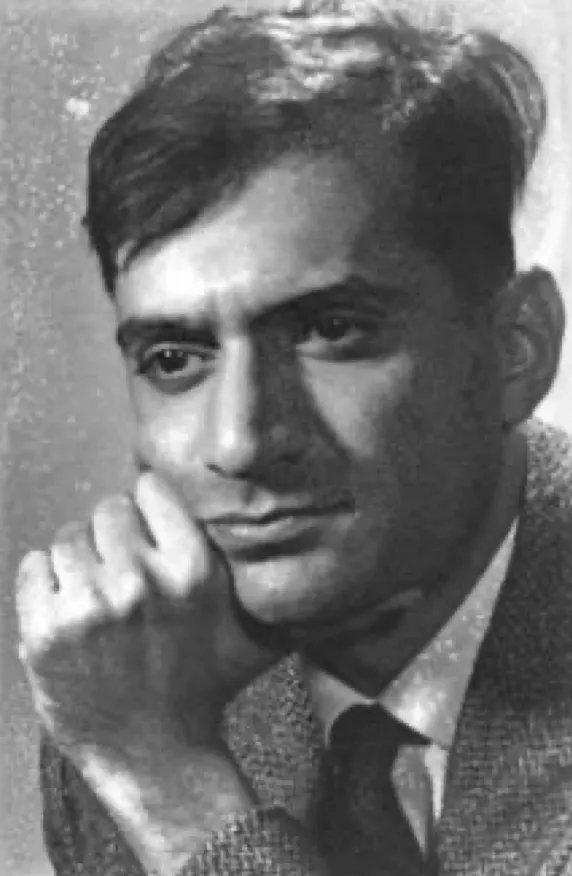
Aneesur Rahman was born in Hyderabad in British India in 1927. His father was a professor and a philanthropist. His family generously donated their property for the creation of Urdu Hall in Hyderabad. His maternal uncle was a professor too. Rahman had a natural flair for subjects that would terrify ‘normal’ students — maths and physics. After getting BSc in Mathematics, he went on to get Tripos in Mathematics and Physics at the prestigious Cambridge University in the UK. From there, he went to Louvaine University in Belgium and got DSc in Physics under Professor Mannenbeck. It’s here that Rahman met a Chinese student Yueh-Erh Li who was doing MD( called Dr Jady by friends). They fell in love and got married.
He came back to teach in Osmania university along with his wife. Soon after, he developed interest in the structure of water molecule - especially the polarisation of the hydrogen atom. Unfortunately research in India was at infancy in those days and Dr Rahman realized he was a whale in a tiny pond. He had to move to the ocean. He joined the Argonne National Laboratory in Illinois.
His foundational paper in 1964 birthed “molecular dynamics” , one of the two pillars on which a vast body of computational physics rests.(the other is Monte Carlo method). His equation made it possible to calculate the trajectory of large number of interacting atoms with ease.
His work, like Ramanujan’s , was so ahead of his time - that even today, potential applications are being discovered. The Nobel prize in physics for 2013 went to Karplus, Levitt and Warshel whose work depended heavily on Dr Aneesur Rahman’s.
Some say there is an inverse association between genius and compassion -Dr Rahman was a prominent exception. He was known not just for his intellect, but also kind nature and mentored many students all over the world. His quiet, unassuming nature made him a much loved professor — and he remained so, until he got Non Hodgkin’s lymphoma — a cancer that took him away from us prematurely, at the age of 59. Perhaps he might have got a Nobel, if only he had lived longer.
American Physical Society honors him as the father of computational physics and has instituted an annual award in his name.
As a doctor with little idea of theoretical physics, writing Dr Aneesur Rahman’s portrait has been difficult , because of the complex nature of his work that straddles so many areas of science : mathematics, physics, computer science and chemistry. His equations are mind boggling, even intimidating, but
what I do understand is this : Dr Rahman didn't just have a beautiful mind, but also a beautiful heart.
All subjects developed from kernels of human intuition.
So, when communicated by keeping intuition, playfulness and free guessing, even reputationally "difficult" subjects lose their intimidation.
Here is a very preliminary version of an attempt to introduce Sanskrit through the Bhagavad Gita in this way (Ver 0.0.0.....1)
Lesson 1 : https://t.co/83iGJ7fuqV
Interlude : https://t.co/Ha18XTvYDc
Lesson 2 : https://t.co/tpGMTELzN9
Released just five days ago, DeepTutor has already surged past 1.4K stars on Github! It seems people are hungry for a smart learning assistant that truly understands them.
🔗 Fully Open-Source: https://t.co/Wd8odKIRSn
We talked to countless students and kept hearing the same pain points: existing AI tools are either too fragmented or fail to capture personal learning context effectively. That's exactly why we built DeepTutor—to create an AI learning companion that actually remembers your progress and adapts to your unique learning style.
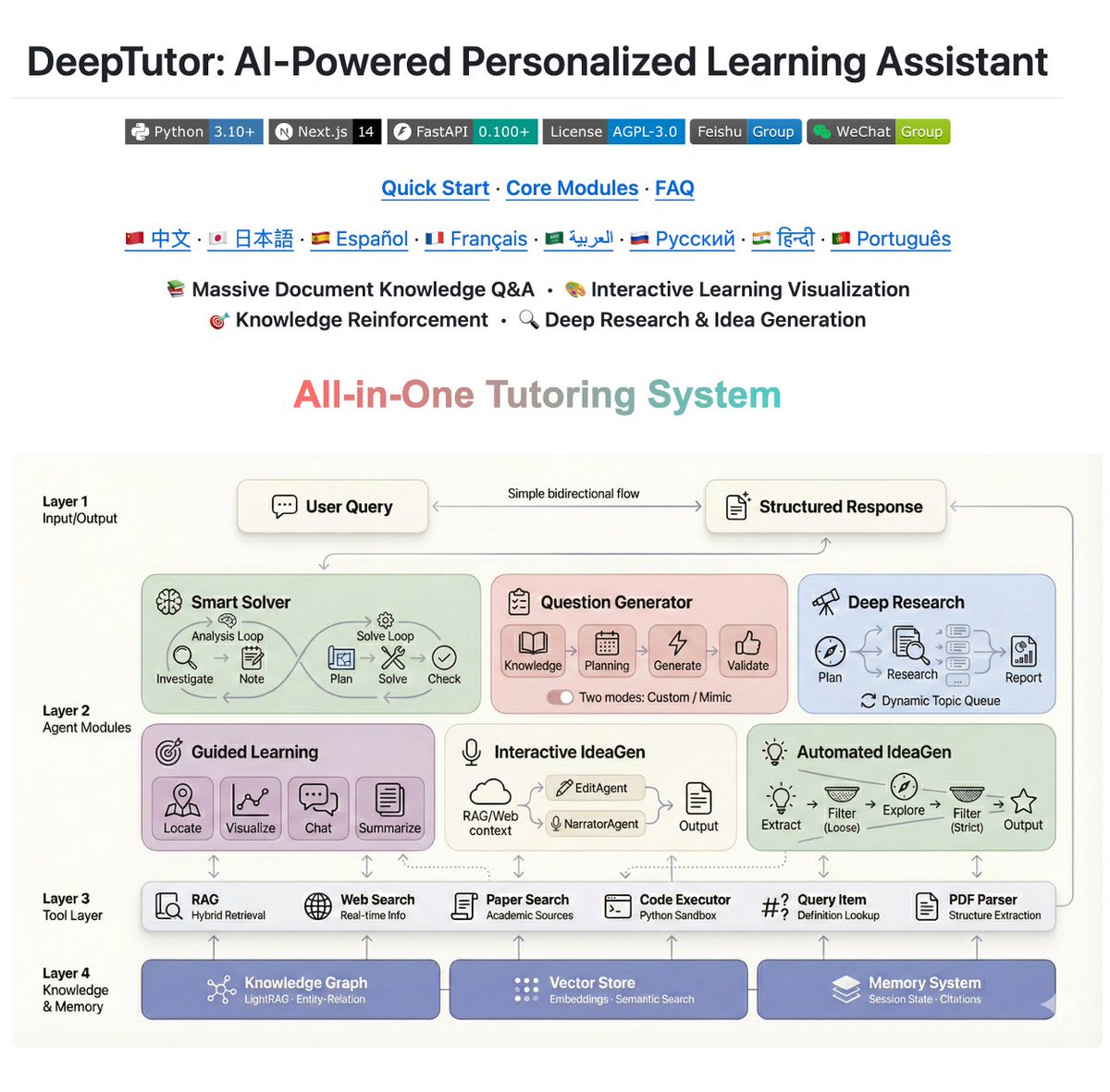
DeepTutor's Core Architecture
- 💬 User Interface Layer
Intuitive bidirectional interaction with structured, actionable outputs that organize complex context seamlessly.
- 🤖 Intelligent Agent Modules
Specialized multi-agent collaboration: problem solving, deep research, guided learning, and idea generation.
- 🔧 Tool Integration Layer
Unified access to RAG retrieval, real-time web search, academic databases, and code execution capabilities.
- 🧠 Personalized Knowledge & Memory Foundation
Persistent memory system built on knowledge graphs with contextual session tracking. Creates truly personalized learning experiences tailored to your individual progress and preferences.
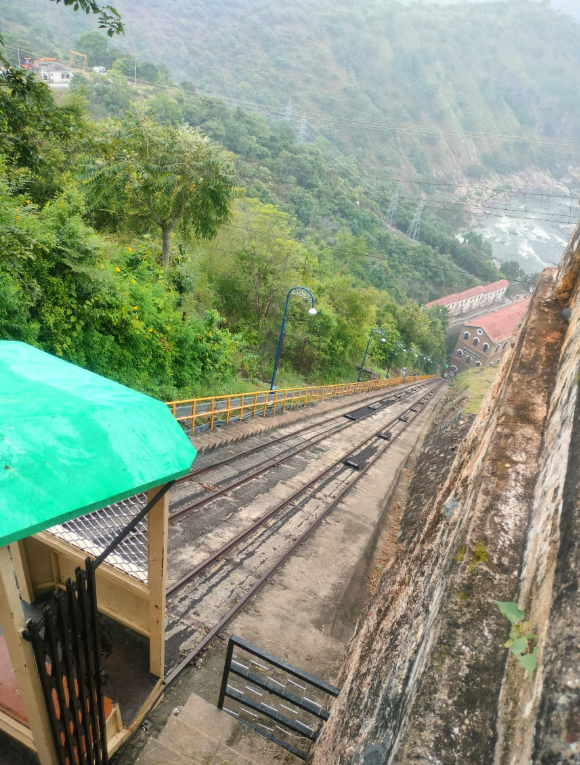
Engineering students who visit Shivanasamudra hydroelectric plant are never told the significance of that plant and how India taught the world the long-distance transmission of electricity! It is this plant which made the steam power obsolete!
This is to fix that gap in the knowledge. I wish I had been made aware of this in 1991 when I visited the site as an Engineering student.
In June 1902, something occurred at a remote Indian waterfall that should have shocked the Western world. A transmission line, 92 miles long, carried 30,000 volts of electrical current through the jungle from Shivanasamudra Falls to the Kolar Gold Fields. It was the longest commercial high-voltage power line on Earth.
Nothing comparable existed in America or Europe.
The achievement emerged from the vision of K. Seshadri Iyer, Dewan of Mysore, and Major Alain Chartier Joly de Lotbiniere, a Canadian engineer in the Hindu kingdom's service. De Lotbiniere saw something others had missed: the Cauvery River's 400-foot drop could turn turbines and generate power sufficient to replace steam engines at Kolar's deep mines, where fuel costs had become prohibitive.
Seshadri Iyer understood that a kingdom's survival depended on economic capacity, not military might alone. In 1898, he commissioned engineers to travel to Niagara Falls to study George Westinghouse's alternating current transmission system. When they returned, the plan crystallized. Mysore would not simply purchase foreign solutions. It would understand every component and build the system itself.
The venture carried substantial risk. The capital was considerable for the 1890s. The technology was unproven. The line would stretch across malaria-infested terrain, requiring 5,000 laborers. The court skeptics outnumbered believers. Yet Seshadri Iyer proceeded with methodical confidence.
Construction began in 1899. Generators came from General Electric in America. Turbines came from Escher Wyss in Switzerland. But the transmission system design and execution remained under Indian leadership. Civil engineers designed channels to divert the Cauvery's flow through penstocks. Electrical engineers stepped voltage upward to 30,000-35,000 volts using transformers, transmitted it across 92 miles of copper line, then stepped it downward at Kolar for mining machinery.
The frequency selected was 25 cycles per second, not arbitrary but deliberate. Heavy rotary converters used in mining operated efficiently at lower frequencies than the 50 or 60 hertz that would eventually become standard globally. This reflected sophisticated understanding of end-user requirements.
In June 1902, high-voltage power generated at Shivanasamudra flowed across 147 kilometers to the gold fields. For the first time, machines in one location could be powered by water falling in a completely separate location, separated by jungles and hills. The mining operations transformed. Deep extraction became economically viable. Steam dependence was broken.
This distinction matters. The Shivanasamudra project was not Western technology imposed on an Indian kingdom. It was an Indian administration studying Niagara Falls, acquiring knowledge, and implementing a solution that exceeded what any Western nation had accomplished in this specific domain. Technologies were sourced globally. Vision and execution were profoundly local.
The surplus power enabled Bangalore to become Asia's first city with meaningful electric street lighting in 1905. Nearly 100 streetlights appeared suddenly, not from gradual urban accumulation of infrastructure, but from a distant river harnessed with precision. Within a year, Bangalore had 861 streetlights and 1,639 domestic connections.
The Shivanasamudra project reveals patterns that extend beyond technical accomplishment. It demonstrates that innovation does not flow exclusively from wealthy Western nations. A kingdom positioned as subordinate within the British Indian Empire could perceive a technological opportunity, acquire knowledge globally, and implement a solution exceeding established industrial powers. It shows that engineering excellence is not the monopoly of any nation or culture. And it illustrates what becomes possible when vision, resources, and technical competence align in common purpose.
The subsequent obscuring of credit should not overshadow the original achievement. The Hindu kingdom of Mysore, through Seshadri Iyer's leadership and de Lotbiniere's engineering, seized a technological frontier and transformed the region's future. That accomplishment deserves recognition as evidence of what is possible when aspiration meets capability.
Kashi honours 19-year-old Vedamurti Devavrat Rekhe for historic Dandakrama Parayanam blessed by Sringeri Jagadgurus
Kashi witnessed a rare spiritual celebration when 19-year-old Vedamurti Devavrat Mahesh Rekhe was honoured with a golden bracelet (worth ₹5 lakhs) and ₹1,11,116, blessed by Jagadguru Shankaracharyas of Dakshinamnaya Sri Sringeri Sharada Peetham. The young scholar from Maharashtra completed the Dandakrama Parayanam of nearly 2000 mantras of the Shukla Yajurveda’s Madhyandini branch in 50 uninterrupted days - a feat accomplished in its classical purity after almost 200 years.
A grand procession from Rathayatra Crossing to Mahmoorganj, featuring musical instruments, shankhadwani, and over 500 Vedic students, transformed the city into a vibrant Vedic festival. Devotees showered flowers and welcomed the procession as a divine yatra.
A special message of blessings to Vedamurti Devavrat Mahesh Rekhe from Sringeri Jagadguru Shankaracharya Sri Sri Bharati Tirtha Mahasannidhanam was conveyed at the felicitation ceremony by the Asthana vidwan, Dr. Tangirala Shivakumar Sharma.
Scholars emphasised that Dandakrama- considered the crown of Vedic recitation due to its complex svara-patterns and intricate phonetic permutations - has been performed only three times in known history, with Devavrat’s recitation being flawless and completed in the shortest span.
The Parayanam, conducted at Vallabharam Shaligram Sangved Vidyalaya from 2 October to 30 November, was supported by several religious and social institutions of Kashi. Saints, Vedic scholars and dignitaries praised the young scholar and his father & teacher, Vedabrahmasri Mahesh Chandrakant Rekhe (who is the chief examiner of the Shukla Yajurveda Madhyandina Shakha exams conducted by the Veda Poshaka Sabha of the Peetham).
Devavrat’s achievement, under the blessings of the Sringeri Shankaracharyas, stands as a divine reminder that the living Vedic tradition continues to flourish through dedication, discipline and Guru-Kripa.
*-*-*
Join our Official WhatsApp Channel: https://t.co/UQh64huClx
#Bharat #SanatanaDharma #Shankaracharya #Sringeri #Vedamurti #Devavrat #Rekhe #Shukla #Yajurveda #Kashi #Varanasi #Vedas
If Chanakya were here, Devdutt’s fantasies would last about as long as the kūśa grass he ripped out when he vowed to destroy the Nandas. Devdutt’s entire thesis rests on one illusion: if he can confuse you with multiple names, shout “interpolation!” a few times, and wrap it in modern caste-politics, maybe just maybe, he can make 1,000 years of evidence of Chanakya’s existence disappear. But the moment you actually look at the sources, his narrative collapses flat.
Let’s start with where he doesn’t want you to look: the Arthaśāstra itself. In multiple verses it explicitly names Viśnugupta Kautilya as its author:
“विष्णुगुप्तेन आर्यकौटिल्येन च सम्पादितम्” (“Compiled by Viśnugupta the noble Kautilya”)
“समाप्तं कौटिलीयम् अर्थशास्त्रम्” (“Here ends the Arthaśāstra of Kautilya”).
Devdutt’s primary deception rests on creating two doubts in the reader's mind: first, that since the Arthaśāstra names “Kautilya,” Chanakya must be fictional; second, that if he can push the Arthaśāstra to a later date, then Chanakya couldn’t have existed in Mauryan times or guided Chandragupta.
But the moment you place the Arthaśāstra’s author in time, things get murky for Devdutt. Ashoka’s edicts (3rd c. BCE) describe an administrative system of mahāmātras, welfare officers, anti-animal-slaughter days, judicial ethics - all straight out of the Arthaśāstra. The Mauryan empire cannot be founded on a Kautilyan framework if the text didn’t exist until 500 CE. The empire itself proves Kautilya predates Ashoka to at least 4th c. BCE as tradition says.
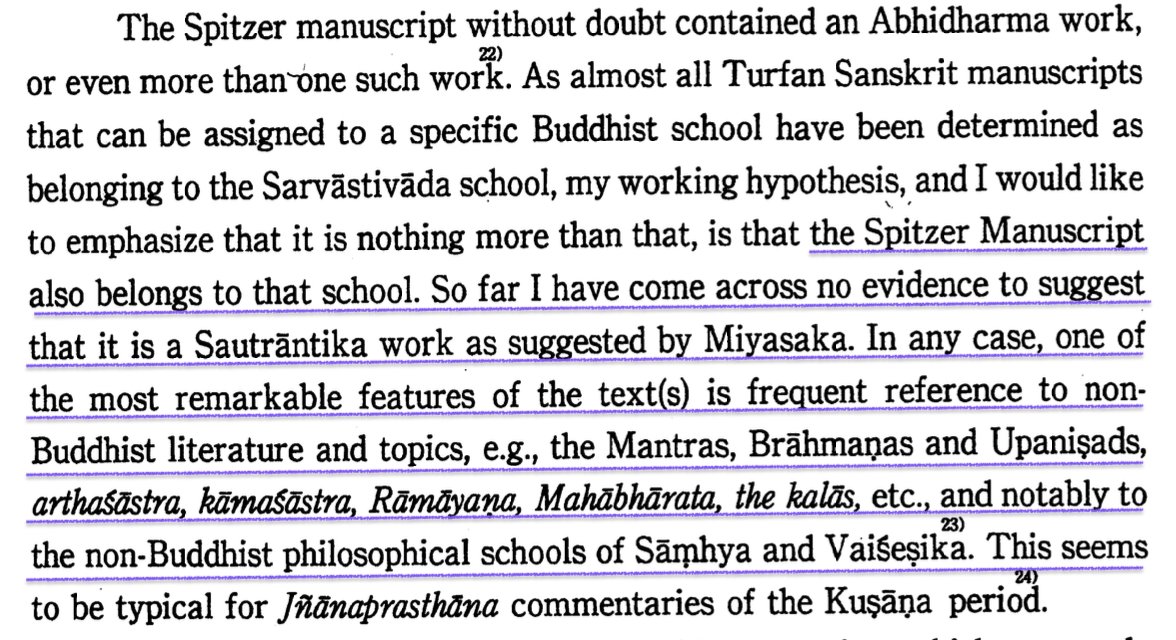
Then comes the Spitzer Manuscript, the oldest Sanskrit manuscript found so far (1st–2nd c. CE), which contains unmistakable references to the Arthaśāstra. And where was it found? A Buddhist monastery in Kizil, Xinjiang - 1000s of miles away from any “Brahmin power structure.” This alone demolishes Devdutt’s claims. Buddhists were studying Kautilya centuries before his imaginary “500 CE Brahmin invention.” Why would Buddhists preserve such “Brahminical propaganda”? They preserved it because it was already an established, authoritative, valuable text.
Next comes the knockout punch: the Kāmāndakīya Nītiśāra (4th c. CE) is a political treatise in the nīti-śāstra tradition, written by Buddhist scholar Kāmāndaki (कामान्दकि). He explicitly & admiringly states that the great Viśnugupta/Kautilya who authored the Arthaśāstra was the exact same strategist who overthrew the Nandas and guided Chandragupta Maurya to victory. This is the same storyline attributed to Chanakya in later literature. Why would a Buddhist writer like Kāmāndaki, with zero incentive to glorify a Brahmin minister, directly attribute Kautilya with the same glorious achievements as those of Chanakya the revolutionary? Because they were the same person. The Kāmāndakīya Nītiśāra text is the bridge which conclusively links : Arthaśāstra's Viśnugupta = Kautilya = Chanakya (in later Buddhist/Jain/Hindu sources)
Several other Buddhist sources specifically identify Viśnugupta/Kautilya as Chandragupta’s kingmaker. Jain sources like the Nisītha Cūrṇi and Hemacandra’s Pariśiṣṭaparvan identify Chanakya as the very same kingmaker overthrowing the same Nandas for the same Chandragupta. Gupta-era dramas like Mudrārākṣasa assume everyone already knows Kautilya as Chanakya. Kashmir’s Tantrākhyāyikā tradition immortalizes “Chanakya” as the archetype of political strategy. Across all traditions - Buddhist, Jain, Hindu, Kashmiri, Gupta - it is the same man performing the same deeds under different names.That is not myth-making. That is historical convergence, the strongest form of evidence when history spans 1000s of years.
As for the multiple names? In ancient worlds, it was perfectly normal. Confucius was also called Kong Qiu, Kongzi, Zhongni. In India: Viśnugupta is the personal name, Kautilya the gotra/scholarly name, & Chanakya the patronymic. One man. Many names. Total consistency. Pretending these names represent three different people is like claiming “Zhongni disproves Confucius.”
Devdutt also relies on the mention of “China” and “Roman coins” to push the Arthaśāstra centuries forward. But historian K. P. Jayaswal has already demonstrated that “Cina” here refers to the Śina/Shina Himalayan region of Gilgit, not Han China, which is why the Arthaśāstra uses kauseya and chinapatta, neither of which are Chinese words. And yes, references to Roman dīnāra are probably later interpolations - just like the many interpolations in Homer, the Pentateuch, or Euclid. No scholar ever claimed that these interpolations proved the authors never existed. Devdutt deploys this strategy only because he needs the text to look late, so that he can detach it from Chanakya and declare him a “Brahmin myth.”
Then comes the collapse of Devdutt's obsessive caste narrative. The earliest sources calling Chanakya a Brahmin are Buddhist and Jain works not Hindu ones - traditions which historically resisted Brahmin power. The Mahāvaṃsa (Buddhist), the Divyāvadāna (Buddhist), the Nisītha Cūrṇi (Jain), and Hemacandra’s Pariśiṣṭaparvan (Jain) all identify him as a Brahmin minister centuries before Hindu traditions elaborated the narrative. If “Brahmins invented Chanakya,” why do rival traditions repeat the same identity independently? Because they were recounting historical memory, not mythic propaganda.
So to make it crystal clear: Chanakya, Kautilya, and Viśnugupta are not three different people - they are simply three traditional names for a single historical strategist. This is exactly how ancient India named its great thinkers: a personal name (Viśnugupta), a gotra or scholastic name (Kauṭilya), and a patronymic (Chanakya). Tradition even preserves additional variants like Dramila, Draumina, Vishamashila & Anśula. Every independent source - Buddhist, Jain, Hindu, Gupta-era, Kashmiri all uses these names interchangeably for the same individual performing the same political revolution. This is not ambiguity; this is unanimity. One mind. One statesman. One architect of empire. Three names, one genius - exactly as ancient Bharat preserved its greatest figures.
Bottom line: three competing religious traditions which often competed as rivals, sometimes even hostile to each other - all remembering the same brilliant strategic genius of Magadha, overthrowing the same Nanda for the same Chandragupta Maurya in the same century CANNOT be coincidence. Devdutt winning the lottery while filming a TikTok and getting struck by lightning inside a volcanic eruption is statistically more likely. There is no “Brahmin propaganda.” There's only history refusing to bow to Devdutt's nauseating political biases and casteist agenda.
When such an overwhelming number of Bharatiya traditions, texts, chronicles, and political manuals over 2000 years point to the same genius - Chanakya/Kautilya/ Viśnugupta with the same narrative, then you don’t get to call him a myth and get away with it!
Devdutt’s article isn’t researched scholarship; it’s the same old casteist provocation wrapped in pseudo-history which crumbles instantly like a soggy biscuit in hot tea - the moment primary sources are allowed to speak.