I wonder if any of these erosion prevention techniques also lower the risk of pollutant runoff? Modern landfills have low permeable liners to prevent leachate from entering groundwater but the eroding sediment could also have hazardous stuff sorbed to it. #AquaEco2018
Land fills have to deal with erosion losses from run off. To combat this they create terraces in their hills and create detention ponds to reduce the amount of sediment entering aquatic ecosystems which can bury habitats, and clog gills. #AquaEco2018
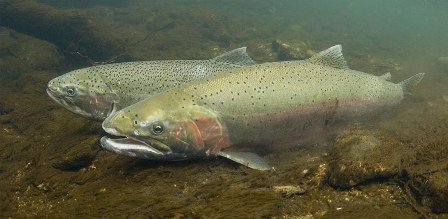
Interesting article about a river restoration/dam removal project in Northern CA that aims to strengthen anadromous fish populations including steelhead (Pictured) and salmon. Other aquatic species should also benefit from this project. #AquaEco2018 https://t.co/UybakSv6vb
It's amazing the info that we can gather from 1 satellite image. Looking at the islands and the edges of the bay you can really see the eddies mixing the tannins and lignins into the water. Some very interesting physical aquatic mechanisms at play in this picture! #AquaEco2018
"The light brown color is probably caused mainly by heavy sediment ... the waters getting darker is a sign of the heavy sediment settling out, while all the CDOM is still in the water because it is dissolved."
Look at that CDOM go! #AquaEco2018
https://t.co/dQdwtRlCZo
Waterfalls like this one located in Milton NH, are similar to man-made dams in the sense that they can block fish passage, which isn't always a bad thing. As mentioned in class obstacles such as this one can prevent spreading of devistating invasive aquatic species. #AquaEco2018
Always interesting to see the impacts of human actions on wildlife. These mussels are a sad reminder that even if we were to stop heavily damaging practices today (such as fracking) there will still be legacies of these actions imprinted on nature for years to come! #aquaeco2018
Freshwater mussels can be great indicators of pollution in local water bodies. As filter feeders, mussels’ shells provide a record of chemical contaminants in the water. Will this cause chemical contaminants to bioaccumulate up the food web? #AquaEco2018 https://t.co/VowZHmkpWT
Took a trip up Maine and found a destroyed bever dam! Looks like a landowner didn't appreciate these little ecosystem engineers. I wonder how quickly the aquatic ecosystem behind the dam responds to a sudden change like this in terms of organisms that live there? #AquaEco2018
With such unusually high flows like this for fall, I wonder how aquatic systems will be different going into winter. For example will Mill Pond still be high when ice over occurs and if so how will this extra water affect the organisms living below? #AquaEco2018
High flows observed behind the library this afternoon. Remember, width changes faster than depth and velocity as discharge increases! #AquaEco2018#HydraulicGeometry
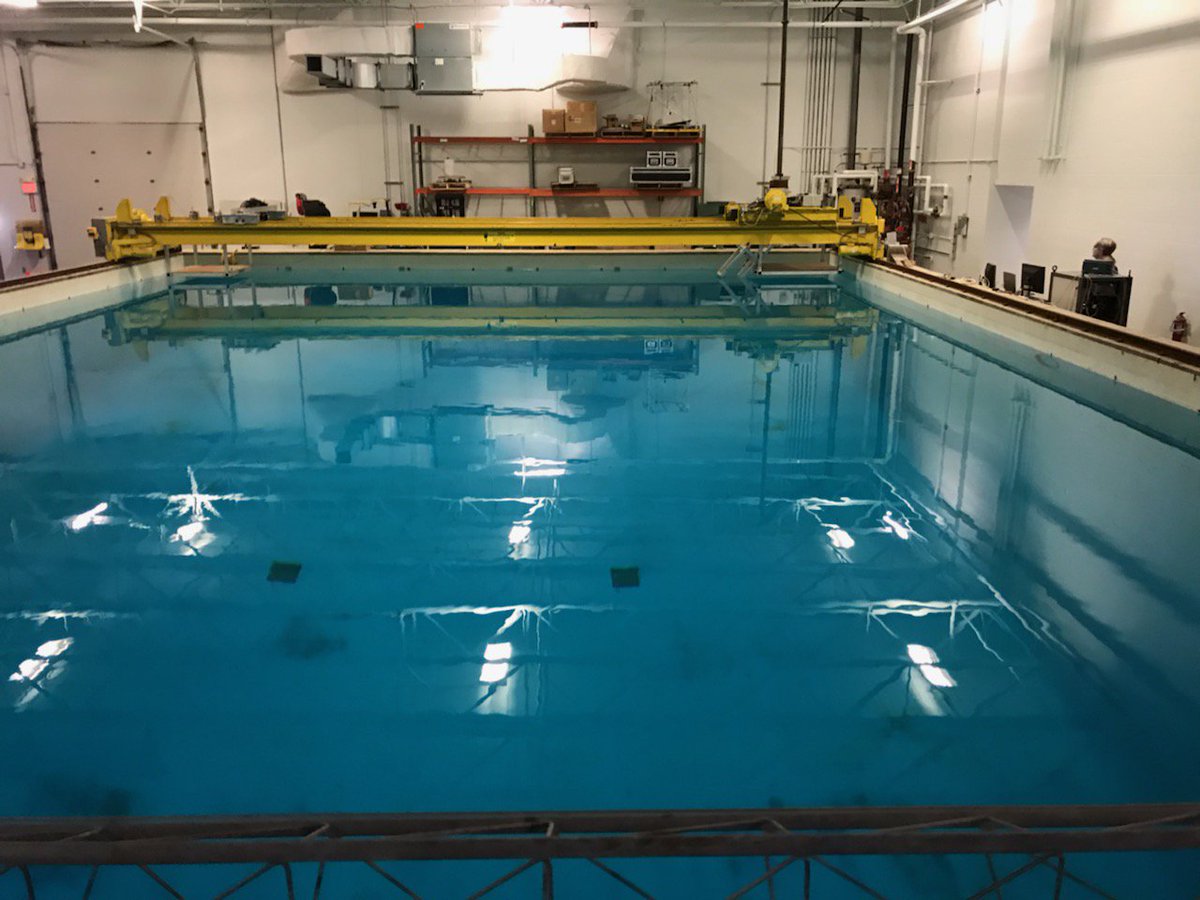
In ESCI654 we went to the Ocean Engineering Laboratory to learn how waves affect mixing and transportation. The new water flume (picture below) simulates the hydraulic conditions of the deep ocean or a river bed. Interested to see the studies that use this new device!#AquaEco2018
The Powder Mill Hatchery is my favorite fish hatchery to visit and it's near the one Grant and I are studying. With such a large operation I can understand why water quality is a concern! It will be interesting to see how this situation unfolds. @grant_a_magee#AquaEco2018
It's neat to see the impacts of temp fluctuations on aquatic systems. Water holds onto heat longer than air which causes this fog. Interesting to think how at night respiration would still be high due to water temp but production would stop due to lack of sunlight. #AquaEco2018
The best part about all this recent rain is getting to see the powerful runoff! I've never seen the Cocheco river this high! This video was taken in downtown Dover. #AquaEco2018
I really enjoy hearing about new eco-friendly ideas, especially when they're a bit strange like this one. I found an informative and somewhat corny Youtube video about the basics of this beet/salt idea. (https://t.co/roaidTWiRK) #AquaEco2018
Plant-based 'road salt' good for highways but not for insects https://t.co/2ZvKHrvMSm via @APSPhysiology@EurekAlert Its awesome to see thay alternatives to road salt are being explored! Although this alternative is biodegradable it still harms invertebrates. #AquaEco2018
I know recently (within last few decades) effort has been put into restoring the population in NH with farmed salmon fry being stocked in local rivers like the Lamprey. I think for the most part it was unsuccessful. Hard to restore natural processes once they're gone!#AquaEco2018
Great example of #shiftingbaselines in rivers. New England historically had sea-run salmon. Now the population is limited mostly to downeast Maine. Can you imagine salmon swimming up the Oyster River in Durham? #AquaEco2018
Fish ladders, built to aid migrating fish navigate past dams, are controversial because usually, they don't actually work. One problem is they need to be maintained or else they end up falling apart or getting clogged like the one I visited in Topsfield MA. #AquaEco2018
Great question, I haven't calculated that yet! I think in most cases it depends on the velocity of the stream. During wet seasons, like spring, College Brook is probably advection dominated. During the summer when the flow is low, it's probably diffusion dominated. #AquaEco2018
I walked along the Lamprey River and noticed this downed tree catching both leaves and natural foam. The foam is caused by decomposition of organic matter. I wonder what stage of decomposition is most prominent in this picture and what organisms live here as a result!#AquaEco2018
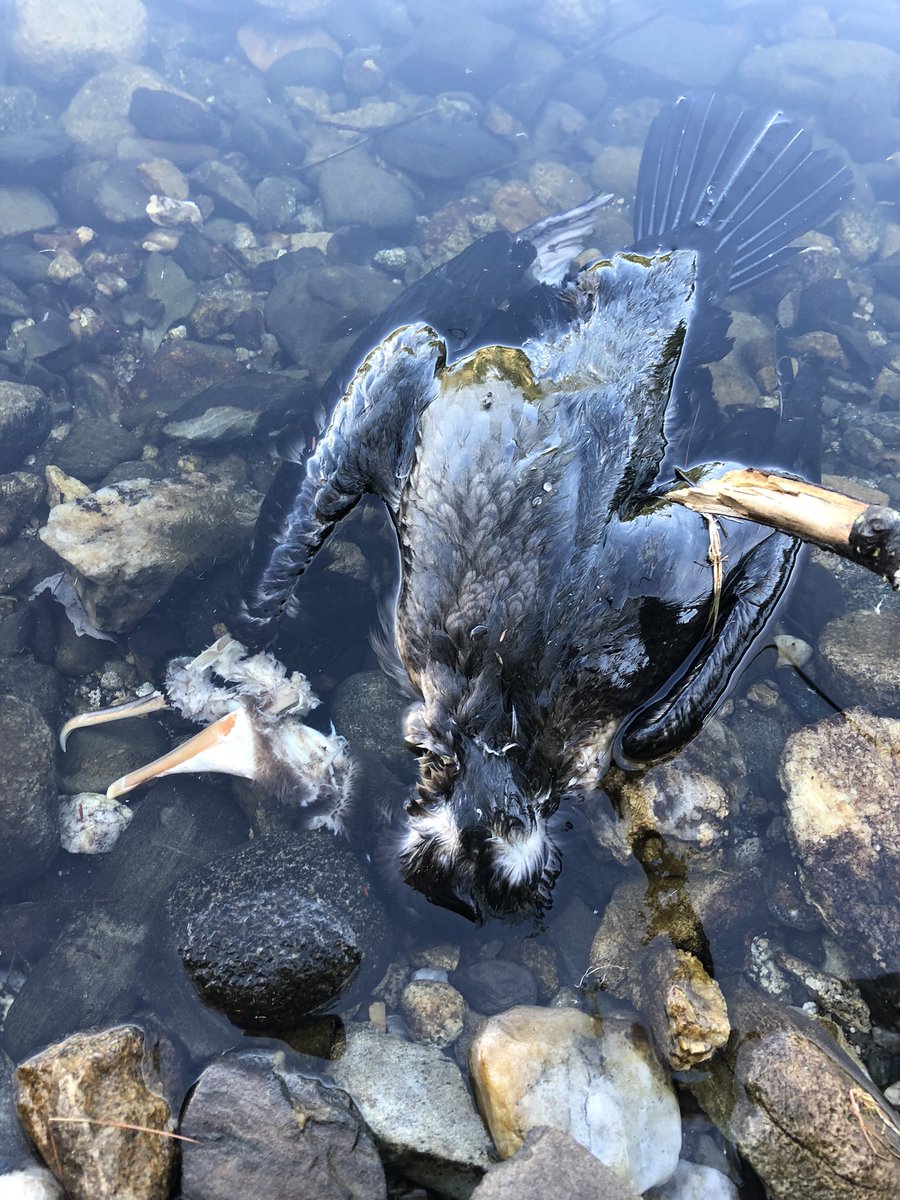
@MrEelgrass Without an 'official' autopsy, we can only speculate! With the bird being a cormorant, a species that feeds on fish, and Barbados pond being a highly active fishing spot my guess would be fishing line entanglement/choking. What do you guys think? #AquaEco2018
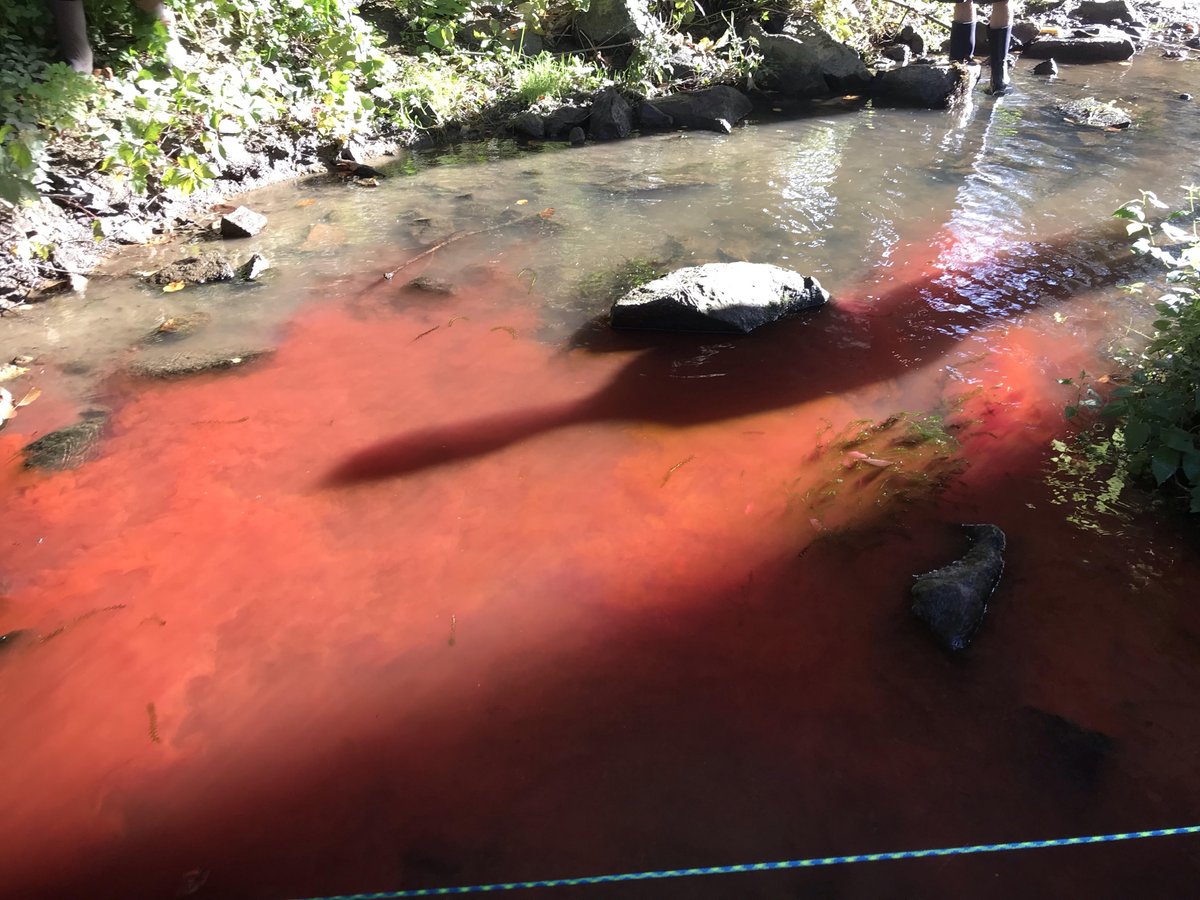
In NR654 we released non-toxic rhodamine dye yesterday in College Brook (under the MUB) to study the properties of advection and diffusion. During set up for this recitation, I found a medium-sized American eel in the stream. Wonder what it thought of the pink water! #AquaEco2018
At winters end, I always see these parking lot glaciers but never considered the impacts on runoff! Instead of 1 big flush of pollutants in the runoff caused by snowmelt, these glaciers probably create a more steady source of pollution in streams into earlier summer. #AquaEco2018
Impervious surfaces and parking lot glaciers go together. It is often fouled with oil or chemicals from cars or trash - a good reason not to let in run into our lakes and rivers and it seems like a waste to dispose of it before potential summer drought conditions... #AquaEco2018
I went fishing over the weekend, while I wasn't able to catch much on my rod, I was able to catch this little fella on camera. While this brook trout might not be native, it's defiantly wild (it was born in the stream) which means the water quality must be great! #AquaEco2018