As an Oxford professor, I loved teaching algorithms, and matrix multiplication was always on the syllabus.
Now a researcher at @OpenAI, working with an advanced model, has finally settled how fast it can really go.
The obvious method takes n³ steps. Strassen and Schönhage famously beat that, pushing the exponent below 3. Every great student I tutored at Magdalen tried to go further, and we'd argue about how low it could go. Computer scientists around the world spent decades on the same question.
Now we have the answer: 9/4. It's another monumental advance.
I'm so glad to be alive right now. We're seeing an explosion of discovery. The risks are real, but the promise of abundance is even greater.
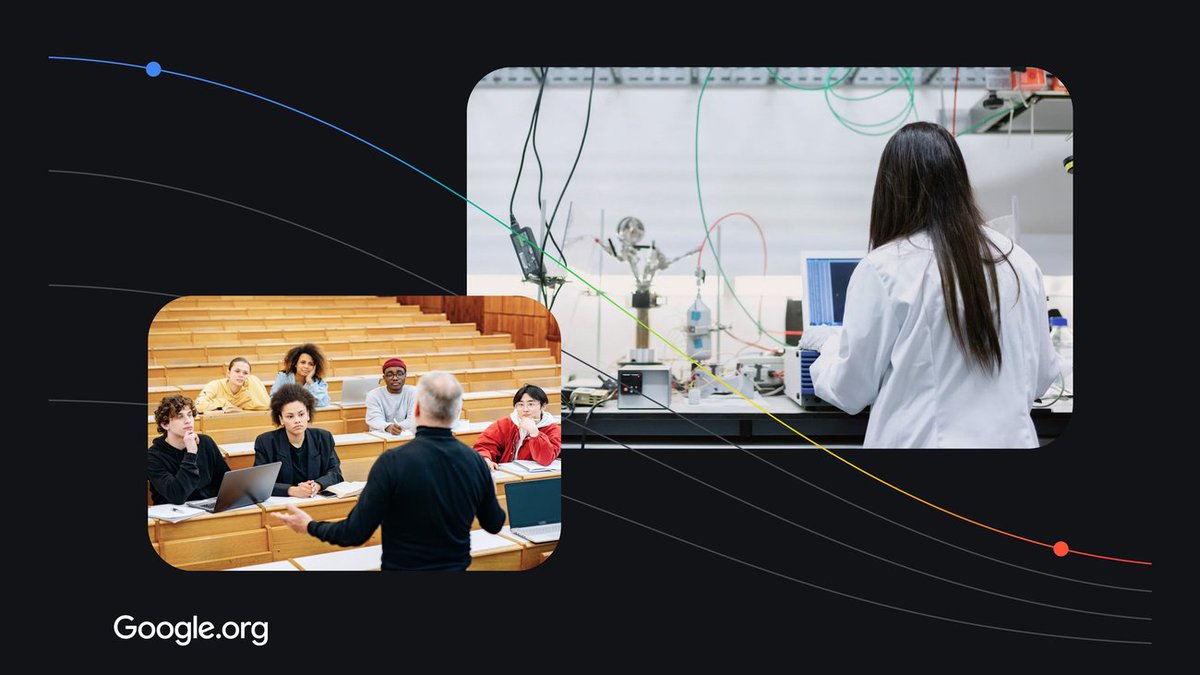
Thrilled and honored to have been awarded a 2026 Google PhD Fellowship in Machine Learning and ML Foundations!
My research proposal, “Foundations of Out-of-Distribution Discovery: from Theory to Molecules” aims to develop new theoretical and algorithmic principles toward a science of generative discovery.
I'm deeply grateful to @GoogleResearch for this recognition and support, and to my PhD advisors @arkrause, @niao_he, and @kjelljorner, my Caltech mentors @yisongyue and @francesarnold, and my previous mentors Marcello Restelli, Marco Santambrogio, and @mmbronstein for their invaluable guidance and support.
A huge thank you also to all the amazing collaborators, students, and colleagues I've had the privilege of working with and learning from along the way! Excited to keep working together!
Thrilled to have been selected as a 2026 Google PhD Fellow in Machine Learning Foundations! Grateful to @GoogleResearch for supporting my research in AI × Causal Inference and its applications in experimental sciences.
Job update: AI Research Scientist at Aleph Alpha!
Learning how LLMs are built in both industry and open source!
(Kolibri - @Aleph__Alpha)
(OpenEuroLLM - @OpenEuroLLM)
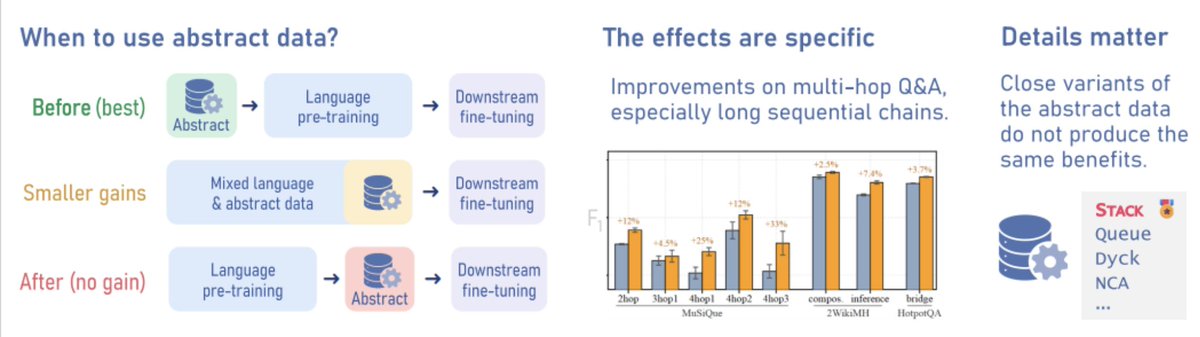
Recent work on abstract synthetic data has shown that it can help pretrain LLMs more efficiently. But *what* does it actually improve? We identified gains in multi-hop/long-chain reasoning, and a series of conditions to obtain these benefits. 🧵
Our first major update on https://t.co/v8KSoNBKqM
- venue confirmed in the heart of Manhattan
- paper deadline is December 22nd
- single-blind, free-form (just a page limit), use AI however you want--focus on the science
- everything public (openreview), < 3 papers per reviewer
To me the real message of the bitter lesson was never that ideas don't matter.
A good idea with little resources (compute, parameters, data) may lose to a bad idea with more resources. But the good ideas are the ones that give you the most bang for the buck. Good ideas improve scaling laws. They are the ones worth investing in. Good ideas are the ones that, resources being equal, beat bad ideas.
So a good idea alone won't win you any prizes. It is when you differentiate ideas by resources that you see which ideas are good because they allow for better scaling. For example, rote memorization might lead to similar results as proper study on a single exam; but it will likely scale much worse over the course of an entire degree.
This reminds me of @SchmidhuberAI 1991 noisy TV example. An agent that just tries to maximize prediction error will get stuck binging entropy. But an agent that maximizes the first temporal derivative of prediction error, i.e., learnability (glossing over some details) will be able to scale their knowledge over time.
Don't give up on thinking hard and searching for great ideas. They will be the ones that scale to the moon 🌕
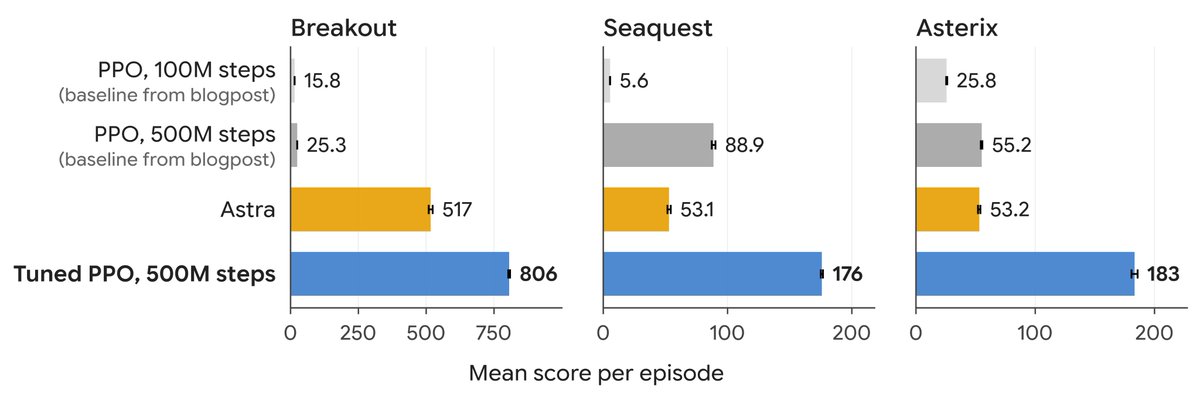
I am not gonna comment on the results per se, but if you believe your work is valuable and insightful, why not tune the baselines?
This took in total about 45 min of training on an A6000.
I regret to inform you that regardless of how broken academia is, you are still responsible for what you become during your PhD.
Your advisor can guide you. Your university can give you a degree. Neither can make you an independent thinker.
Stop chasing paper counts. Stop waiting for the perfect research direction. Stop confusing publications with scientific progress.
Stay curious. Question everything. Take ownership of your research.
The goal was never to become a paper-producing machine. It was to become a scientist.
A working linear probe ≠ a linear representation. We propose 3 tests that tell them apart: reverse predictivity, spectral concentration and OOD transfer.
Code + data: https://t.co/KUcXD3eKun
See you at NeurIPS Sydney 🇦🇺 🦘
with @klindt_david and https://t.co/oksfSKaCtI
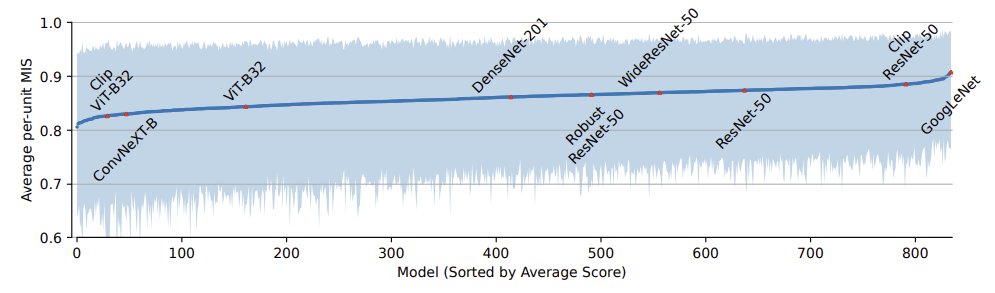
In 2024, @zimmerrol and I wrote a paper on AutoInterp for vision models. The interpretability score (MIS) is basically an accuracy of how well most and least activating inputs can be distinguished. He analyzed over 70 Million neurons from over 800 models and found scores from 80% to over 90%. Back then, I was really into SAEs/Superposition and kind of bummed that even the neurons scored so high – maybe now this is relevant again?
https://t.co/FVXuaOVzLw
Looking for a PhD program where you can study computational neuroscience? NYU has a fantastic array of researchers covering the field, and we'd love to consider your application:
https://t.co/B2GlQXFG8y
Check out @hazel_heejeong latest paper. This was a pleasure to work on. Turns out now that we know World Models can be disentangled we can move on to Compositional Generalization: Has your model actually learned the dynamics of the world or is it just predicting a biased policy?
Your world model may know less about the world than you think.
I've always wondered what world models really learn.
Humans don't memorize every trajectory. We learn rules we can reuse.
Can world models do the same?
We built AnyGoal to find out.
https://t.co/gMc0Zg10ja
New surprising result:
We trained AI recursively on its own safe generations, while giving it a benign cue. Models became increasingly misaligned over time, giving advice on how to do harm and build biological weapons.
We call this Progressive Misalignment. 🧵👇
Does this explain everything, like why we found direction selective neurons or face cells in the brain or why all these monosemantic neurons were/are about to be found in LLM MLPs?
NO. This is theory. There are assumptions. It is always a bit of "theory fairyland" (@ChrisInterno). Our goal as theoreticians is to bring these assumptions as close as possible to reality (e.g., not just pretending the KL were the other way around). But ultimately, it is a model, hopefully a useful one that will spark further research, ideas and hypotheses ☺️
In 2023 I showed @zimmerrol this neuron's most activating images and said that it is polysemantic (https://t.co/rTSNUS3LQR). He said hold on, I think it codes for "crossing diagonal lines".. 🤯
That was eye opening and highlighted a limitation of our VisionAutoInterp metric (https://t.co/oOT3FV5AA8)