Clarisse Hagège @clarisse_hagege spent a decade in global investment banking at Goldman Sachs, Bank of America Merrill Lynch and Crédit Agricole CIB before co-founding DFNS to build the mission-critical plumbing that safely connects institutional finance to blockchains.
DFNS @dfnsHQ is the core banking platform for digital assets: the infrastructure layer between a regulated institution's existing systems and the blockchains where value moves and settles. More than 400 institutions and fintechs run on it, among them Standard Chartered, First Abu Dhabi Bank, Stripe, Kraken and Circle. It is one of the 15 partners DTCC brought together for its Tokenization Service, where institutions hold, move and govern tokenised securities on Canton and DTCC's Besu network.
Her test for an institution is not whether it can hold a key or sign a transaction, but whether it can run onchain with the control, governance and auditability its board, its regulators and its clients expect. In Abu Dhabi she takes that question to the core of the bank itself.
We are delighted to welcome her for the first time. Clarisse Hagège, Co-Founder and CEO of DFNS, is confirmed for Proof of Talk Abu Dhabi.
About Clarisse Hagège
Co-Founder and CEO, DFNS
Board member, MPC Alliance
Formerly Goldman Sachs, Bank of America Merrill Lynch, Crédit Agricole CIB
Speaker 10 of 120.
Proof of Talk · Louvre Abu Dhabi · December 3 and 4, 2026
Many of the world's banks run on @Microsoft Azure.
@dfnsHQ is now available on @Azure too 🟢
There are two ways to deploy:
1️⃣ 𝗜𝗻 𝘆𝗼𝘂𝗿 𝗼𝘄𝗻 𝗔𝘇𝘂𝗿𝗲 𝘀𝘂𝗯𝘀𝗰𝗿𝗶𝗽𝘁𝗶𝗼𝗻. Run the full DFNS platform in the region you choose. All key shares are created and stored in your environment. DFNS has no access to your infrastructure or keys.
2️⃣ 𝗜𝗻 𝗗𝗙𝗡𝗦-𝗼𝗽𝗲𝗿𝗮𝘁𝗲𝗱 𝗔𝘇𝘂𝗿𝗲 𝗿𝗲𝗴𝗶𝗼𝗻𝘀. Use DFNS on Azure without managing the platform yourself. The first regions are in the US and Europe, with the UAE and Asia-Pacific coming next.
Our Infrastructure Engineer, Arnaud Dezandee, explains how it works. Here are some key points for security teams:
✔️ Entra ID handles all identity and access. No database passwords to manage.
✔️ The database has no public endpoint. Vault is only accessible inside the cluster.
✔️ 5 MPC signers with 3 required to sign. Each has its own identity, database access and storage.
✔️ Every key share is backed up in encrypted form at birth. Only the signer that created it can read it.
✔️ Sensitive actions require human approval. Creating a key store requires staff credentials.
Azure supports MPC signing today.
⏭️ More is coming: an Azure Marketplace listing, hardware-backed key storage, backup parity with other deployments and signers running in Azure trusted execution environments.
For banks on Microsoft Azure, DFNS can now run in the same cloud environment as their existing systems.
That's what onchain core banking is for.
📖 Read more: https://t.co/CBtjVNyevf
⌨️ Start building: https://t.co/EaYdvasEGe
The tokens with the strictest rules were also the hardest for institutions to hold on @solana.
But not anymore. @dfnsHQ now supports Token-2022 transfer hooks on Solana.
A transfer hook is a program attached to a token. It runs on every transfer and enforces the issuer’s rules. It can check who is allowed to hold the token, verify credentials, enforce holding periods or reject a transfer.
This is how issuers build permissioned securities, fund shares and compliant stablecoins on Solana.
Until now, these tokens were difficult to use with institutional wallets. Transfer hooks require extra accounts for every transfer. Wallet platforms must find and pass the right accounts or the transfer fails.
DFNS now handles this automatically:
✔️ Reads the hook and finds the required accounts directly from the chain. Developers use the same transfer request as for any other token.
✔️ Checks every transfer against the institution’s policies before signing.
✔️ Shows the reason when a hook rejects a transfer.
✔️ Includes these tokens in balances and transaction history, with standard webhooks.
Banks can now hold and transfer permissioned Solana assets through DFNS just like any other token, without losing the controls they need.
🟢 Live on Solana mainnet and devnet. No configuration required.
That's what onchain core banking is for.
📖 Read more: https://t.co/Ssoa1v0syV
⌨️ Start building: https://t.co/EaYdvatcvM
🇨🇭 We asked a room full of decision-makers one question.
𝘚𝘩𝘰𝘶𝘭𝘥 𝘣𝘢𝘯𝘬𝘴 𝘣𝘶𝘪𝘭𝘥 𝘵𝘩𝘦𝘪𝘳 𝘰𝘯𝘤𝘩𝘢𝘪𝘯 𝘪𝘯𝘧𝘳𝘢𝘴𝘵𝘳𝘶𝘤𝘵𝘶𝘳𝘦 𝘪𝘯-𝘩𝘰𝘶𝘴𝘦, 𝘰𝘳 𝘪𝘴 𝘵𝘩𝘢𝘵 𝘢 𝘣𝘢𝘵𝘵𝘭𝘦 𝘵𝘩𝘦𝘺 𝘩𝘢𝘷𝘦 𝘢𝘭𝘳𝘦𝘢𝘥𝘺 𝘭𝘰𝘴𝘵?
The options were simple: 𝐀 = build. 𝐁 = buy. 𝐂 = not sure.
𝐁 won 🏆
That was the workshop Clarisse Hagège led at @TheBigWhale_'s Geneva Summit last week and the room was full.
The only criticism we heard afterwards was that the session should have been longer, which is the kind of criticism you hope for.
It was one of the best of the year. Small, carefully curated, decision-makers only, Chatham House Rule, and real energy across both days.
Thank you to Raphaël Bloch, Noé Giglio, Dimitri Granger, and The Big Whale team for building it and to everyone who came to argue with us.
Next stop, @ADFinanceWeek in December. See you in the UAE! 👋
Your own stablecoin showed as “not verified” in your own dashboard.
Not anymore. Today, you can verify your own tokens ✅
@dfnsHQ maintains a global list of verified tokens to filter out spam and scam airdrops. But it also meant that every bank stablecoin, tokenized fund or partner token had to be added by DFNS, one support ticket at a time.
Just provide a network and contract address. DFNS checks the contract onchain and reads the token’s name, symbol and decimals. It then marks the token as verified for your organization.
From then on:
✔️ It appears as verified in balances and under “only show verified assets”.
✔️ It is sent to your configured compliance providers for screening.
✔️ Your UAT environment can match production.
✔️ Adding or removing tokens requires specific permissions and a signed action. You can also require approval from multiple people. Every edit logged.
Verification applies only to your organization. It does not change pricing. Tokens listed publicly keep their market price. Others show their balance in units. Clients cannot set prices, because prices affect policy decisions and reporting.
@DFNS maintains a global list of verified tokens to filter out spam and scam airdrops. But it also meant that every bank stablecoin, tokenized fund or partner token had to be added by DFNS, one support ticket at a time.
That's what an onchain core banking platform is for.
📖 Read more: https://t.co/bu1tFgRQXC
⌨️ Start building: https://t.co/EaYdvasEGe
A user holding USDC on @monad should never have to learn what MON is.
🟢 DFNS Fee Sponsors now work on Monad. Designate one of your wallets as a sponsor, fund it with MON, and pay the gas for every other wallet you run.
Users send stablecoins. The sponsor pays the fee. The API is the same one you already use for sponsorship on Ethereum, Solana and Stellar ✔️
Monad was built for payments at scale and cannot afford poor performance due to missing gas tokens.
How it works:
1️⃣ Monad supports EVM and EIP-7702. The sponsor pays gas but the wallet authorizes every action with its own key.
2️⃣ Add the sponsor ID to the transfer request. One line of API code.
3️⃣ Both signatures go through the Policy Engine. Set spending limits or require approvals for the sponsor.
4️⃣ Every sponsored transfer appears in both wallets' histories, with the sponsor identified for clear cost tracking.
Monad joins Ethereum, Base, Arbitrum, Optimism, Polygon, BNB Smart Chain, Berachain, Solana and Stellar as networks where @dfnsHQ sponsors gas through one API.
That's what onchain core banking is for.
📖 Read it: https://t.co/J0NUe6yZ9U
📚 Documentation: https://t.co/w4Q9p0n9ul
⌨️ Start building today: https://t.co/EaYdvasEGe
DFNS is hiring! 📯
Here are the open roles from around the world:
𝗦𝗮𝗹𝗲𝘀 𝗮𝗻𝗱 𝗮𝗰𝗰𝗼𝘂𝗻𝘁𝘀
▪️ Sales Director, North America
▪️ Strategic Account Director, LatAm
▪️ Strategic Account Director, APAC
▪️ Revenue Operations Lead
𝗘𝗻𝗴𝗶𝗻𝗲𝗲𝗿𝗶𝗻𝗴 𝗮𝗻𝗱 𝘀𝗲𝗰𝘂𝗿𝗶𝘁𝘆
▪️ Senior Infrastructure Engineer, US
▪️ Senior Infrastructure Engineer, EU
▪️ Lead Mobile Engineer
▪️ Staff Corporate Security Engineer
▪️ Staff Product Security Engineer
▪️ Principal Solutions Engineer, US
𝗠𝗮𝗻𝗮𝗴𝗲𝗺𝗲𝗻𝘁
▪️ Head of People
▪️ Head of Legal
Finance is moving onchain. Banks, payments, fintechs, trading, and capital markets need a new core infrastructure for digital assets. That's what we're building, and over 500 institutions already work with us. Our team spans San Francisco, New York, Paris, Zurich, Dubai, Singapore, Hong Kong, São Paulo.
If you want to help build the next generation of financial infrastructure, work on hard problems and help shape how the world's largest institutions move onchain, we'd like to hear from you.
📮 Apply here: https://t.co/CYnMYGTWkY
Know someone who would be a good fit? Share this with them.
⚠️ $6 billion left @binance in 20 minutes…
No key was stolen. No cryptography was broken.
The attacker got Binance's own signing service to sign. And it did.
Our CISO, Thibault de Lachèze-Murel, has published another post in his series on major hacks in digital assets.
At Bitget, the signer trusted the machine talking to it. At NEAR, it trusted a corrupted ledger. At Binance, the signer trusted the workload asking it to sign.
The attack took 5 months to prepare and it targeted people first.
→ In June, a tampered developer tool exposed members of the wallet team.
→ In September, a fake recruiter installed a zero-day on an engineer's computer.
→ In October, an internal AI tool gave the attacker access to two more engineers and a container deployment token.
→ On October 29, that token placed a container next to Binance's signing service. A script asked it to sign.
The service signed across 10 blockchains. On Ethereum, one signature was not a transfer but an EIP-7702 authorization, allowing a contract to control the account. 50 authorizations were prepared. One actually worked ⛓️💥
167,464 ETH and 63 tokens were stolen. The delegation continued draining the wallet for nearly 4 hours despite Binance's attempts to stop it.
Five key takeaways:
☑️ A signer must verify 𝙬𝙝𝙖𝙩 it is asked to sign, not just 𝙬𝙝𝙤 is asking.
☑️ Every signature type matters. Delegations must be blocked by default.
☑️ Using one signer across 10 chains creates a much larger attack surface.
☑️ Emergency containment must be planned and rehearsed, regularly.
☑️ Security must include people and internal tools, not just infrastructure.
There is a lesson here beyond Binance:
𝘈 𝘷𝘢𝘭𝘪𝘥 𝘤𝘳𝘦𝘥𝘦𝘯𝘵𝘪𝘢𝘭 𝘪𝘯 𝘵𝘩𝘦 𝘸𝘳𝘰𝘯𝘨 𝘩𝘢𝘯𝘥𝘴 𝘤𝘢𝘯 𝘴𝘵𝘪𝘭𝘭 𝘴𝘪𝘨𝘯. 𝘈𝘯 𝘢𝘱𝘱𝘳𝘰𝘷𝘦𝘳 𝘸𝘩𝘰 𝘥𝘰𝘦𝘴𝘯'𝘵 𝘶𝘯𝘥𝘦𝘳𝘴𝘵𝘢𝘯𝘥 𝘸𝘩𝘢𝘵 𝘵𝘩𝘦𝘺 𝘢𝘱𝘱𝘳𝘰𝘷𝘦 𝘤𝘢𝘯 𝘴𝘵𝘪𝘭𝘭 𝘢𝘱𝘱𝘳𝘰𝘷𝘦 𝘪𝘵. 𝘕𝘰 𝘱𝘳𝘰𝘷𝘪𝘥𝘦𝘳 𝘤𝘢𝘯 𝘮𝘢𝘬𝘦 𝘢 𝘸𝘢𝘭𝘭𝘦𝘵 𝘵𝘦𝘢𝘮 𝘪𝘮𝘱𝘰𝘴𝘴𝘪𝘣𝘭𝘦 𝘵𝘰 𝘱𝘩𝘪𝘴𝘩.
The attack didn't break cryptography. It exploited misplaced trust.
That is the problem onchain infrastructure must solve. Now.
📖 Read the full analysis: https://t.co/Xt48rXgd1K
⌨️ Start building: https://t.co/EaYdvasEGe
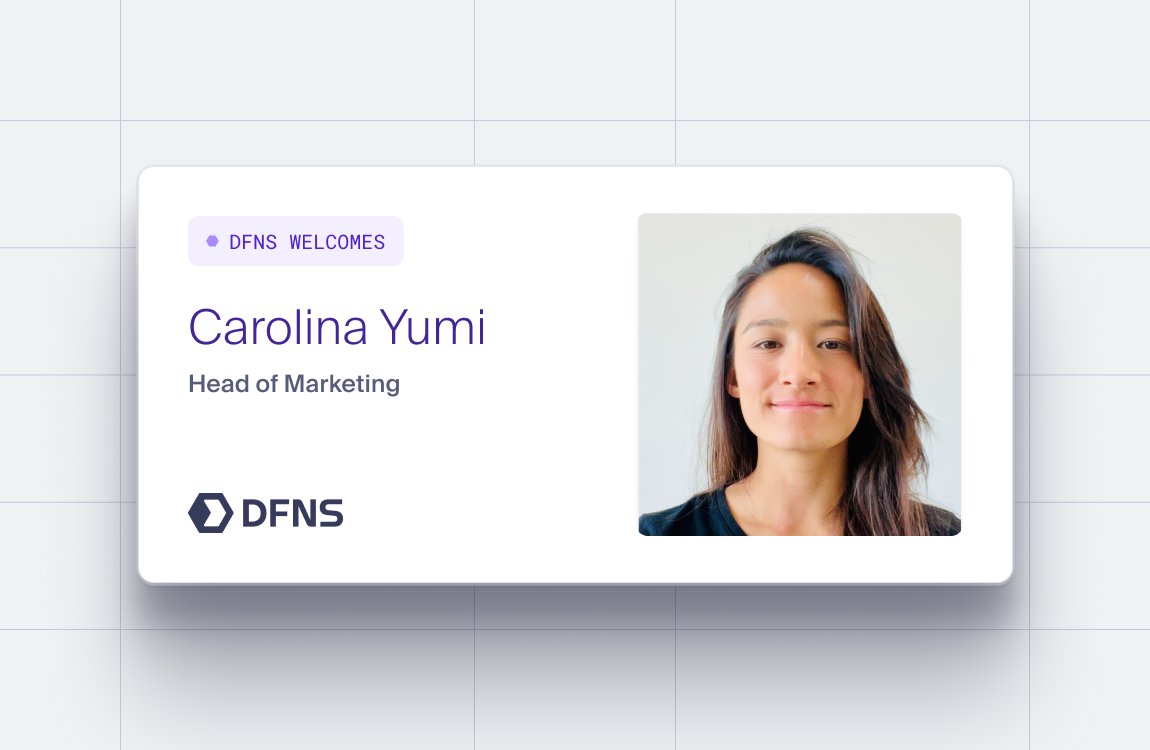
DFNS welcomes @carolyumi6, our new Head of Marketing 🤝
She was the second marketer at @nubank, first marketer at @TrueLayer, and she built @0xProject's marketing from zero. Now she's building ours.
Carolina has a habit of arriving early and building the function from scratch:
→ At Nubank, she contributed to building the largest digital bank in the world
→ At TrueLayer, she helped make open banking something fintechs could build on
→ At 0x, she built the marketing function behind one of the largest DeFi trading infrastructures
At DFNS, she will lead brand, positioning, go-to-market and growth as one connected function.
Our customers are banks, fintechs, payment companies and market infrastructures. They operate in markets where trust, technical credibility and long-term relationships matter.
Building a strong position in these markets takes more than campaigns. It takes clear positioning, consistent execution and a deep understanding of the industry.
That's what Carolina brings and we're excited to build the next chapter together.
Welcome to DFNS, Carolina. 🤝
📖 Read the announcement: https://t.co/rjkhiuFCbE
📮 See our open positions: https://t.co/CYnMYGTovq
One team, one role, one list. Policies update automatically.
Our CPO Chris Sutton shows how User Groups work in two minutes.
A User Group is a named team the platform understands. It can hold permissions and it can approve anywhere DFNS would otherwise expect an individual.
In the demo, Chris:
1️⃣ Creates an Operations group with four members.
2️⃣ Assigns the Operations role to the group. All members inherit its permissions.
3️⃣ Sets a wallet policy requiring approval from two of the four members.
4️⃣ Signs with a passkey ✔️
Policies now reference the group, not individuals. Membership changes automatically update who can approve, without changing the policy. Adding or removing members is itself governed, signed and audited.
The org chart and the platform finally say the same thing.
That's what onchain core banking is for.
🔘 Watch the demo: https://t.co/tV42Cd3vaA
📖 Read it: https://t.co/AH3iq9lUTr
⌨️ Start building today: https://t.co/EaYdvasEGe
🚨 We (@dfnsHQ) have been warning about the risks of social login for digital assets for years.
We documented the issues and responsibly disclosed vulnerabilities to several providers, including Privy, Turnkey, 𝚆̶𝚎̶𝚋̶𝟹̶𝙰̶𝚞̶𝚝̶𝚑̶, Magic, and Sequence.
But this goes beyond social login. The real problem is the push to make access to digital assets always faster and more frictionless. One click, instant access, no complexity, etc.
𝗘𝘃𝗲𝗿𝘆 𝘀𝗵𝗼𝗿𝘁𝗰𝘂𝘁 𝗰𝗼𝗺𝗲𝘀 𝗮𝘁 𝗮 𝙨𝙚𝙘𝙪𝙧𝙞𝙩𝙮 𝙘𝙤𝙨𝙩. And the love for speedy UX is exposing which teams have not thought deeply enough about the security implications of their design choices.
That is the real danger and it will only get worse.
We hope more people start listening.
If you ever used a "social login" for your crypto wallet, you will want to research this topic 👇 further to protect your funds.
Self custody = self responsibility. 🙏
🌏 SGD stablecoins are coming to @monad via @dfnsHQ.
We’re proud to announce a strategic partnership with @StraitsX 🤝
StraitsX issues XSGD and XUSD through entities licensed as Major Payment Institutions by the Monetary Authority of Singapore (MAS). Both stablecoins are backed 1:1 by reserves and represent nearly $70 billion in annualized transaction volume across its infrastructure.
As a next step, StraitsX plans to issue both stablecoins natively on Monad in early 2027 (subject to regulatory approval).
XSGD would be the first Singapore dollar stablecoin on the network 🇸🇬
The goal is to support cross-border payments, stablecoin card settlements and payment apps across the Monad ecosystem. StraitsX would be responsible for issuance, reserves and regulatory compliance.
And DFNS would provide the platform to manage issuance across networks:
✔️ Minting and burning governed by policy
✔️ Approvals, limits and screening before transactions are signed
✔️ Treasury tools to track balances across networks
✔️ One audit trail for every action
Regulated money needs reliable infrastructure and clear controls.
That’s what onchain core banking is for.
📖 Read more: https://t.co/5KOVaWvzd8
⌨️ Start building: https://t.co/EaYdvatcvM
🆕 @dfnsHQ now supports @monad
Monad brings high throughput, fast finality and Ethereum compatibility.
DFNS brings the controls financial institutions need to use it.
Monad is an EVM-compatible blockchain designed to process transactions in parallel while keeping compatibility with existing Ethereum smart contracts.
For payment companies and stablecoin issuers, this creates new options for fast, low-cost settlement. But speed alone isn't enough. Financial institutions also need control over how assets are issued, moved and managed.
DFNS provides that layer:
✔️ Wallets for MON, tokens, and smart contract execution.
✔️ Token issuance, minting and burning through the Tokenization Engine.
✔️ Approvals, limits, allowlists and screening through the Policy Engine.
✔️ Secure signing, balance tracking, webhooks, audit logs, and more.
🟢 Monad joins 100+ networks and services supported by DFNS.
That’s what onchain core banking is for.
📖 Read more: https://t.co/bWvAHpap23
⌨️ Start building: https://t.co/EaYdvatcvM
Every request on @dfnsHQ is signed by the caller, by default.
Until now, it took three round trips to get confirmation. Today, it takes one one.
Introducing 𝗔𝘂𝘁𝗵𝗲𝗻𝘁𝗶𝗰𝗮𝘁𝗶𝗼𝗻 𝟮.𝟬, the v2 of user action signing on DFNS.
User action signing is the foundation of every control on DFNS. The caller proves with a key it alone holds that it intended this exact action. DFNS verifies the proof before a wallet is created, a transaction is sent or a policy is changed.
Our first version asked the API for a challenge, exchanged the signed challenge for a token, then submitted the operation. 3 requests…
In our second version, the application builds the challenge itself, signs it, and sends the signature in the same request as the operation. 1 request (~67% fewer HTTP requests per protected operation) ✅
What stays exactly the same:
✔️ A valid bearer token is still required, and the credential must be an active Key credential.
✔️ The signature still binds the exact action, hostname, method, path, query string and body digest.
✔️ Permissions, governance restrictions and the Policy Engine still run on every request.
✔️ Every verified action still gets a user action ID and recorded credential evidence for the audit trail.
Replay protection is built in. A timestamp limits the window, a fresh nonce makes each request unique, and we record every nonce in shared storage so a signed request can never be used twice on any replica.
For a service creating wallets or submitting transactions at volume, two round trips removed from every operation adds up quickly. For a security reviewer, nothing that mattered has moved.
🟢 Available now as an opt-in preview for integrations signing with a Key credential.
That's what onchain core banking is for.
📖 Read it: https://t.co/Oxl2kApO1R
⌨️ Start building today: https://t.co/EaYdvasEGe