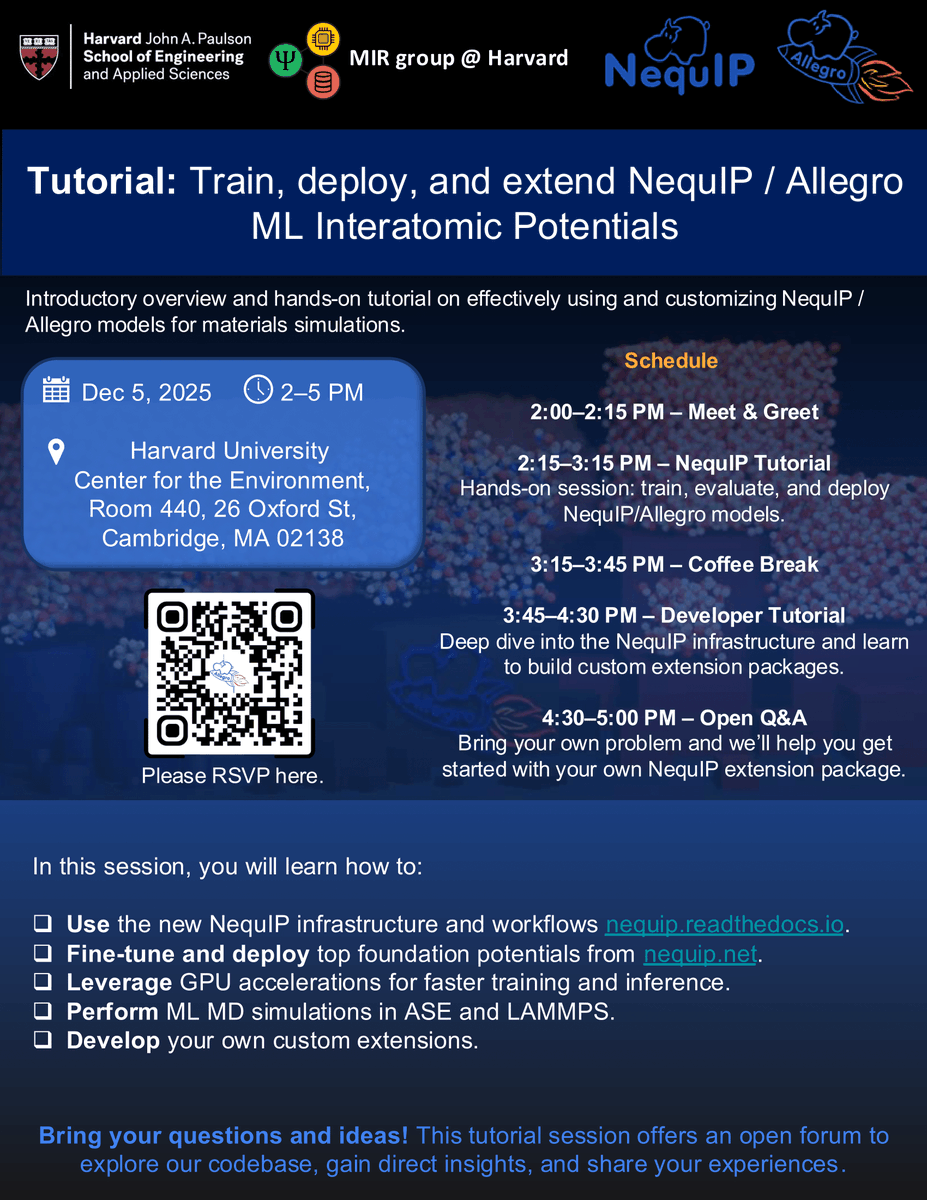
If you’re in the Boston/Cambridge area on Friday, December 5 (right after the Materials Research Society Fall Meeting), join us at Harvard University for our NequIP Tutorial.
👉 Please RSVP here to attend and receive event updates:
https://t.co/iRSKdtvhNt
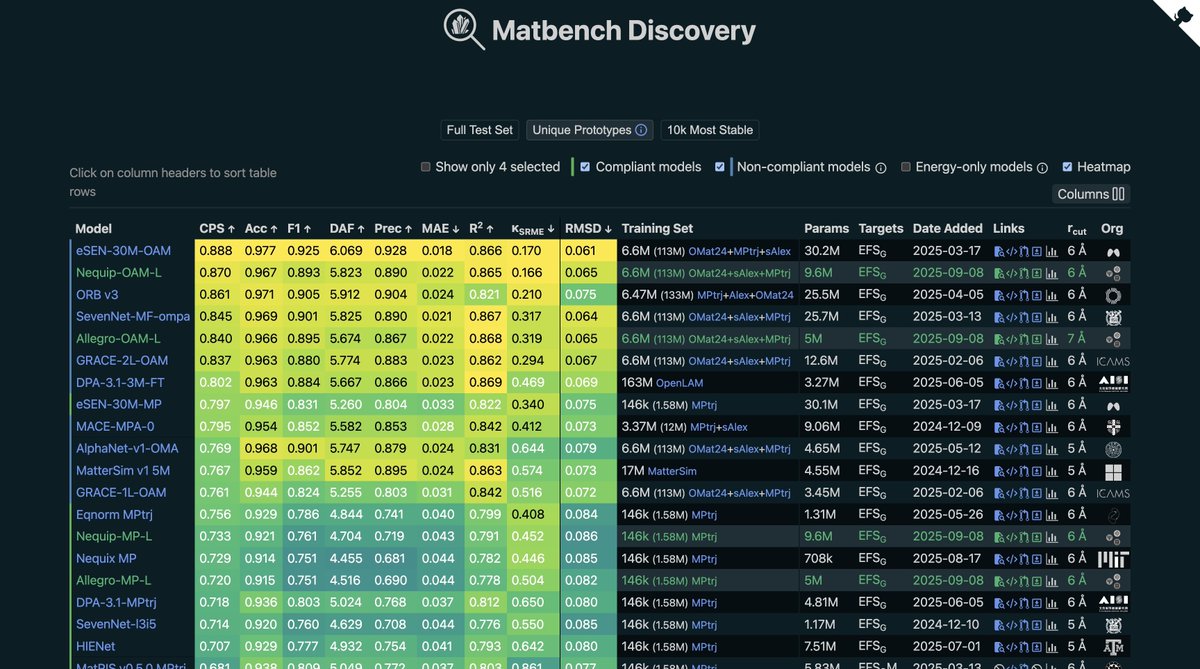
Excited to share that our NequIP and Allegro foundation potentials, trained by @Kavanagh_Sean_, are up on Matbench Discovery. Check them out at https://t.co/oLrHUBuQxm ! 🚀
I will be joining the University of Cambridge as an Assistant Professor in the Yusuf Hamied Department of Chemistry! 🧪🎉
𝐈 𝐚𝐦 𝐚𝐜𝐭𝐢𝐯𝐞𝐥𝐲 𝐫𝐞𝐜𝐫𝐮𝐢𝐭𝐢𝐧𝐠 𝐬𝐭𝐮𝐝𝐞𝐧𝐭𝐬, and am very keen to support fellowship applications – visit our website for details! ⬇️
@Kavanagh_Sean_@ylysogorskiy Hi Yury, the initial embeddings are done in FP64 while the rest of the model is in FP32. We then upcast for the energy scaling and shifting.
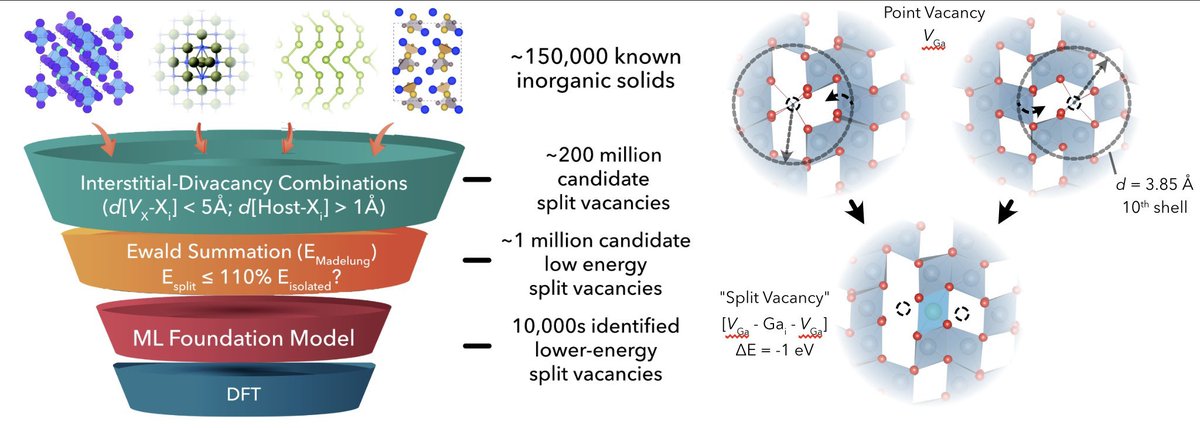
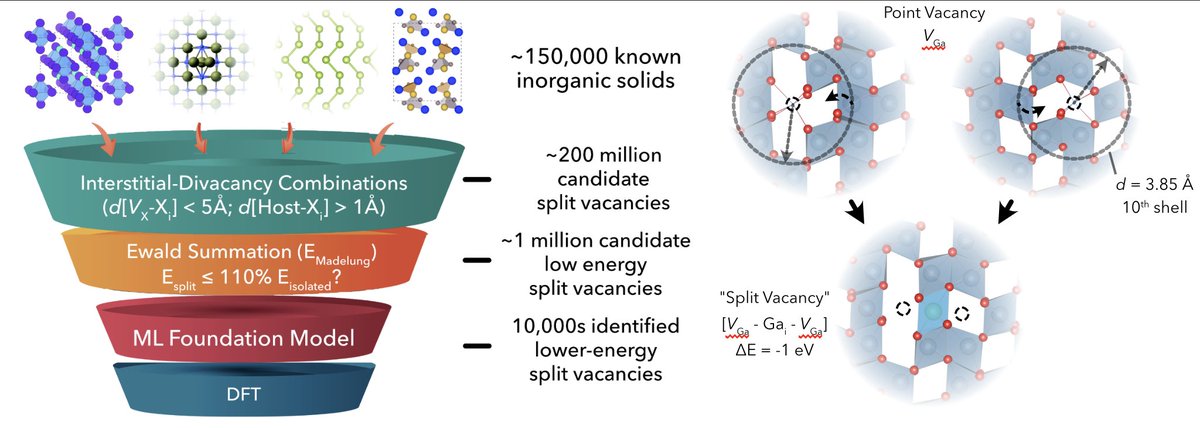
Machine learning can be powerful for understanding defects, but currently sufficient only in select cases.
MLIPs (& geometric/electrostatic tools in doped) allow screening for challenging 'non-local' defect reconstructions (split vacancies) in all ICSD/MP solids, w/caveats 🔗
Last month, we released a major update to the NequIP framework that fully leverages PyTorch 2.0 compilation for MLIPs. It’s significantly faster, easier to use, and more versatile than before.
Preprint: https://t.co/YuX5cOAcl7
Code: https://t.co/qfNPqWR5nU
https://t.co/TW6oJiKa5L
Our Allegro-Pol model extended the Allegro architecture to predict how materials respond to external electric fields while enforcing physical rules. It could describe vibrational, dielectric, and ferroelectric behavior for systems up to millions of atoms!
https://t.co/T5GImDzVak
Beyond happy to announce today Allegro-pol, a machine-learning framework that predicts how materials respond to electric fields with quantum-level accuracy, capturing vibrational, dielectric, and ferroelectric behavior at the million-atom scale! 🚀
https://t.co/rEKPH58Snd
For existing MLIPs, lower test errors do not always translate to better performance in downstream tasks. We bridge this gap by proposing eSEN -- SOTA performance on compliant Matbench-Discovery (F1 0.831, κSRME 0.321) and phonon prediction.
https://t.co/rzpjGm32QL
1/6
The latest version of 𝙙𝙤𝙥𝙚𝙙 (and 𝑺𝒉𝒂𝒌𝒆𝑵𝑩𝒓𝒆𝒂𝒌), our defect modelling python packages, have been released!
Incl:
- Major efficiency updates
- Advanced defect/carrier thermodynamics w/custom constraints
- Auto shallow defect handling
- CC diagram generation
...🧵👇
Excited to give an invited talk on our ML model for modeling materials' response to electric fields at the Ferro2025 conference, and to see the latest developments on the fundamental physics of ferroelectrics!
https://t.co/FuFsVi4rS6
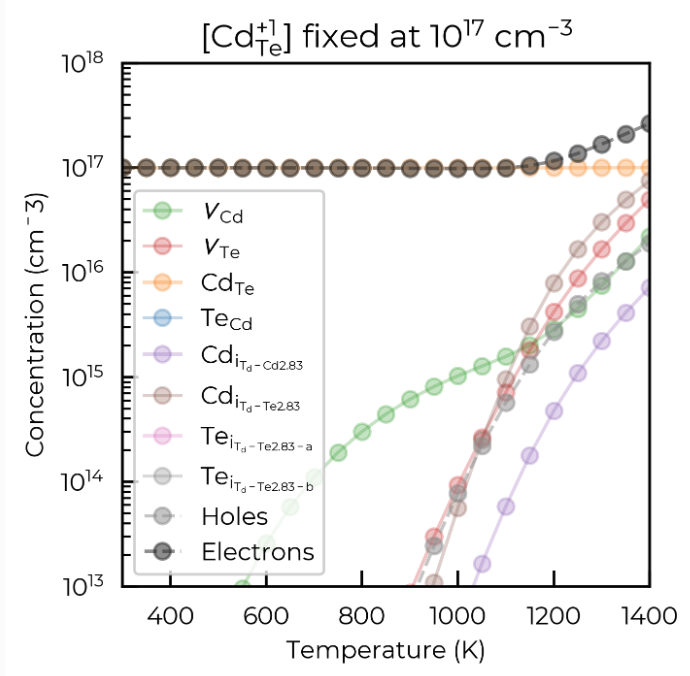
Machine learning can be powerful for understanding defects, but currently sufficient only in select cases.
MLFFs (& geometric/electrostatic tools in doped) allow screening for challenging 'non-local' defect reconstructions (split vacancies) in all ICSD/MP solids, w/caveats 🔗👇
🚀 Call for Abstracts! 🚀
Join us at the APS March Meeting symposium "Machine Learning for Atomistic Simulations" to shape this rapidly-evolving field!
📝 Submission Deadline: October 25, 2024
🌐 Submit here: https://t.co/LCcGf7AAAA
#APS#MarchMeeting#ML@MikPavanello
Intrinsic & extrinsic defect chemistry of trigonal Selenium, incl metastable states & non-radiative recombination
Combined theory & expt analysis, we find an intrinsic tolerance to 𝘱𝘰𝘪𝘯𝘵 defects, with GBs/interfaces the limiting factor for PV 📈
https://t.co/VYxZPMtnvm
New work by T. Bischoff, B. Jäckl, and me:
Benchmarking machine-learning potentials for molecular dynamics requires running accelerated simulations. We provide a fully automated benchmark for this.
Preprint: https://t.co/6qgUmulKOB
Repository: https://t.co/GCYpYSLLtj
My latest work is on @ChemRxiv. We used Allegro, an ML interatomic potential based on local equivariant representations, to perform large-scale MD simulations for a series of deep eutectic electrolytes./1
https://t.co/B3pyqzXCEH
New preprint is out: https://t.co/AF7xui3Us6! Here, we present a multimodal technique for understanding surface roughening in nanoparticle catalysts using CO-DRIFTS, X-ray absorption (XAS), and machine learned force fields. The expt. methods provide disparate insights into the 🧵