💸 In AI search, your brand can get recommended in the answer... while the citation (and the click) goes to a magazine or a marketplace instead of your own page. 👇
A new study by Gentian Shero / @SheroCommerce analyzed 8,573 product descriptions across 1,000 Shopify stores, then ran 60 real buying questions through Google's AI Mode, ChatGPT & Perplexity to see who gets cited.
📊 What they found:
* Across all 1,851 sources AI cited, only 2.8% were a brand's own page. 59% were publishers.
* In Google's AI answer layer, established DTC brands were cited or recommended just 9.5% of the time, and in 1 of every 3 categories, not a single one was named.
* Even when a brand WAS recommended, its own page earned the citation only 31% of the time. The rest went to Good Housekeeping, Verywell Fit, Reddit, CNN Underscored...
* 20% of product descriptions appear near verbatim on another domain, almost always a retailer or marketplace (Nordstrom, Amazon, Sally Beauty), not a rival brand. Your own copy, syndicated everywhere, with zero signal telling AI which page is the origin.
* The "thin content" panic is overstated: measured on raw HTML, only ~15.6% of stores are genuinely thin. The real weak layer is structured data: 88% feature product schema, yet 59% leave the AI-readable description under 50 words or empty.
🧠 The takeaway: the problem isn't thin copy, it's duplication + weak attribution.
When your description is copied across 15 websites, an LLM has no reason to treat YOUR page as the authority, so it cites whoever wrote something original about you first.
✅ The solution is editorial, not technical: original, product-specific copy in every area an LLM reads (including the structured data description) so your page becomes the attributable source, not the reviewer's.
Well built, reproducible study (they even published the full dataset). Check it out 👇
https://t.co/59IzK2U557
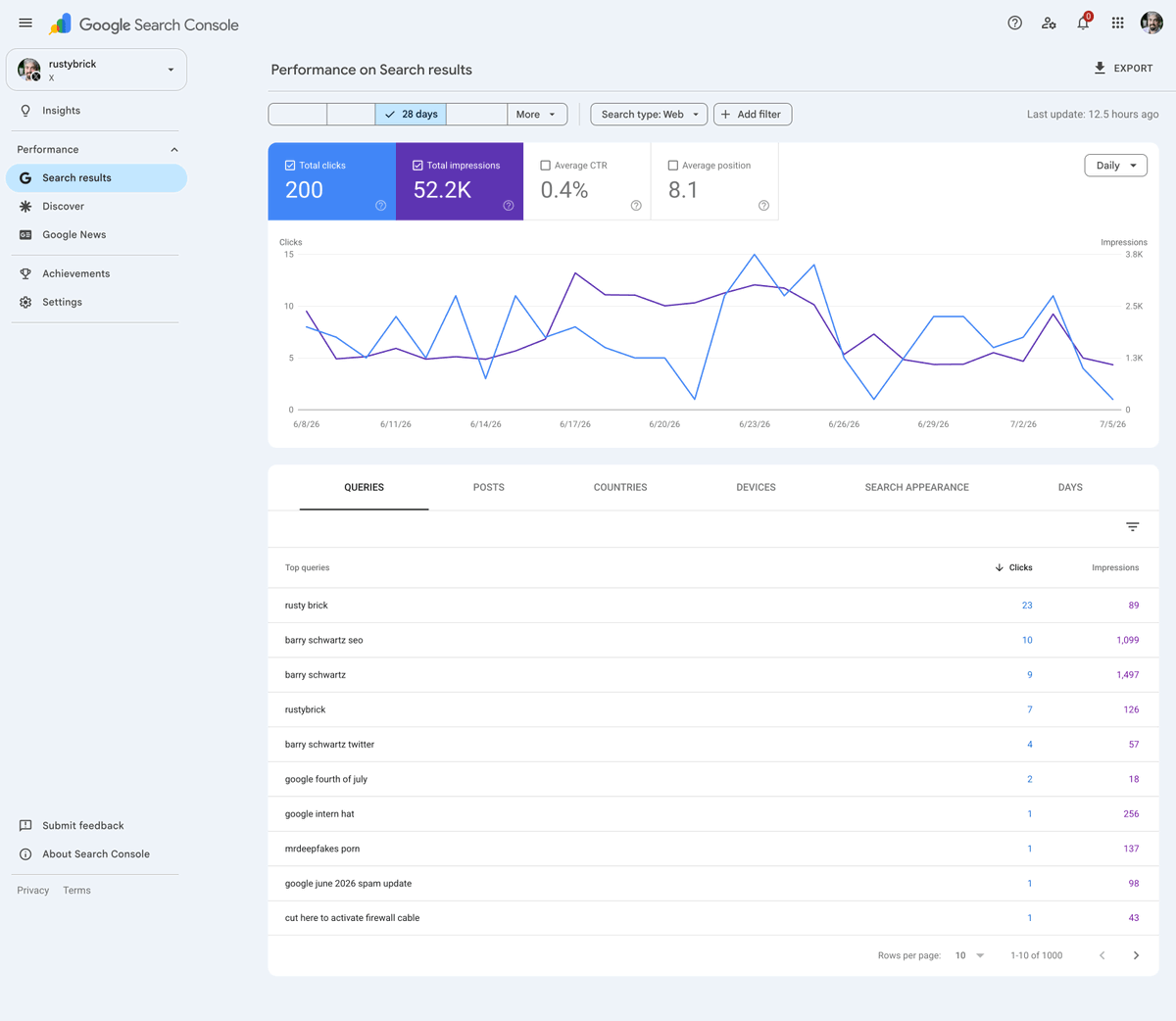
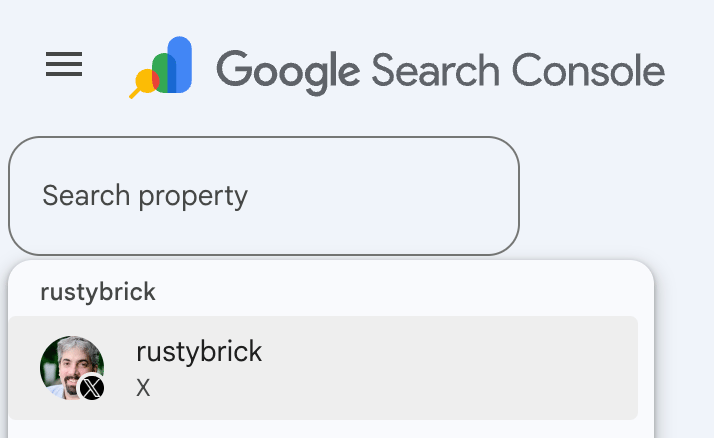
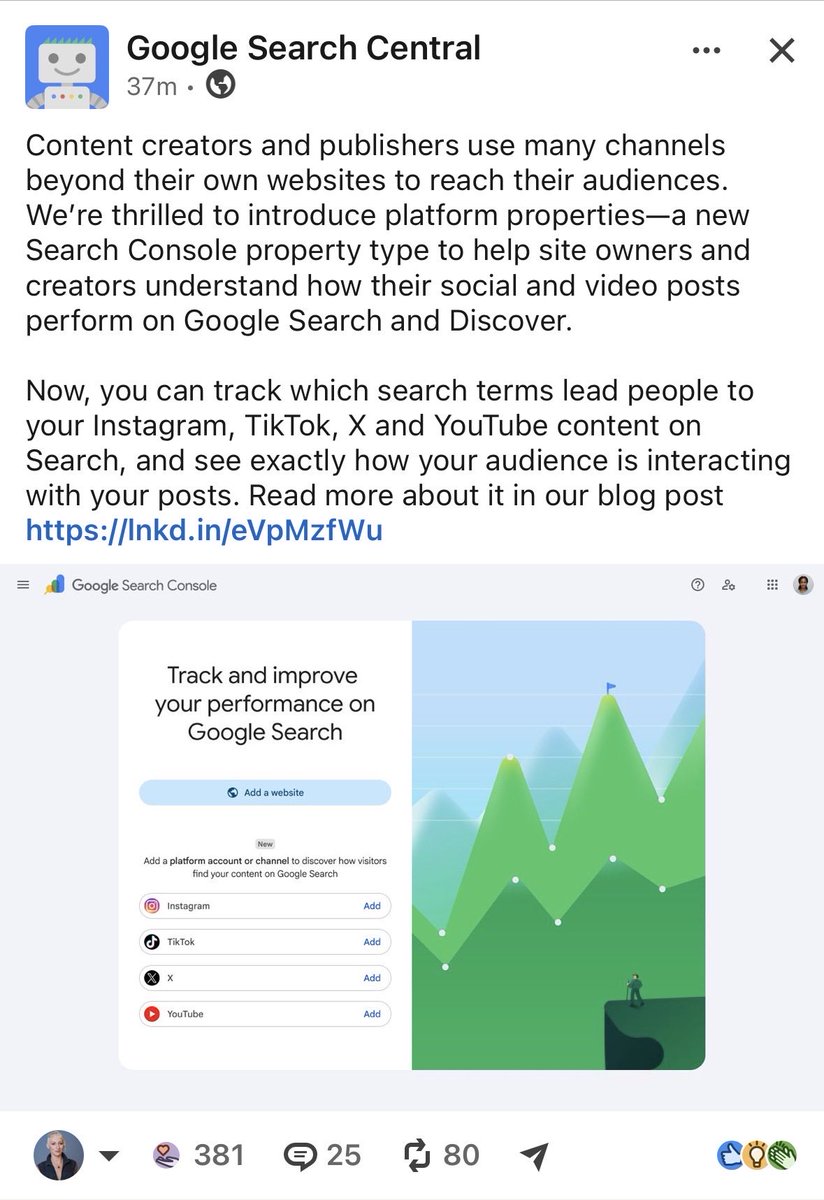
Google Search Console now can show you your social and video content performance in Google Search for Instagram, TikTok, X and YouTube https://t.co/s9zMM7WoIH
Anthropic engineer:
"You're not supposed to prompt Claude. You're supposed to build a system that prompts itself."
In 45 minutes she breaks down how Anthropic builds agents that remember, learn from their mistakes, and get smarter with every run.
Worth more than any paid course you'll find on building agents.
Watch the session, then read the guide on building loops below.
A must read from @search_magician going through well known challenges that those of us who work in D2C retail brands face: Retailers outrank you for your own products - what actually works? He goes through a few solutions:
1. Own the full range
2. Own the exclusives
3. Own the story
4. Own the data
5. Own the brand search experience
Read: https://t.co/HPYr7MtWVQ
So @wilreynolds published the best explainer about AI brand building we've seen
👎"You can’t become hardwired with scaled content, listicles, and chunking. Those are tactics."
👍"When content wins hearts and minds you’ve actually created a flywheel for your algorithmic traffic"
Technical SEO article: How to optimize the Accessibility Tree for AI agents.
This covers semantic HTML, visualizing hierarchy, spying on competitors + more:
👀 A useful and often underused input for your AI Search prompt library: question based queries that trigger Google AI Overviews, identified through keyword research tools with SERP feature filters 👇 In this case, using @semrush Keyword Magic Tool.
PS: I've recently published a Guide about How to Build a Representative AI Search Prompt Library for Better AI Visibility Measurement. Take a look: https://t.co/Lh5tWiqFrM
Heads-up, two new updates from Google in their docs. First, Google just updated it's "Do you need an SEO" page in the documentation with mentions of "Optimizing for generative AI". It now contains guidance advising site owners to check if advice on optimizing for AEO/GEO aligns with its new guidelines. The page also says to make sure any tools you use are aligned with Google's guidance.
"If they have advice on optimizing for AI experiences (also known as "AEO" "GEO" services), is their advice aligned with Google Search's official guidance on optimizing for generative AI features?"
https://t.co/4GNZ7qoRWe
Google anuncia, en colaboración con la comunidad de Schema(.)org un nuevo repositorio con datos de uso de los diferentes marcados de datos estructurados a lo largo de Internet.
Estos datos, que se actualizarán de manera mensual, estarán disponibles para su análisis o descarga (en .csv o .json) desde el GitHub oficial de Schema: https://t.co/jL1s9lMAz2
Una manera de ver la adopción de los datos estructurados con el paso del tiempo, así como para ver cuál de ellos escoger en base a su nivel de implantación en casos de duda ante otros similares.
Puedes ver el comunicado oficial de Schema en: https://t.co/sZRRJBMjMh
Así como algo más de información adicional en: https://t.co/wG57AjzdKs
Google added a bunch of info to their guide on hiring an SEO and even made a whole new page with warnings to be careful about using a third party tool.
https://t.co/sbDoZNvyvO
https://t.co/IgrYQA0JSn
Very, very interesting.
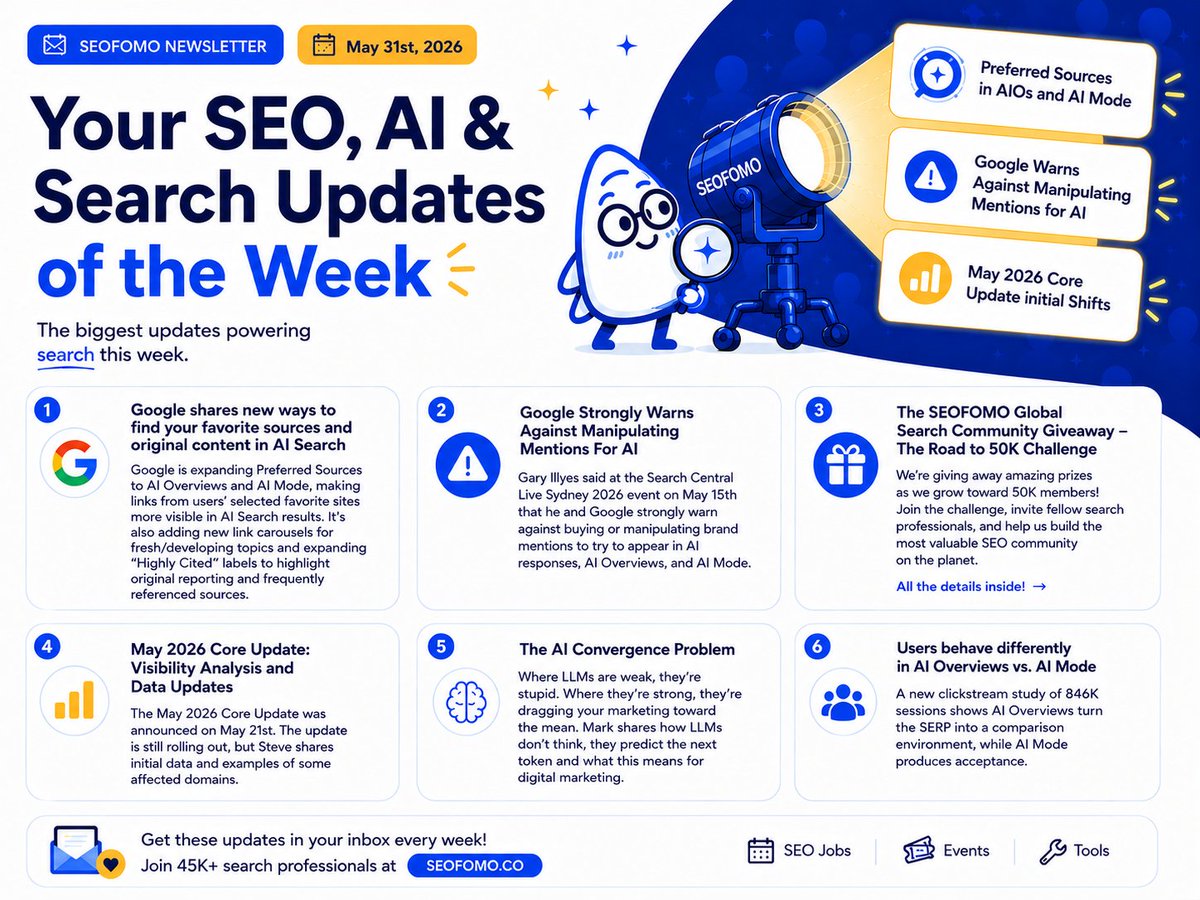
🎁 Your SEO & AI Search Updates of the Week from #SEOFOMO - May 31st, 2026 👇
* Google shares new ways to find your favorite sources and original content in AI Search - Does this mean more traffic from AIOs & AI Mode?
* Google Strongly Warns Against Manipulating Mentions For AI - A timely reminder!
* Reddit CEO Says LLMs ‘Would Not Exist’ Without Reddit Data - Learn what changed Reddit’s openness
* May 2026 Core Update: Visibility Analysis and Data Updates - Initial core update visibility shifts
* AI Traffic vs AI Citations: What Clicks and Cited Pages Show About the AI Search Journey - Homepages are AI traffic sinks, but not the citation footprint
* Schema, LLMs and the Low Bar for “Evidence” in GEO
* Users behave differently in AI Overviews vs. AI Mode - Search type no longer predicts behavior
Including SEO jobs, professionals looking for new roles, events, tools ... and more!
Read: https://t.co/Y4LkKpJNnk
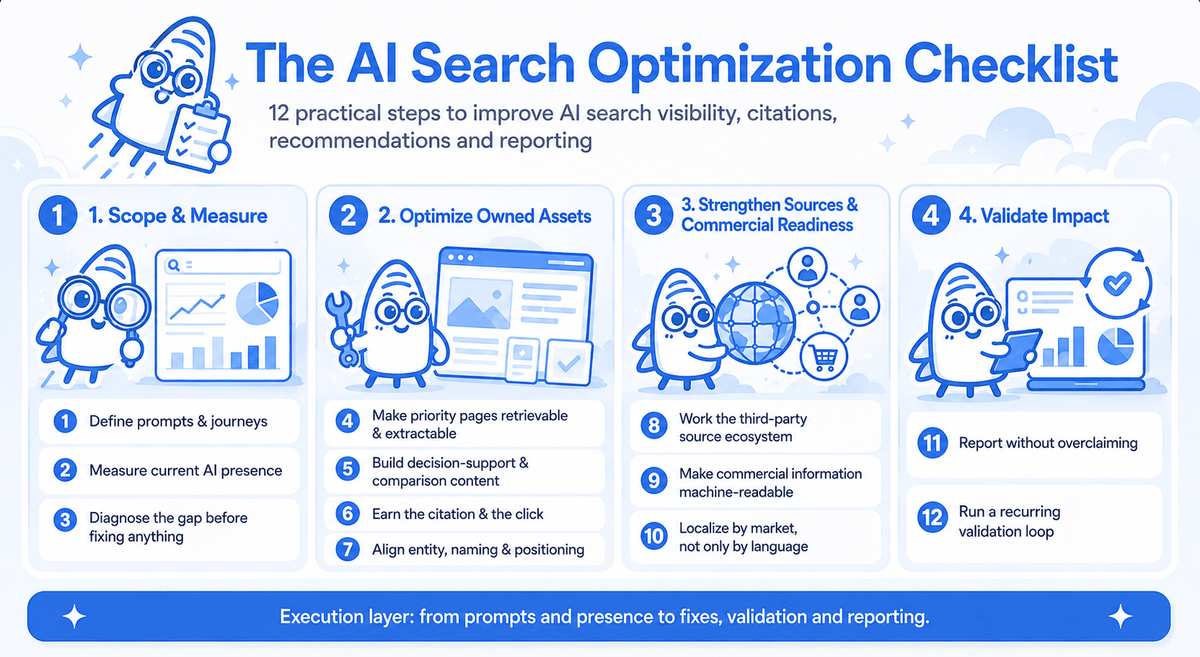
🚨 I’ve just updated my AI Search Optimization Checklist (and worksheet) 👇
Following a workflow for a strategical AI search optimization process:
✅ Which prompts and journeys do we actually want to influence?
✅ Where are we visible, cited, recommended or missing?
✅ Which owned pages and third-party sources are shaping the answers?
✅ What needs to be fixed: content, accessibility, entity clarity, source ecosystem, commercial data, localization…?
✅ How do we validate if the changes moved the needle?
✅ How do we report progress without overclaiming AI impact?
It now includes:
⭐️ 12 practical AI search optimization steps
⭐️ Examples and “what good looks like” sections
⭐️ Prompt and presence measurement guidance
⭐️ Gap diagnosis and prioritization examples
⭐️ Source ecosystem mapping
⭐️ Commercial and transactional readiness checks
⭐️ International/local AI search considerations
⭐️ Reporting guidance to separate observed, proxy and modelled signals
⭐️ A recurring validation workflow
⭐️ A downloadable checklist worksheet to use it in practice
The biggest point I’d emphasize: AI search optimization should start with understanding which AI-assisted journeys matter, how your brand appears across them, which sources influence the answers, and what you need to improve to be selected, cited, recommended and accurately represented.
Guide + checklist worksheet here:
https://t.co/e87HMPhDce
Opus 4.8 vient de sortir. C'est le modèle le plus puissant pour le SEO qu'Anthropic ait jamais sorti. Mais presque tout le monde va l'utiliser de travers.
Voici comment vraiment faire du SEO avec :
Long contexte, raisonnement multi-étapes solide, excellent usage des outils. Il peut faire tourner de vrais workflows SEO de bout en bout, pas juste sortir des conseils génériques.
Seul souci :
La plupart des gens essaient de faire TOUT leur SEO dans une seule conv Opus géante.
Voilà ce qui se passe généralement :
→ Ils entassent stratégie, mots-clés, concurrents et rédaction dans une seule conversation
→ Le contexte devient une bouillie et le modèle perd le fil
→ La sortie redérive vers des best-practices génériques, pas leurs vraies données
→ Ils obtiennent des articles qui se lisent bien mais ne rankent sur rien
→ Résultat : le modèle SEO le plus puissant du marché, gâché
Ce n'est PAS comme ça qu'on utilise Opus 4.8 pour le SEO.
La solution : découper le travail en deux phases et utiliser le bon outil pour chacune.
Phase 1 : Stratégie (visuel, one-off) dans une UI dédiée
Tu explores de la donnée et tu prends des décisions, donc tu veux que ce soit posé visuellement.
Lance trois plays dans l'app :
→ Recherche de mots-clés, classés par volume x difficulté x potentiel business
→ Analyse concurrentielle, la photo complète en un seul aperçu
→ Une roadmap par phases : quick wins, moyen terme, long terme
À la fin tu as une liste de mots-clés priorisée, une vision concurrentielle claire, et un calendrier de contenu.
Phase 2 : Production de contenu (scalé, récurrent) avec Opus 4.8 + MCP
C'est ça le déclic. Opus 4.8 c'est le cerveau : raisonnement, structure, écriture on-brand.
Le MCP c'est la couche de données live : SERPs, données mots-clés, ta GSC, le contexte de ton site. Ensemble, Opus écrit, mais chaque décision est ancrée dans de la vraie donnée au lieu de best-practices hallucinées.
Ta boucle hebdo devient :
→ Tu ouvres une nouvelle conv Opus 4.8
→ "Écris l'article de cette semaine ciblant [mot-clé de ma roadmap]"
→ Opus tire la donnée live via le MCP, construit le brief, écrit, optimise
→ Tu relis, tu ajustes la voix, tu publies
La règle du pouce :
Tu réfléchis, tu décides, tu explores ? L'UI. Visuel, one-off, stratégique.
Tu produis, tu répètes, tu scales ? Opus 4.8 + MCP. Rapide, ancré, constant.
La stratégie c'est un tableau blanc. La production c'est une ligne d'usine.
Ce que c'est : le système exact en deux phases pour faire du SEO avec Opus 4.8 (avec le system prompt complet du moteur de contenu).
Ce que c'est PAS : un énième avis tranché sur "le meilleur modèle IA pour le SEO".
-----
Tu veux le setup complet avec le system prompt ?
1. Follow moi
2. Commente "OPUS" en-dessous
3. Reposte ça
Big SEO News: Google has officially posted an "LLMs.txt" page to the Chrome Developers site.
"Without this file, agents may spend more time crawling the site to understand its high-level structure and primary content."
Google's URL Inspection tool is so under-rated & underused.
It can LITERALLY show you whether your vibe coded website or website built on a fancy JS framework is something that it can parse & render.
It can show you HTML source output which is a KEY indicator as to whether you have rendering or JS issues that are preventing Google crawling, rendering or indexing properly.
I've put together a comprehensive guide and VIDEO on using Google Search Console's URL inspection tool >
https://t.co/XfJm0q4IkT
Some of what I cover:
➪ What the URL Inspection tool is
URL-level diagnostic inside GSC that returns Google's own view of a single page from a verified property: index status, indexing state and reasons, last crawl date and user agent, Google-selected vs declared canonical, rendered HTML, screenshot, HTTP headers, page resources, JS console messages, and detected enhancements.
➪How it works
The distinction between cached inspection (default; reflects Google's last crawl and answers "what does Google currently believe about this URL?") and Test Live URL (a real-time fetch via Googlebot Smartphone that answers "what would Google see today?" but doesn't update the index).
➪ Why it's important
Its key use cases: URL-level indexing diagnosis, fix verification, JavaScript rendering validation, canonical auditing, structured data/enhancement validation, and manual indexing requests.
➪Cached vs Live, the critical difference
Practical consequences, including always running a live test before requesting indexing, cached data lagging by weeks, and live tests not updating the index.
➪ Top-level index verdicts
The six headline states (URL is on Google; on Google but has issues; not on Google with errors; not on Google; unknown to Google; alternate version).
➪ Page indexing states
A full rundown of every reason Google gives, grouped into successful states, exclusion states, and failure/warning states (e.g. soft 404, crawled-not-indexed, duplicate canonical issues), plus which states to act on immediately.
➪ Enhancements and experience reports
what each rich-result/structured-data report means (HTTPS, breadcrumbs, products, reviews, article, video, etc.), with notes on deprecated types (FAQ, How-to) and retired Mobile Usability.
➪ Live URL testing
What "Test Live URL" actually does and the common live-test failure reasons.
➪ View Tested Page (the deep diagnostic value)
Detailed breakdown of the three tabs:
HTML (rendered DOM), Screenshot (with the caveat it's only partial/top-of-page), and More Info (HTTP Response, Page Resources, JavaScript Console Messages, Page Availability including the high-value user-declared vs Google-selected canonical comparison).
➪ A practical diagnostic workflow
Step-by-step sequence for diagnosing a misbehaving URL, from cached inspection through live test, fix, re-test, and request indexing.









![VengeonsP's tweet photo. Opus 4.8 vient de sortir. C'est le modèle le plus puissant pour le SEO qu'Anthropic ait jamais sorti. Mais presque tout le monde va l'utiliser de travers.
Voici comment vraiment faire du SEO avec :
Long contexte, raisonnement multi-étapes solide, excellent usage des outils. Il peut faire tourner de vrais workflows SEO de bout en bout, pas juste sortir des conseils génériques.
Seul souci :
La plupart des gens essaient de faire TOUT leur SEO dans une seule conv Opus géante.
Voilà ce qui se passe généralement :
→ Ils entassent stratégie, mots-clés, concurrents et rédaction dans une seule conversation
→ Le contexte devient une bouillie et le modèle perd le fil
→ La sortie redérive vers des best-practices génériques, pas leurs vraies données
→ Ils obtiennent des articles qui se lisent bien mais ne rankent sur rien
→ Résultat : le modèle SEO le plus puissant du marché, gâché
Ce n'est PAS comme ça qu'on utilise Opus 4.8 pour le SEO.
La solution : découper le travail en deux phases et utiliser le bon outil pour chacune.
Phase 1 : Stratégie (visuel, one-off) dans une UI dédiée
Tu explores de la donnée et tu prends des décisions, donc tu veux que ce soit posé visuellement.
Lance trois plays dans l'app :
→ Recherche de mots-clés, classés par volume x difficulté x potentiel business
→ Analyse concurrentielle, la photo complète en un seul aperçu
→ Une roadmap par phases : quick wins, moyen terme, long terme
À la fin tu as une liste de mots-clés priorisée, une vision concurrentielle claire, et un calendrier de contenu.
Phase 2 : Production de contenu (scalé, récurrent) avec Opus 4.8 + MCP
C'est ça le déclic. Opus 4.8 c'est le cerveau : raisonnement, structure, écriture on-brand.
Le MCP c'est la couche de données live : SERPs, données mots-clés, ta GSC, le contexte de ton site. Ensemble, Opus écrit, mais chaque décision est ancrée dans de la vraie donnée au lieu de best-practices hallucinées.
Ta boucle hebdo devient :
→ Tu ouvres une nouvelle conv Opus 4.8
→ "Écris l'article de cette semaine ciblant [mot-clé de ma roadmap]"
→ Opus tire la donnée live via le MCP, construit le brief, écrit, optimise
→ Tu relis, tu ajustes la voix, tu publies
La règle du pouce :
Tu réfléchis, tu décides, tu explores ? L'UI. Visuel, one-off, stratégique.
Tu produis, tu répètes, tu scales ? Opus 4.8 + MCP. Rapide, ancré, constant.
La stratégie c'est un tableau blanc. La production c'est une ligne d'usine.
Ce que c'est : le système exact en deux phases pour faire du SEO avec Opus 4.8 (avec le system prompt complet du moteur de contenu).
Ce que c'est PAS : un énième avis tranché sur "le meilleur modèle IA pour le SEO".
-----
Tu veux le setup complet avec le system prompt ?
1. Follow moi
2. Commente "OPUS" en-dessous
3. Reposte ça](https://pbs.twimg.com/media/HJdyPIlWoAQQLqR.jpg)


