Introducing the Google Workspace CLI: https://t.co/8yWtbxiVPp - built for humans and agents.
Google Drive, Gmail, Calendar, and every Workspace API. 40+ agent skills included.
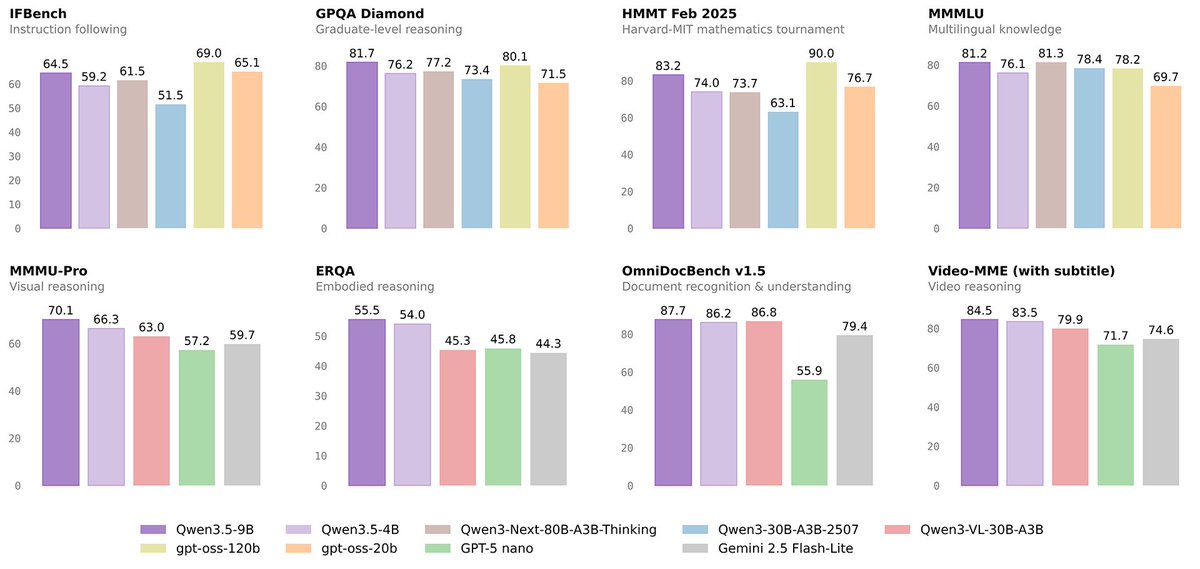
🚀 Introducing the Qwen 3.5 Small Model Series
Qwen3.5-0.8B · Qwen3.5-2B · Qwen3.5-4B · Qwen3.5-9B
✨ More intelligence, less compute.
These small models are built on the same Qwen3.5 foundation — native multimodal, improved architecture, scaled RL:
• 0.8B / 2B → tiny, fast, great for edge device
• 4B → a surprisingly strong multimodal base for lightweight agents
• 9B → compact, but already closing the gap with much larger models
And yes — we’re also releasing the Base models as well.
We hope this better supports research, experimentation, and real-world industrial innovation.
Hugging Face: https://t.co/wFMdX5pDjU
ModelScope: https://t.co/9NGXcIdCWI
In the next version of Claude Code..
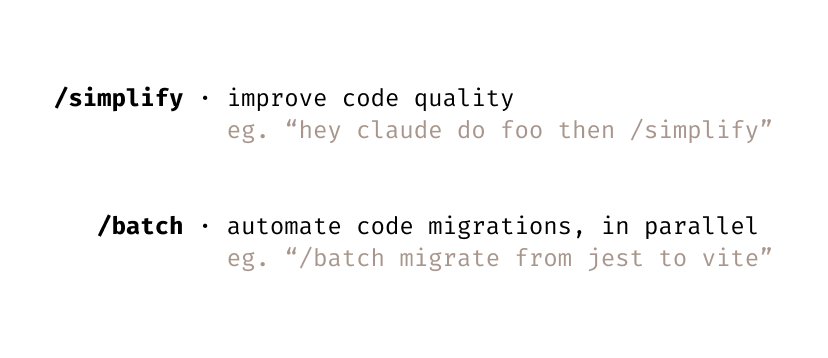
We're introducing two new Skills: /simplify and /batch. I have been using both daily, and am excited to share them with everyone.
Combined, these kills automate much of the work it used to take to (1) shepherd a pull request to production and (2) perform straightforward, parallelizable code migrations.
Wow they did it 🔥
"Qwen3.5-35B-A3B now surpasses Qwen3-235B-A22B-2507"
So in 6 months they've trained a model which is:
- 6.7x smaller than the previous one
- Better in all benchmarks
- Available locally on a laptop
We're just at the very beginning of local LLMs and, at some point, we'll have an Opus 4.6 intelligence running on a phone.
@Alibaba_Qwen I used your coding plan with Qwen3.5 Plus at the weekend, great model and great value plan! I want to convince others to try it but what is holding other back is the lack of SWE-Bench Pro results?
I'm Boris and I created Claude Code. I wanted to quickly share a few tips for using Claude Code, sourced directly from the Claude Code team. The way the team uses Claude is different than how I use it. Remember: there is no one right way to use Claude Code -- everyones' setup is different. You should experiment to see what works for you!
npm install -g cline
Not just Cline in the terminal, but the primitive you can build on.
> scriptable
> open-source
> open-model
Return to the primitives.
(Preview)
Apple just changed the game with AI. But it's not what you think.
They used AI agents to cut software testing time 85% and improve accuracy 45%.
Apple proved the ROI of AI.
This is not what I expected from them.
What else are they cooking in Cupertino?
Here's how it works:
- Map: Feeds all project documentation into a hybrid knowledge base using a vector database for semantic search and a graph database (TigerGraph). It maps the relationships between business processes that AI often misses.
- Delegate: Assigns specific jobs to a team of specialized agents. A 'legacy analysis' agent, a 'compliance validator,' and a 'test case generator' work together. They used Gemini Pro for complex reasoning.
- Automate: Generates 25,000 test cases with full contextual awareness, achieving 98.7% functional coverage and complete requirement traceability from end to end.
Result: This Agentic RAG system improved accuracy by 45% (from 65.2% to 94.8%), crushing the baseline of older AI methods.
This isn't a lab experiment. It was validated on a real-world SAP S/4HANA migration with over 100 external system integrations.
Why this matters:
- Business Leaders: An 85% timeline reduction and a projected 35% cost saving is a massive competitive advantage. This de-risks projects and changes the economics of enterprise software deployment.
- Practitioners: This provides a production-grade blueprint to use AI for creating test artifacts. The hybrid vector-graph architecture solves the context-loss problem that plagues most enterprise AI automation.
- Researchers: This paper provides a real-world validation of multi-agent systems. It demonstrates that moving from monolithic RAG to orchestrated, specialized agents is necessary for solving complex, context-dependent enterprise problems.
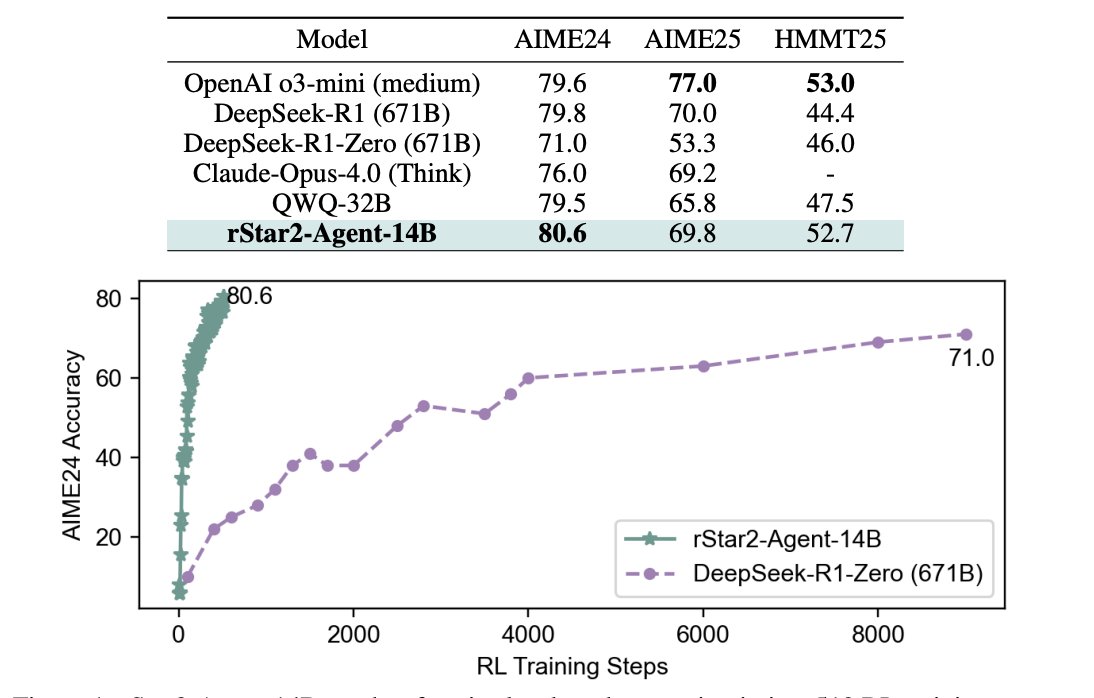
A 14B model just beat a 671B model on math reasoning.
Here’s how Microsoft’s rStar2-Agent achieves frontier math performance in 1 week of RL training
- by “thinking smarter, not longer.” 🧵
We were able to reproduce the strong findings of the HRM paper on ARC-AGI-1.
Further, we ran a series of ablation experiments to get to the bottom of what's behind it.
Key findings:
1. The HRM model architecture itself (the centerpiece of the paper) is not an important factor.
2. The outer refinement loop (barely mentioned in the paper) is the main driver of performance.
3. Cross-task transfer learning is not very helpful. What matters is training on the tasks you will test on.
4. You can use much fewer data augmentations, especially at inference time.
Finding 2 & 3 mean that this approach is a case of *zero-pretraining test-time training*, similar to the recently published "ARC-AGI without pretraining" paper by Liao et al.