Transmural MI: Necrosis that extends through endocardium to epicardium presents ST-segment elevation & pathological Q waves
Non-Transmural MI: Necrosis to the subendocardium or inner layers of the myocardium presents ST-segment depression or T-wave inversion without Q waves
Mechanical circulatory support for patients with infarct-related cardiogenic shock: a state-of-the-art review
In this episode of the Heart podcast, Digital Media Editor @jhfrudd is joined by Prof. Jacob Eifer Moller from Odense, Denmark. They discuss his review paper on mechanical circulatory support, along with supporting guidelines and papers in this area.
Podcast: https://t.co/aQQGioFhRI
Paper: https://t.co/DjFxj3J5ei
🫥AYRTON SENNA ENTRÓ EN OTRA DIMENSIÓN… Y CASI NO REGRESÓ🫥
Mónaco, clasificación de 1988. Ayrton Senna ya tenía la pole position asegurada, pero algo inexplicable comenzó a suceder.
Cada vuelta era más rápida que la anterior.
El circuito dejaba de ser un trazado y se convertía en un túnel infinito.
Las barreras, el público, el ruido… todo desaparecía. Senna ya no estaba conduciendo conscientemente.
Estaba en otra dimensión, más allá de los límites humanos, más allá de lo que su mente podía controlar.
Esto comentó:
“Era como si ya no estuviera conduciendo conscientemente. Estaba en otra dimensión. Iba cada vez más rápido, encontrando velocidad donde no debería existir, flotando en un estado que me asustó”.
De repente algo lo despertó. Frenó. Redujo.
Volvió lentamente a los boxes y decidió que ese día no saldría más a pista.
Porque había tocado algo que no debía tocar.
Un momento que quedó marcado como uno de los relatos más misteriosos e impactantes de toda la historia de la Fórmula 1…🤔
📣 JAMA Clinical Guidelines Synopsis: The 2026 #Dyslipidemia guideline by @ACCinTouch and @American_Heart recommends earlier risk assessment, lifetime risk estimation, and measurement of new #biomarkers, including apolipoprotein B and lipoprotein(a) [Lp(a)], for individualized #atherosclerotic #cardiovascular disease (#ASCVD) prevention.
https://t.co/aLCpves3mt
Bolón de verde
📍 Ecuador 🇪🇨
Taste Ecuador: https://t.co/jPpGBwJmys
A staple of Ecuador’s coastal region, bolón de verde (literally "large green ball") is a traditional dumpling made from green plantains. The dish typically features the barraganete variety, a large, starch-dense plantain prized for its ability to hold its shape during mashing.
The preparation begins by boiling or frying chunks of the green plantain until soft. While still hot, they are mashed with butter, lard, salt, and cumin to form a thick, pliable dough. This dough is shaped into baseball-sized spheres and stuffed with savory fillings.
Once stuffed and sealed, the dumpling is fried a second time to develop a deeply crunchy outer crust while keeping the inside soft. It is traditionally served hot for breakfast or mid-afternoon Merienda, accompanied by a fried egg, hot ají salsa, and black coffee.
Video: Nievita Zambrano
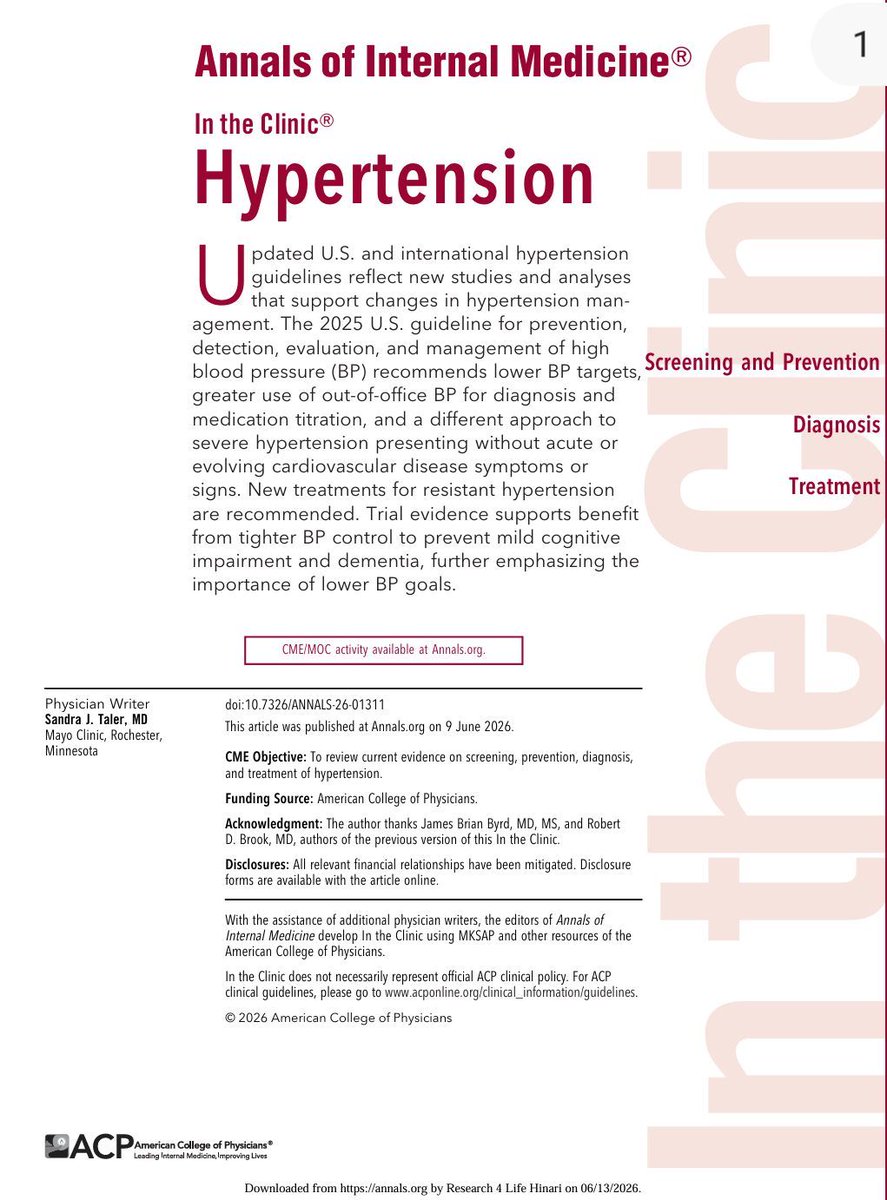
🫀Hypertension in 2026: Five practice changing updates every clinician should know
Hypertension remains the leading modifiable risk factor for cardiovascular disease worldwide, yet recent evidence suggests that many patients continue to be undertreated.
The updated Annals of Internal Medicine "In the Clinic" review summarizes the most important changes introduced by the 2025 AHA/ACC guideline and highlights how hypertension management is evolving.
The first major change is that blood pressure should no longer be judged solely in the clinic.
Out of office blood pressure monitoring is now strongly recommended not only to confirm the diagnosis, but also to detect white coat hypertension, masked hypertension and guide treatment titration. Ambulatory blood pressure monitoring remains the reference standard whenever available.
The second message is that lower targets matter.
For most patients, the recommended goal remains below 130/80 mmHg, with increasing evidence supporting systolic pressures below 120 mmHg in selected high cardiovascular risk patients when tolerated. Recent trials demonstrated reductions in major cardiovascular events without a significant increase in serious complications.
Third, lifestyle interventions continue to be the foundation of therapy.
Weight reduction, dietary sodium restriction, the DASH diet, regular exercise and potassium enriched salt substitutes remain among the most effective nonpharmacological interventions. Emerging evidence also supports meditation and yoga as useful adjunctive therapies for selected patients.
Fourth, treatment should become increasingly individualized.
The guideline incorporates overall cardiovascular risk into treatment decisions using the new PREVENT risk calculator instead of relying exclusively on blood pressure values. This approach better identifies patients who derive the greatest benefit from earlier pharmacological therapy.
Finally, resistant hypertension is no longer a therapeutic dead end.
Mineralocorticoid receptor antagonists remain central to treatment, while newer agents such as aprocitentan, a dual endothelin receptor antagonist, expand therapeutic options for carefully selected patients with resistant hypertension.
The most important lesson is simple.
Hypertension management is moving away from isolated office measurements toward precision cardiovascular prevention, integrating accurate blood pressure assessment, global cardiovascular risk, intensive lifestyle intervention and individualized pharmacotherapy.
Better blood pressure control is not simply about preventing myocardial infarction or stroke.
It is increasingly recognized as an investment in preserving kidney function, preventing heart failure and reducing cognitive decline throughout life.
Reference 📚
Taler SJ. In the Clinic: Hypertension. Annals of Internal Medicine. Published June 9, 2026. DOI: 10.7326/ANNALS-26-01311.
Step up your management of patients with vasoplegia after cardiac surgery. Learn from the greats, including @pwierusz and @SXC71. 🎩 tip to the authors.
https://t.co/Sfr6vCn6le
🫀➡️Infarto de Ventrículo Derecho
🔰📚JOURNAL OF THE AMERICAN COLLEGE OF CARDIOLOGY
https://t.co/34sZmrkCJK
Enlace a Artículo Completo👇🏻🆓✅
https://t.co/rPEDXf5xvO
🩸🫀Manejo Práctico de la Anticoagulación en Pacientes con Fibrilación Auricular
📚 JACC State-of-the-Art Review
https://t.co/FpPpEjdfOV
Enlace a Artículo Completo👇🏻🆓✅
https://t.co/rPEDXf5xvO
🔱Documento de consenso ESC @escardio 2026 sobre las Complicaciones Mecánicas del IAM. 🫀💥
🟥Rotura de pared libre ventricular, pseudoaneurisma ventricular y rotura del músculo papilar. Aunque hoy ocurren en <1% de los IAM gracias a la reperfusión temprana, siguen siendo complicaciones devastadoras, con mortalidad intrahospitalaria de 30–40%. ⚠️📈☠️
🔺️Rotura de pared libre ventricular (RPLV): suele aparecer entre las primeras 24–48 h, aunque clásicamente se describía a los 5–7 días post-IAM. Puede manifestarse con dolor torácico, disnea, choque cardiogénico, taponamiento o paro cardíaco. Factores de riesgo: presentación tardía, IAM extenso, sexo femenino, edad avanzada e hipertensión.
🔺️Pseudoaneurisma ventricular
Es una ruptura contenida por pericardio o trombo, con alto riesgo de ruptura franca. Su incidencia actual es 0.1–0.3%. Suele localizarse en pared inferior o posterolateral y puede debutar semanas o meses después del IAM. El riesgo de ruptura espontánea puede alcanzar 30–45%. Datos clásicos: cuello estrecho (relación cuello/fondo <0.5) y flujo turbulento Doppler. El riesgo de ruptura espontánea puede alcanzar 30–45%.
📜🆓️⤵️
https://t.co/rMc1LU3xqn
https://t.co/jU8OGv1XW0
🧠🫀Anticoagulación Temprana en Stroke Isquémico Agudo con Fibrilación Auricular
🔰📚Journal of Stroke 2026
https://t.co/4djKzQeqlJ
Enlace a Articulo Completo👇🏻🆓✅
https://t.co/rPEDXf5xvO


![JAMA_current's tweet photo. 📣 JAMA Clinical Guidelines Synopsis: The 2026 #Dyslipidemia guideline by @ACCinTouch and @American_Heart recommends earlier risk assessment, lifetime risk estimation, and measurement of new #biomarkers, including apolipoprotein B and lipoprotein(a) [Lp(a)], for individualized #atherosclerotic #cardiovascular disease (#ASCVD) prevention.
https://t.co/aLCpves3mt](https://pbs.twimg.com/media/HNrsX8mWUAADaJ6.jpg)