One reason some people don't save for retirement is that they somehow consider the future version of themselves a different person than the current version.
So treat your future self like someone you'd go out of your way to help 🧵
Trim trees and bushes now—before there is activity in the Atlantic basin.
WHY IT MATTERS: Trimming trees before a storm forms can reduce the risk of branches becoming dangerous projectiles and gives crews enough time to collect yard waste before the storm arrives.
Two questions that persuade better than any argument.
Yale psychologist Michael Pantalon calls them irrational.
I first wrote about them in To Sell Is Human, and they still work on everyone, including me. 🧵
Yale researchers asked 3,635 people over 50 how much they read, then followed them for twelve years to see who was still alive.
Book readers had a 20 percent lower risk of dying over that period. At the point where a fifth of each group had died, the readers reached it 23 months later.
Thirty minutes a day was enough to show the effect. Newspapers and magazines did much less, and that gap between the two is what makes the study worth taking seriously, because it kills the obvious explanation. Reading anything means you are literate, have decent eyesight and some leisure. Books specifically did more, and the researchers think it is because a book holds you for hours across days, asks you to keep a cast of people in your head, and makes you work out what someone means when they say one thing and want another.
There was also a dose response. People reading more than three and a half hours a week did better than lighter readers, which is the pattern that makes researchers take a correlation seriously.
The effect survived adjustment for age, sex, race, education, wealth, marital status, employment, self-rated health, eyesight and depression. It held when they split the sample by sex and by income.
The honest limits. Nobody was assigned to read, so this is a correlation, and the 23-month figure comes from the raw curves before adjustment. Reading may be carrying other advantages the model could not see.
Even allowing for that, the size is the thing. A 20 percent lower mortality risk is in the range of interventions doctors write prescriptions for, from an activity that costs nothing, needs no appointment, and is available to a woman who cannot easily leave the house.
There is a particular kind of guilt around sitting down with a novel in the middle of the day, as though it were the thing you do once everything else is finished. It appears to be one of the more useful hours of the week.
https://t.co/n5E6fsaYjc
We’re often told that marriage will protect us from being alone at the end of our lives. But studies suggest those who have never wed may be especially likely to experience what experts call a “good death." https://t.co/ttK4lPfU0L
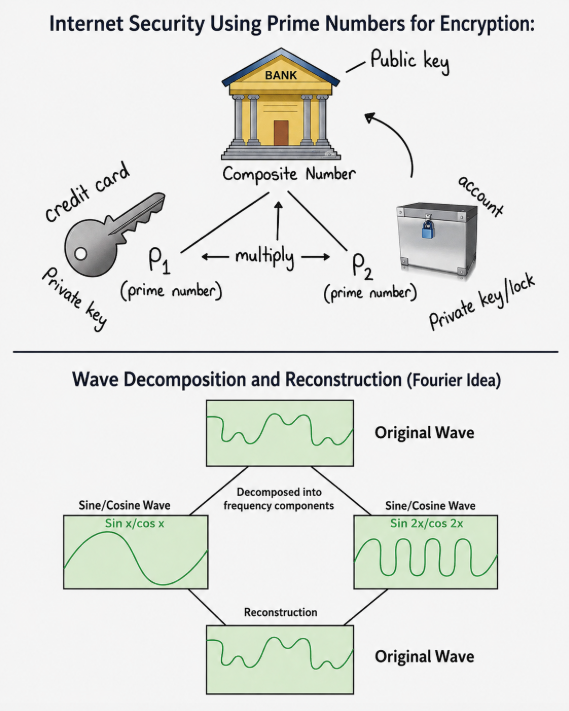
In the 1970s, a mathematics professor told an undergraduate student that two fields would never have practical use: prime number theory and Fourier transforms.
Today, prime number theory is essential for internet encryption, and Fourier transforms are widely used in video and audio compression. This shows that it is difficult to predict which areas of mathematics will become useful.
Some people suggest that progress in fundamental physics has slowed because it lacks new mathematical tools. Many of the mathematical ideas developed in the 18th and 19th centuries were heavily used in the 20th century. As a result, current physics research may be limited until new mathematics is developed.
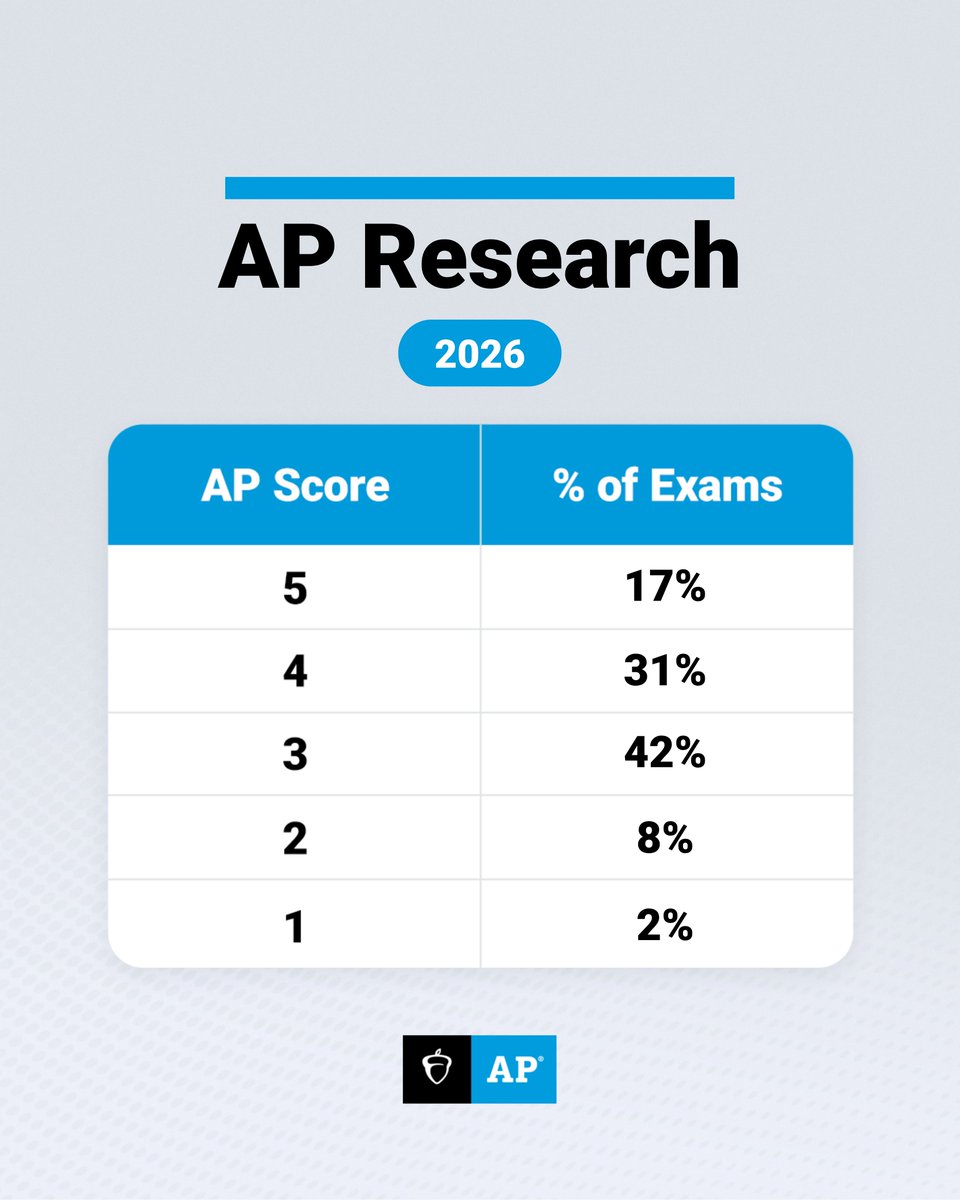
The 2026 AP Research scores:
5: 17%; 4: 31%; 3: 42%; 2: 8%; 1: 2%
AP Research papers were developed and submitted by ~53,000 students this year, less than 1% of the high school population.
About the AP Research scores
We hear often from Higher Education and employers about the need for students to develop and demonstrate durable skills. And when we surveyed AP students across all 40+ subject areas last year to ask whether what they learned in the AP course was relevant to their futures, AP Research received higher ratings than any other AP subject, period. (The next highest-rated for future relevance were Calculus, English Literature, Seminar, Spanish Language, and Spanish Literature.)
And this makes sense to me, given the persistence, self-management, and transferable skills students develop and demonstrate in AP Research. Over the course of the year, each student independently designs, plans, and carries out an original scholarly investigation on an academic topic, problem, issue, or idea of their own choosing—selecting their own research question, methodology, and sources. This kind of sustained, self-directed inquiry mirrors the authentic work of university researchers.
The course culminates in a 4,000–5,000-word academic paper and a 15–20-minute presentation with oral defense. (Students must defend their research question, methodology, and findings before a panel of evaluators—answering probing questions that test the depth and rigor of their scholarship.) The paper accounts for 75% of the AP score, and the presentation and defense for 25%.
The scoring rubric is designed to reward papers that go beyond summarizing existing research to make genuine contributions to knowledge: articulating a clear and defensible research question, applying a sound and replicable methodology, presenting logical reasoning supported by sufficient evidence, and demonstrating mastery of academic conventions including accurate citation.
The topics AP Research students pursue reflect genuine intellectual curiosity across virtually every discipline—from the sciences and social sciences to the humanities and the arts. Each year, the range and inventiveness of the research questions students generate impresses and sometimes astonishes the faculty who read and score these papers.
In short, AP Research students build and use a set of transferable research and writing skills—including literature review, research design, data analysis or textual analysis, argumentation, and citation—that are directly applicable in college coursework regardless of major. Students who complete AP Research demonstrate that they can identify a meaningful question, engage seriously with the scholarly literature, collect and analyze evidence, and communicate findings to an academic audience.
AP Research scores of 5: Papers earning AP 5s demonstrated original inquiry—a well-defined research question, a detailed and replicable methodology, logical reasoning that ties evidence to conclusions, and skillful use of academic conventions.
AP Research scores of 3 or higher: Papers earning at least a 3 advanced meaningfully beyond summary—they articulated a focused research purpose, engaged credibly with sources, and presented findings in appropriate academic form.
All subjects’ AP score distributions for 2026 will be posted here when available: https://t.co/OrkaQhPZYO
Every AI pitch promises the same thing:
Do more in less time. Finally get to the important stuff. Work less.
New research from Berkeley followed real workers for 8 months.
That's not what happened. 👇
You open ChatGPT. You type the question. A clean, structured answer comes back in three seconds. You read it, it makes sense, you move on. You feel like you learned something.
Forty-five days later, a professor walks in and hands you a test you weren't expecting. You don't remember most of it.
André Barcaui at the Federal University of Rio de Janeiro ran the experiment to find out if the feeling was accurate. 120 undergraduate business students, ages 18 to 24. All told to spend two weeks researching AI concepts, ethics, societal impacts, technical foundations, and prepare a 10-minute presentation.
Sixty used ChatGPT freely. Sixty used textbooks, library databases, articles, and standard web search. Then, 45 days later, with no warning, a retention test.
The ChatGPT group scored 57.5%. The traditional group scored 68.5%. Cohen's d was 0.68, a medium-to-large effect. In most grading systems, that's the difference between passing and failing.
This is called cognitive offloading. When your brain delegates thinking to an external tool, it reduces the mental effort required during encoding. Effort is what makes memories durable. Struggling to find, synthesize, and connect information is not an inefficiency in the learning process. It is the learning process. ChatGPT removes the struggle and takes the encoding with it.
Barcaui calls what the AI group experienced "borrowed competence." The answer was structured, the vocabulary was right, the reasoning felt sound. It just wasn't theirs. And 45 days later, it was gone.
The AI group's forgetting curve was steeper and didn't stabilize the way the traditional group's did. The memories weren't just smaller. They were more fragile from the start.
You didn't learn it. You borrowed it.
Early support influences not just how new teachers begin, but how they grow, perform, and stay. A thoughtful start makes a lasting difference. The FCIS New Teacher Institute can help.
#FCIS#NewTeachers#TeacherDevelopment#EdLeaders#IndySchools
Basit ve güzel bir anlatımla " tüm çokgenlerin dış açılarının toplamının neden 360 derce olduğunun ispatı. Hiç bir çocuk bu şekilde anlatıldığında bunu unutmaz.
There are three boxes on a table. One contains only apples, one contains only oranges, and one contains both apples and oranges. The boxes are labeled incorrectly. You can pick one fruit from one box, but after that, you must correctly label all boxes.
How do we do this?
Students who took notes by hand scored ~28% higher on conceptual questions than laptop note-takers.
Writing forces your brain to process and compress ideas instead of copying them.