Restored archive — SCALE Volume 1 (2004): nine UCSD issues on aesthetics & computation. Full issues as open PDFs and backdated posts; read early open‑source publishing and networked community experiments.
📚https://t.co/tdCsmWNEeV
Fascinating work about the role of DNA « Martínez Arias refutes this perspective of the selfish gene and proposes a much more romantic alternative: the altruistic cell. “An organism is the work of cells. Genes merely provide materials for their work, » https://t.co/RsG7KpVvGj
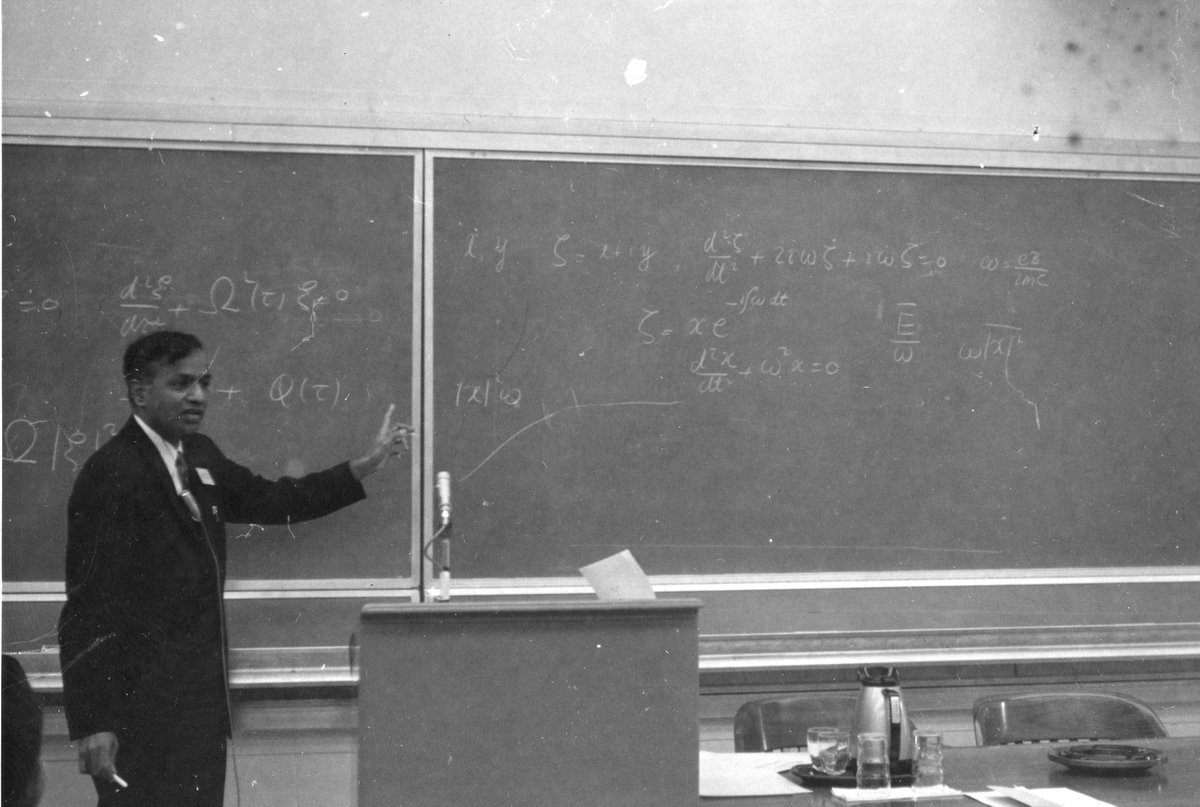
In the 1940s, Subrahmanyan Chandrasekhar was committed to his teaching role at the University of Chicago, despite being based at the Yerkes Observatory. Each week, he traveled 80 miles to teach a special course attended by only two students.
The students were Tsung-Dao Lee and Chen-Ning Yang. They proved their mentor's faith was well-placed when they both won the Nobel Prize in Physics in 1957, years before Chandrasekhar received the same honor in 1983. Remarkably, this course went down in history as the only one where every attendee received a Nobel Prize, underscoring the extraordinary impact of Chandrasekhar's dedication and teaching.
📷 AIP Emilio Segrè Visual Archives, Physics Today Collection
come work with me? I am hiring 2 postdocs to join my 4-year research project “Algorithmic folklore: The mutual shaping of vernacular creativity and automation” (ALGOFOLK) at the University of Bergen - looking for socsci&hum+tech people with global outlook https://t.co/lB1EEXLGCM
"Today I wouldn't get an academic job. It's as simple as that. I don't think I would be regarded as productive enough."
Nobel Laureate Peter Higgs explains how the focus on quantified indicators (number of publications, citations) harms scientific progress.
Friday's https://t.co/XSu1u9b6db listing:
Shapes by @makio135 and @clemsos
A collection of generative on-chain artworks with 4 different main shapes (slashes, arcs, grids and stencils). Each token can be changed/rerolled, with goal of creating a collector curated collection